Telemedicine and Telepharmacy Center, School of Medicinal and Health Products Sciences, University of Camerino, Camerino, Italy
Research Department, International Radio Medical Centre (C.I.R.M.), Rome, Italy.
BMJ Open. 2021 Mar 16;11(3):e044633. doi: 10.1136/bmjopen-2020-044633.
Workers at sea have high mortality, injuries and illnesses and work in a hazardous environment compared to ashore workers. The present study was designed to measure the incidence of occupational injuries and diseases among seafarers and quantify the contribution of differences in rank and job onboard on seafarers' diseases and injuries rates.
Descriptive epidemiological study.
This study's data were based on contacts (n=423) for medical requests from Compagnie Maritime d'Affrètement/Compagnie Générale Maritime (CMA-CGM) container ships to the Italian Telemedical Maritime Assistance Service in Rome from 2016 to 2019, supplemented by data on the estimated total at-risk seafarer population on container ships (n=13 475) over the study period.
Distribution of injuries by anatomic location and types of diseases across seafarers' ranks and worksites. We determined the incidence rate and incidence rate ratio (IRR) with a 95% CI.
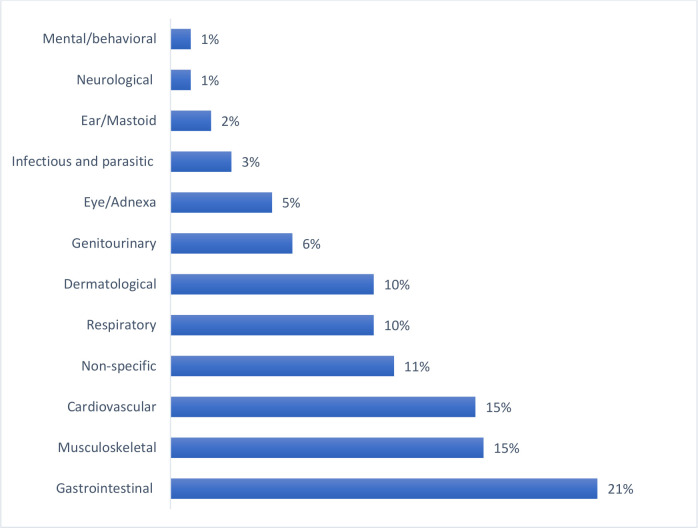
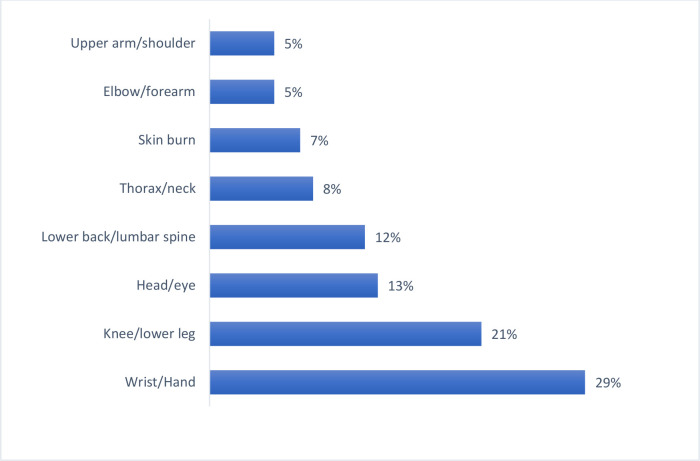
The total disease rate was 25 per 1000 seafarer-years, and the overall injury rate was 6.31 per 1000 seafarer-years over the 4 years study period. Non-officers were more likely than officers to have reported gastrointestinal (IRR 2.12, 95% CI 1.13 to 4.26), dermatological (IRR 3.66, 95% CI 1.27 to 14.42) and musculoskeletal (IRR 2.25, 95% CI 1.11 to 5.05) disorders onboard container ships. Deck workers were more likely than engine workers to be injured in the wrist and hand (IRR 3.25, 95% CI 1.19 to 10.23).
Rates of reported injury and disease were significantly higher among non- officers than officers; thus, this study suggests the need for rank-specific preventative measures. Future studies should consider risk factors for injury and disease among seafarers in order to propose further preventive measures.
与岸上工人相比,海员在海上工作时死亡率、受伤和患病较高,工作环境也较为危险。本研究旨在测量海员职业性损伤和疾病的发生率,并量化船上职位和工作差异对海员疾病和损伤发生率的贡献。
描述性流行病学研究。
本研究的数据基于 2016 年至 2019 年期间,Compagnie Maritime d'Affrètement/Compagnie Générale Maritime(CMA-CGM)集装箱船向罗马的意大利远程医疗海上援助服务提出医疗请求的 423 次接触(n=423),并补充了研究期间集装箱船上估计的高危海员总人数(n=13475)的数据。
根据海员职位和工作场所,对损伤的解剖部位和疾病类型进行分布。我们确定了发病率和发病率比(IRR)及其 95%置信区间。
4 年研究期间,总的疾病发病率为每 1000 名海员年 25 例,整体损伤发病率为每 1000 名海员年 6.31 例。与军官相比,非军官更有可能报告胃肠道疾病(IRR 2.12,95%CI 1.13 至 4.26)、皮肤病(IRR 3.66,95%CI 1.27 至 14.42)和肌肉骨骼疾病(IRR 2.25,95%CI 1.11 至 5.05)。甲板工人比轮机工人更有可能在手腕和手上受伤(IRR 3.25,95%CI 1.19 至 10.23)。
非军官的报告损伤和疾病发生率明显高于军官;因此,本研究表明需要针对特定职级的预防措施。未来的研究应考虑海员受伤和患病的风险因素,以便提出进一步的预防措施。