From the CORe (T.U., C.M., T.K.), Department of Medicine, the University of Melbourne, VIC, Australia; Department of Neurology and Center of Clinical Neuroscience (T.U., E.K.H., D.H.), Charles University in Prague, 1st Faculty of Medicine and General University Hospital; Department of Radiology (J.K., M.V.), Charles University in Prague, First Faculty of Medicine and General University Hospital in Prague, Czech Republic; Buffalo Neuroimaging Analysis Center (N.B., M.G.D., R.Z.), Department of Neurology, Jacobs School of Medicine and Biomedical Sciences, University at Buffalo, State University of New York; IRCCS (N.B.), Fondazione Don Carlo Gnocchi, Milan, Italy; Center for Biomedical Imaging at Clinical Translational Science Institute (R.Z.), University at Buffalo, State University of New York; and Melbourne MS Centre (T.K.), Department of Neurology, the Royal Melbourne Hospital, VIC, Australia.
Neurol Neuroimmunol Neuroinflamm. 2021 Mar 16;8(3). doi: 10.1212/NXI.0000000000000979. Print 2021 May.
To describe the dynamics of brain volume loss (BVL) at different stages of relapsing-remitting multiple sclerosis (RRMS), to describe the association between BVL and clinical measures, and to investigate an effect of treatment escalation on the rate of BVL.
Together, 1903 patients predominantly with RRMS from the Avonex-Steroids-Azathioprine cohort (N = 166), the study of early IFN-β1a treatment cohort (N = 180), and the quantitative MRI cohort (N = 1,557) with ≥2 MRI scans and ≥1-year of follow-up were included. Brain MRI scans (N = 7,203) were performed using a single 1.5-T machine. Relationships between age or disease duration and global and tissue-specific BVL rates were analyzed using mixed models.
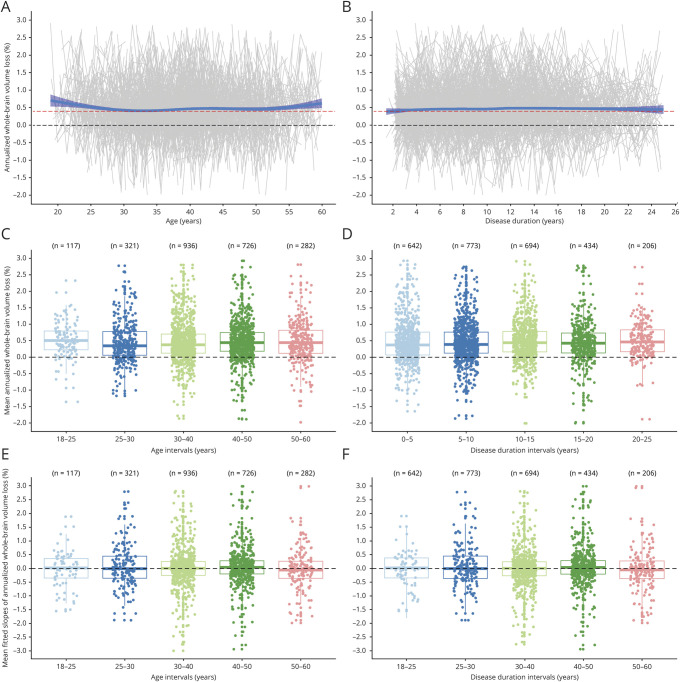
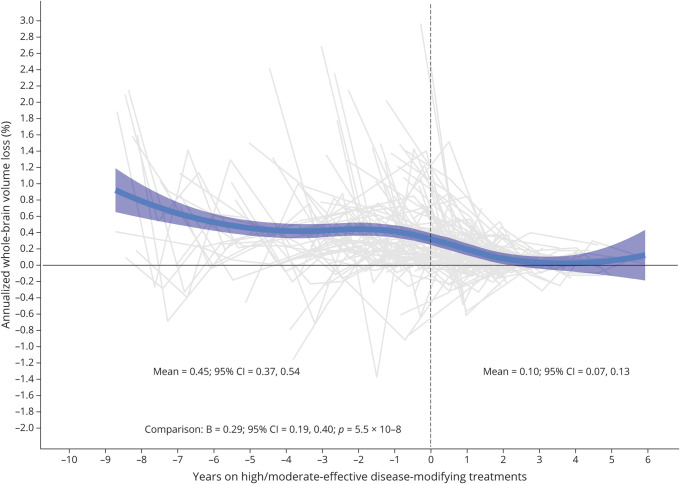
Age was not associated with the rate of BVL (β = -0.003; Cohen f2 = 0.0005; adjusted = 0.39). Although disease duration was associated with the rate of BVL, its effect on the BVL rate was minimal (β = -0.012; Cohen f2 = 0.004; adjusted = 4 × 10). Analysis of association between tissue-specific brain volume changes and age (β = -0.019 to -0.011; adjusted = 0.028-1.00) or disease duration (β = -0.028 to -0.008; adjusted = 0.16-0.96) confirmed these results. Although increase in the relapse rate (β = 0.10; adjusted = 9 × 10), Expanded Disability Status Scale (EDSS; β = 0.17; adjusted = 8 × 10), and EDSS change (β = 0.15; adjusted = 2 × 10) were associated with accelerated rate of BVL, their effect on the rate of BVL was minimal (all Cohen f2 ≤ 0.007). In 94 patients who escalated therapy, the rate of BVL decreased following treatment escalation by 0.29% (β = -0.29; Cohen f2 = 0.133; = 5.5 × 10).
The rate of BVL is relatively stable throughout the course of RRMS. The accelerated BVL is weakly associated with concurrent higher disease activity, and timely escalation to high-efficacy immunotherapy helps decrease the rate of BVL.
描述复发缓解型多发性硬化症(RRMS)不同阶段脑容量损失(BVL)的动态变化,描述 BVL 与临床指标的相关性,并探讨治疗升级对 BVL 速率的影响。
共纳入来自 Avonex-Steroids-Azathioprine 队列(N=166)、早期 IFN-β1a 治疗队列(N=180)和定量 MRI 队列(N=1557)的 1903 名主要为 RRMS 患者,这些队列至少进行了 2 次 MRI 扫描和 1 年以上的随访。使用 1.5-T 单台机器进行脑 MRI 扫描(N=7203)。使用混合模型分析年龄或疾病持续时间与全球和组织特异性 BVL 率之间的关系。
年龄与 BVL 率无关(β=-0.003;Cohen f2=0.0005;调整后 =0.39)。尽管疾病持续时间与 BVL 率相关,但对 BVL 率的影响很小(β=-0.012;Cohen f2=0.004;调整后 =4×10)。组织特异性脑容量变化与年龄(β=-0.019 至-0.011;调整后 =0.028-1.00)或疾病持续时间(β=-0.028 至-0.008;调整后 =0.16-0.96)之间的相关性分析证实了这些结果。尽管复发率(β=0.10;调整后 =9×10)、扩展残疾状况量表(EDSS;β=0.17;调整后 =8×10)和 EDSS 变化(β=0.15;调整后 =2×10)与 BVL 加速率相关,但对 BVL 率的影响很小(所有 Cohen f2 ≤0.007)。在 94 名升级治疗的患者中,治疗升级后 BVL 率下降了 0.29%(β=-0.29;Cohen f2=0.133; =5.5×10)。
RRMS 病程中 BVL 率相对稳定。加速的 BVL 与并发更高的疾病活动度弱相关,及时升级到高效免疫疗法有助于降低 BVL 率。