Carvalho Bruno, Lopes José Manuel, Silva Roberto, Peixoto Joana, Leitão Dina, Soares Paula, Fernandes Ana Catarina, Linhares Paulo, Vaz Rui, Lima Jorge
Faculty of Medicine, University of Porto, Alameda Prof. Hernâni Monteiro, 4200-319, Porto, Portugal.
Department of Neurosurgery, Centro Hospitalar Universitário S. João, Alameda Prof. Hernâni Monteiro, 4200-319, Porto, Portugal.
Sci Rep. 2021 Mar 16;11(1):6067. doi: 10.1038/s41598-021-85385-1.
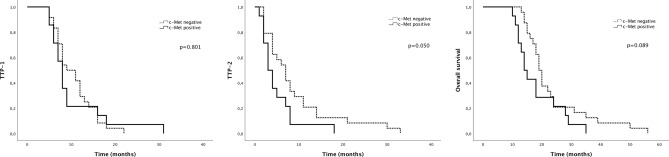
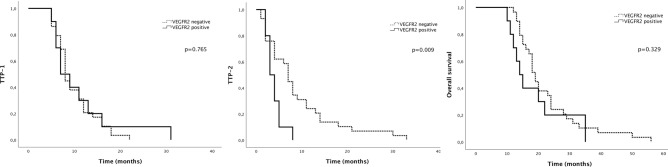
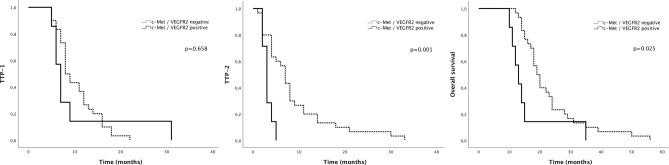
Dismal prognosis of glioblastoma (GBM) prompts for the identification of response predictors and therapeutic resistance mechanisms of current therapies. The authors investigated the impact of c-Met, HGF, VEGFR2 expression and microvessel density (MVD) in GBM patients submitted to second-line chemotherapy with bevacizumab. Immunohistochemical expression of c-Met, HGF, VEGFR2, and MVD was assessed in tumor specimens of GBM patients treated with bevacizumab, after progression under temozolomide. Survival analysis was evaluated according to the expression of the aforementioned biomarkers. c-Met overexpression was associated with a time-to-progression (TTP) after bevacizumab of 3 months (95% CI, 1.5-4.5) compared with a TTP of 7 months (95% CI, 4.6-9.4) in patients with low or no expression of c-Met (p = 0.05). VEGFR2 expression was associated with a TTP after bevacizumab of 3 months (95% CI, 1.8-4.2) compared with a TTP of 7 months (95% CI, 5.7-8.3) in patients with no tumoral expression of VEGFR2 (p = 0.009). Concomitant c-Met/VEGFR2 overexpression was associated with worse overall survival (13 months) compared with concomitant c-Met/VEGFR2 negative expression (19 months; p = 0.025). Our data support the hypothesis that c-Met and VEGFR2 overexpression have a role in the development of glioblastoma early resistance and might predict poorer responses to anti-angiogenic therapies.
胶质母细胞瘤(GBM)预后不佳,促使人们去寻找当前治疗方法的反应预测指标和治疗耐药机制。作者研究了c-Met、HGF、VEGFR2表达以及微血管密度(MVD)对接受贝伐单抗二线化疗的GBM患者的影响。在替莫唑胺治疗后病情进展的GBM患者肿瘤标本中,评估了c-Met、HGF、VEGFR2的免疫组化表达以及MVD。根据上述生物标志物的表达情况进行生存分析。与c-Met低表达或无表达的患者相比,c-Met过表达的患者接受贝伐单抗治疗后的疾病进展时间(TTP)为3个月(95%可信区间,1.5 - 4.5),而c-Met低表达或无表达的患者TTP为7个月(95%可信区间,4.6 - 9.4)(p = 0.05)。与肿瘤组织无VEGFR2表达的患者相比,VEGFR2表达的患者接受贝伐单抗治疗后的TTP为3个月(95%可信区间,1.8 - 4.2),而肿瘤组织无VEGFR2表达的患者TTP为7个月(95%可信区间,5.7 - 8.3)(p = 0.009)。与c-Met/VEGFR2阴性表达(19个月)相比,c-Met/VEGFR2同时过表达的患者总生存期较差(13个月;p = 0.025)。我们的数据支持这样的假设,即c-Met和VEGFR2过表达在胶质母细胞瘤早期耐药的发生中起作用,并且可能预示对抗血管生成治疗的反应较差。