Rastogi Sanjeev
Department of Kaya Chikitsa, State Ayurvedic College and Hospital, Lucknow University, Lucknow, 226003, India.
J Ayurveda Integr Med. 2022 Apr-Jun;13(2):100417. doi: 10.1016/j.jaim.2021.02.008. Epub 2021 Mar 12.
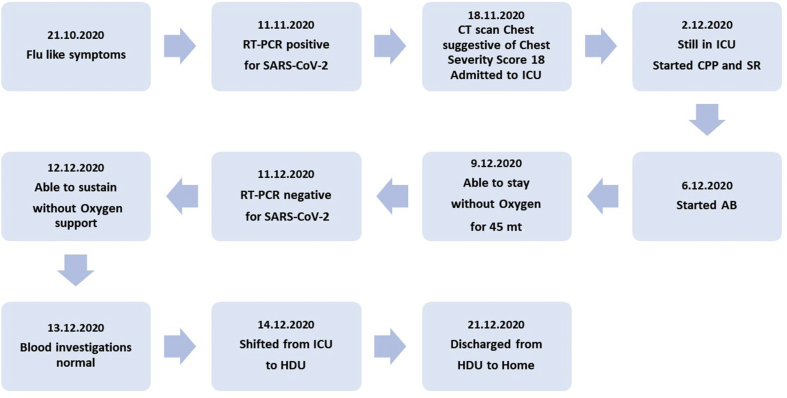
Severe COVID-19 infection requiring oxygen support is reported to have high mortality. Chest Severity Score evaluated through CT scan has a predictive value about future outcomes in such cases. Score value ∼18 is predicted to have poor outcomes. We are presenting here a case of severe COVID-19 with all predictors suggestive of a bad prognosis including IL-6, D-Dimer, Ferritin and CRP in addition to 18/25 Chest Severity Score. Initially treated under ICU care at a tertiary care COVID hospital for about 14 days, the patient was intervened with Ayurveda on his own insistence seeing the unsatisfactory improvements. Ayurveda intervention for 19 days along with standard ICU care resulted in complete clinical recovery of the patient besides the correction of biomarker levels. Rapid clinical and biochemical correction in this severe COVID-19 case against all odds is highly significant and warrants an urgent search for possibility of instituting the integrative management strategies for all those treated in an allopathic facility. This case also advocates an early institution of Ayurveda interventions in COVID-19 in order to prevent deterioration leading to complications.
据报道,需要氧气支持的重症新冠病毒感染死亡率很高。通过CT扫描评估的胸部严重程度评分对此类病例的未来预后具有预测价值。预计评分值约为18时预后不良。我们在此介绍一例重症新冠病毒感染病例,除了胸部严重程度评分为18/25外,所有预测指标都提示预后不良,包括白细胞介素-6、D-二聚体、铁蛋白和C反应蛋白。该患者最初在一家三级护理新冠医院的重症监护病房接受了约14天的治疗,由于病情改善不明显,在患者的坚持下接受了阿育吠陀疗法干预。在接受19天的阿育吠陀疗法干预并结合标准重症监护治疗后,患者不仅生物标志物水平得到纠正,还实现了完全临床康复。在这例重症新冠病毒感染病例中,尽管困难重重,但临床和生化指标迅速得到纠正,这具有高度重要意义,值得迫切探索为所有在西医机构接受治疗的患者制定综合管理策略的可能性。该病例还提倡在新冠病毒感染中尽早采用阿育吠陀疗法干预,以防止病情恶化导致并发症。