Kibr Gesessew
Department of Food and Nutritional Sciences, Faculty of Agriculture, Shambu Campus, Wollega University, Shambu, Ethiopia.
J Nutr Metab. 2021 Feb 28;2021:6654659. doi: 10.1155/2021/6654659. eCollection 2021.
What food people choose to eat is embraced by circumstances that are essentially influenced by the underlying motives of food choices which are important to a healthful dietary change. Therefore, this study aimed to explore food choice behaviors associated with nutritional status and FVs intake in women during lactation from central Amhara.
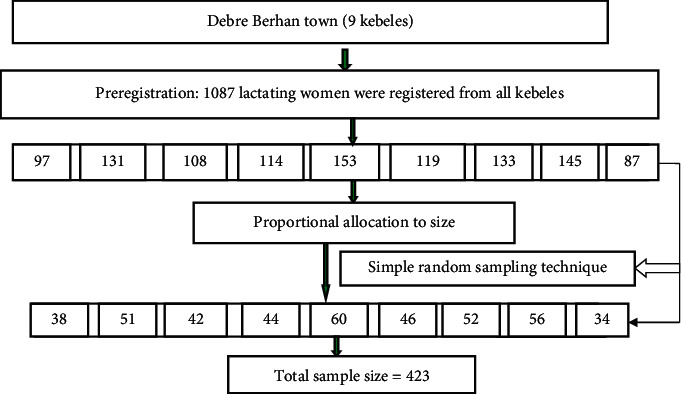
A multistage sampling technique was applied to select study participants. A study was conducted among 423 randomly selected lactating women using a face-to-face interview of the questionnaire. A community-based cross-sectional, quantitative study with descriptive and analytical components was done. Anthropometrics measurements such as weight, height, waist, and hip circumference were taken from all participants. Body mass index was calculated to determine the nutritional status of women. Data were analyzed using SPSS version 20 computer software program. Association between dependent and independent variables was identified by logistic regression analysis, and a -value< 0.05 was taken as statistically significant.
About 21.7% of women were underweight. Approximately 37.4% of women had good consumption trends to fruits and vegetables. Healthy meal eating motivation, price-consciousness, and mood concern were identified as the most significant behaviors of food choice, influencing the nutritional status of women with AOR (95% CI) of 2.1 (1.21-3.62), 3.01 (1.32-6.9), and 0.5 (0.30-0.95), respectively. Natural content (AOR (95%): 2.37 (1.39-4.06)), mood concern (AOR (95%): 2.29 (1.15-4.56)), religion concern (AOR (95%): 2.45 (1.37-4.4)), husband encouragement (AOR (95%): 2.26 (1.04-4.89)), and availability of milk and milk products (AOR (95%): 1.6 (1.39-2.74)) and fruits and vegetables (AOR (95%): 1.66 (1.16-3.48)) in home were associated significantly with a good intake of fruit and vegetables.
This finding provides a useful insight into the food choice motivations of a group of women with preference for natural foods, mood concern, religion concern, and husband support with good fruit and vegetable intake. This can help practitioners make recommendations for health promotion strategies. Emphasis on assisting women with healthy meal eating and avoiding psychological stress is important. Nutrition education about healthy food choice is recommended for communities.
人们选择吃什么受到多种因素的影响,这些因素本质上受食物选择的潜在动机影响,而食物选择动机对于健康的饮食改变至关重要。因此,本研究旨在探讨阿姆哈拉中部哺乳期妇女的食物选择行为与营养状况及水果和蔬菜摄入量之间的关系。
采用多阶段抽样技术选择研究参与者。通过对问卷进行面对面访谈,对423名随机选择的哺乳期妇女进行了研究。开展了一项基于社区的横断面定量研究,包括描述性和分析性部分。对所有参与者进行了体重、身高、腰围和臀围等人体测量。计算体重指数以确定妇女的营养状况。使用SPSS 20版计算机软件程序对数据进行分析。通过逻辑回归分析确定自变量与因变量之间的关联,P值<0.05被视为具有统计学意义。
约21.7%的妇女体重过轻。约37.4%的妇女对水果和蔬菜有良好的消费趋势。健康饮食动机、价格意识和情绪关注被确定为食物选择的最显著行为,分别以2.1(1.21 - 3.62)、3.01(1.32 - 6.9)和0.5(0.30 - 0.95)的调整后比值比(AOR)(95%置信区间)影响妇女的营养状况。天然成分(AOR(95%):2.37(1.39 - 4.06))、情绪关注(AOR(95%):2.29(1.15 - 4.56))、宗教关注(AOR(95%):2.45(1.37 - 4.4))、丈夫的鼓励(AOR(95%):2.26(1.04 - 4.89))以及家中牛奶和奶制品(AOR(95%):1.6(1.39 - 2.74))和水果和蔬菜(AOR(95%):1.66(1.16 - 3.48))的可获得性与水果和蔬菜的良好摄入量显著相关。
这一发现为一群偏爱天然食物、关注情绪、关注宗教且得到丈夫支持且水果和蔬菜摄入量良好的妇女的食物选择动机提供了有益的见解。这有助于从业者制定健康促进策略的建议。强调帮助妇女养成健康饮食习惯并避免心理压力很重要。建议对社区进行关于健康食物选择的营养教育。