Galicia-Moreno Marina, Silva-Gomez Jorge A, Lucano-Landeros Silvia, Santos Arturo, Monroy-Ramirez Hugo C, Armendariz-Borunda Juan
University of Guadalajara, Institute of Molecular Biology in Medicine and Gene Therapy, Department of Molecular Biology and Genomics, Health Science University Center (CUCS), Guadalajara 44340, JAL, Mexico.
Tecnologico de Monterrey, Escuela de Medicina y Ciencias de la Salud, Zapopan 45138, Jalisco, Mexico.
Can J Gastroenterol Hepatol. 2021 Feb 28;2021:8837811. doi: 10.1155/2021/8837811. eCollection 2021.
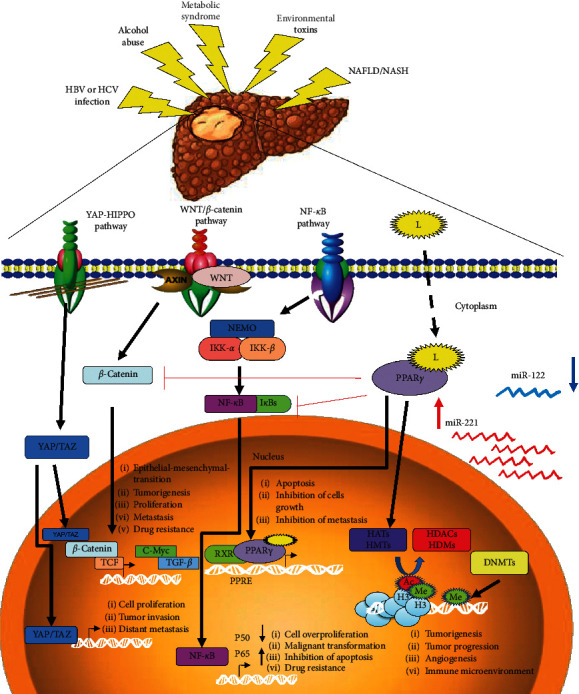
Liver cancer is one of the main causes of death related to cancer worldwide; its etiology is related with infections by C or B hepatitis virus, alcohol consumption, smoking, obesity, nonalcoholic fatty liver disease, diabetes, and iron overload, among other causes. Several kinds of primary liver cancer occur, but we will focus on hepatocellular carcinoma (HCC). Numerous cellular signaling pathways are implicated in hepatocarcinogenesis, including YAP-HIPPO, Wnt--catenin, and nuclear factor-B (NF-B); these in turn are considered novel therapeutic targets. In this review, the role of lipid metabolism regulated by peroxisome proliferator-activated receptor gamma (PPAR) in the development of HCC will also be discussed. Moreover, recent evidence has been obtained regarding the participation of epigenetic changes such as acetylation and methylation of histones and DNA methylation in the development of HCC. In this review, we provide detailed and current information about these topics. Experimental models represent useful tools for studying the different stages of liver cancer and help to develop new pharmacologic treatments. Each model and has several characteristics and advantages to offer for the study of this disease. Finally, the main therapies approved for the treatment of HCC patients, first- and second-line therapies, are described in this review. We also describe a novel option, pirfenidone, which due to its pharmacological properties could be considered in the future as a therapeutic option for HCC treatment.
肝癌是全球癌症相关死亡的主要原因之一;其病因与丙型或乙型肝炎病毒感染、饮酒、吸烟、肥胖、非酒精性脂肪性肝病、糖尿病和铁过载等因素有关。原发性肝癌有多种类型,但我们将重点关注肝细胞癌(HCC)。众多细胞信号通路与肝癌发生有关,包括YAP-HIPPO、Wnt-β-连环蛋白和核因子-κB(NF-κB);这些反过来又被视为新的治疗靶点。在本综述中,还将讨论过氧化物酶体增殖物激活受体γ(PPAR)调节的脂质代谢在HCC发生发展中的作用。此外,关于表观遗传变化如组蛋白乙酰化和甲基化以及DNA甲基化在HCC发生发展中的参与,也已获得最新证据。在本综述中,我们提供了有关这些主题的详细且最新的信息。实验模型是研究肝癌不同阶段的有用工具,有助于开发新的药物治疗方法。每种模型都有其自身的特点和优势,可用于该疾病的研究。最后,本综述描述了已批准用于治疗HCC患者的主要疗法,一线和二线疗法。我们还描述了一种新的选择,吡非尼酮,由于其药理特性,未来可能被视为HCC治疗的一种选择。