Department of Physiology and Neurobiology, University of Connecticut, Storrs, Connecticut.
Department of Neuroscience, University of Naples Federico II, Naples, Italy.
J Neurophysiol. 2021 Apr 1;125(4):1440-1449. doi: 10.1152/jn.00564.2020. Epub 2021 Mar 17.
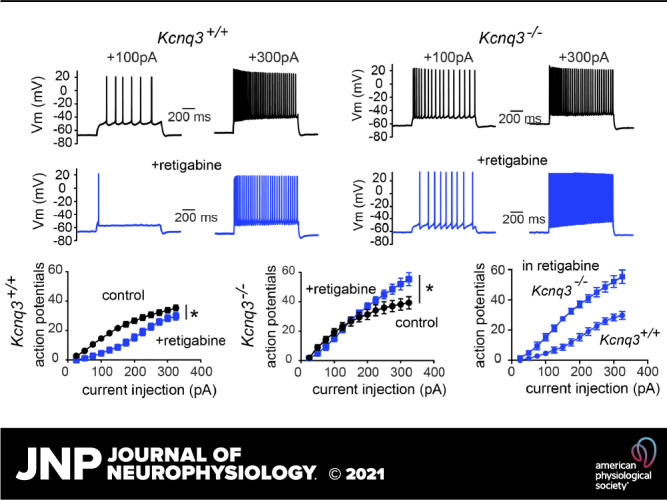
Retigabine is a first-in-class potassium channel opener approved for patients with epilepsy. Unfortunately, several side effects have limited its use in clinical practice, overshadowing its beneficial effects. Multiple studies have shown that retigabine acts by enhancing the activity of members of the voltage-gated KCNQ (Kv7) potassium channel family, particularly the neuronal KCNQ channels KCNQ2-KCNQ5. However, it is currently unknown whether retigabine's action in neurons is mediated by all KCNQ neuronal channels or by only a subset. This knowledge is necessary to elucidate retigabine's mechanism of action in the central nervous system and its adverse effects and to design more effective and selective retigabine analogs. In this study, we show that the action of retigabine in excitatory neurons strongly depends on the presence of KCNQ3 channels. Deletion of severely limited the ability of retigabine to reduce neuronal excitability in mouse CA1 and subiculum excitatory neurons. In addition, we report that in the absence of KCNQ3 channels, retigabine can enhance CA1 pyramidal neuron activity, leading to a greater number of action potentials and reduced spike frequency adaptation; this finding further supports a key role of KCNQ3 channels in mediating the action of retigabine. Our work provides new insight into the action of retigabine in forebrain neurons, clarifying retigabine's action in the nervous system. Retigabine has risen to prominence as a first-in-class potassium channel opener approved by the Food and Drug Administration, with potential for treating multiple neurological disorders. Here, we demonstrate that KCNQ3 channels are the primary target of retigabine in excitatory neurons, as deleting these channels greatly diminishes the effect of retigabine in pyramidal neurons. Our data provide the first indication that retigabine controls neuronal firing properties primarily through KCNQ3 channels.
瑞替加滨是一种首创的钾通道开放剂,已被批准用于癫痫患者。不幸的是,其多种副作用限制了它在临床实践中的应用,使其有益作用黯然失色。多项研究表明,瑞替加滨通过增强电压门控 KCNQ(Kv7)钾通道家族成员的活性来发挥作用,特别是神经元 KCNQ 通道 KCNQ2-KCNQ5。然而,目前尚不清楚瑞替加滨在神经元中的作用是否由所有 KCNQ 神经元通道介导,还是仅由一部分通道介导。了解这一点对于阐明瑞替加滨在中枢神经系统中的作用机制及其不良反应以及设计更有效和更具选择性的瑞替加滨类似物是必要的。在这项研究中,我们表明瑞替加滨在兴奋性神经元中的作用强烈依赖于 KCNQ3 通道的存在。KCNQ3 通道的缺失严重限制了瑞替加滨降低小鼠 CA1 和下托兴奋性神经元兴奋性的能力。此外,我们报告称,在不存在 KCNQ3 通道的情况下,瑞替加滨可以增强 CA1 锥体神经元的活动,导致更多的动作电位和减少的尖峰频率适应;这一发现进一步支持 KCNQ3 通道在介导瑞替加滨作用中的关键作用。我们的工作为瑞替加滨在前脑神经元中的作用提供了新的见解,阐明了瑞替加滨在神经系统中的作用。瑞替加滨作为一种首创的钾通道开放剂被美国食品和药物管理局批准,具有治疗多种神经疾病的潜力。在这里,我们证明 KCNQ3 通道是瑞替加滨在兴奋性神经元中的主要靶点,因为删除这些通道大大降低了瑞替加滨在锥体神经元中的作用。我们的数据首次表明,瑞替加滨主要通过 KCNQ3 通道控制神经元的放电特性。