
破乳剂 A 和 B 直系同源基因在担子菌酵母假丝酵母南极洲 GB-4(0)中的破坏产生了一种稳定的可分泌的生物可降解塑料降解酶。
Disruption of protease A and B orthologous genes in the basidiomycetous yeast Pseudozyma antarctica GB-4(0) yields a stable extracellular biodegradable plastic-degrading enzyme.
机构信息
Research Institute for Innovation in Sustainable Chemistry, National Institute of Advanced Industrial Science and Technology (AIST), Tsukuba, Japan.
Institute for Agro-Environmental Sciences, National Agriculture and Food Research Organization (NARO), Tsukuba, Japan.
出版信息
PLoS One. 2021 Mar 17;16(3):e0247462. doi: 10.1371/journal.pone.0247462. eCollection 2021.
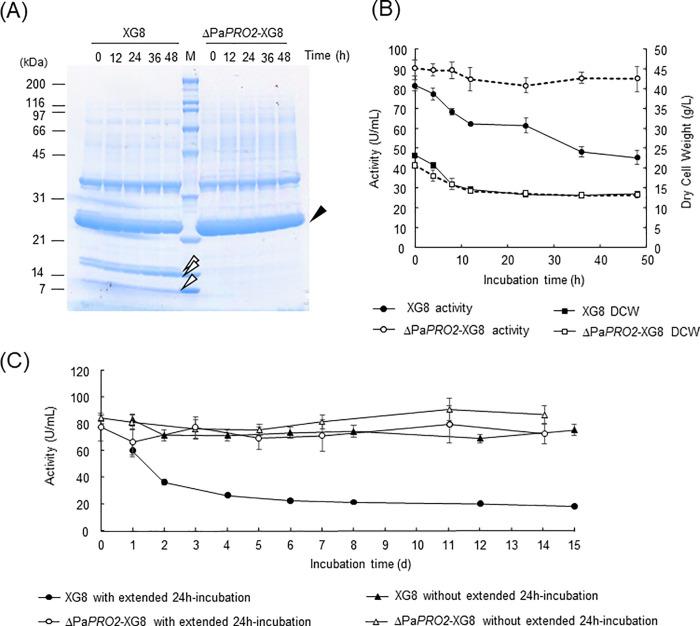
The yeast Pseudozyma antarctica (currently designated Moesziomyces antarcticus) secretes a xylose-induced biodegradable plastic-degrading enzyme (PaE). To suppress degradation of PaE during production and storage, we targeted the inhibition of proteolytic enzyme activity in P. antarctica. Proteases A and B act as upper regulators in the proteolytic network of the model yeast, Saccharomyces cerevisiae. We searched for orthologous genes encoding proteases A and B in the genome of P. antarctica GB-4(0) based on the predicted amino acid sequences. We found two gene candidates, PaPRO1 and PaPRO2, with conserved catalytically important domains and signal peptides indicative of vacuolar protease function. We then prepared gene-deletion mutants of strain GB-4(0), ΔPaPRO1 and ΔPaPRO2, and evaluated PaE stability in culture by immunoblotting analysis. Both mutants exhibited sufficient production of PaE without degradation fragments, while the parent strain exhibited the degradation fragments. Therefore, we concluded that the protease A and B orthologous genes are related to the degradation of PaE. To produce a large quantity of PaE, we made a PaPRO2 deletion mutant of a PaE-overexpression strain named XG8 by introducing a PaE high-production cassette into the strain GB-4(0). The ΔPaPRO2 mutant of XG8 was able to produce PaE without the degradation fragments during large-scale cultivation in a 3-L jar fermenter for 3 days at 30°C. After terminating the agitation, the PaE activity in the XG8 ΔPaPRO2 mutant culture was maintained for the subsequent 48 h incubation at 25°C regardless of remaining cells, while activity in the XG8 control was reduced to 55.1%. The gene-deleted mutants will be useful for the development of industrial processes of PaE production and storage.
南极假丝酵母(现命名为南极毛孢子菌)分泌一种木糖诱导的可生物降解塑料降解酶(PaE)。为了抑制 PaE 在生产和储存过程中的降解,我们将目标锁定在抑制南极假丝酵母的蛋白水解酶活性上。蛋白酶 A 和 B 作为模式酵母酿酒酵母蛋白水解网络的上调控因子。我们根据预测的氨基酸序列,在南极假丝酵母 GB-4(0)的基因组中搜索编码蛋白酶 A 和 B 的同源基因。我们发现了两个候选基因,PaPRO1 和 PaPRO2,它们具有保守的催化重要结构域和指示液泡蛋白酶功能的信号肽。然后,我们制备了菌株 GB-4(0)的基因缺失突变体ΔPaPRO1 和ΔPaPRO2,并通过免疫印迹分析评估了培养物中 PaE 的稳定性。两个突变体都表现出足够的 PaE 产量而没有降解片段,而亲本菌株则表现出降解片段。因此,我们得出结论,蛋白酶 A 和 B 的同源基因与 PaE 的降解有关。为了大量生产 PaE,我们通过将 PaE 高产盒引入菌株 GB-4(0),构建了一个 PaE 过表达菌株 XG8 的 PaPRO2 缺失突变体。XG8 的ΔPaPRO2 突变体在 30°C 下 3L 罐发酵器中大规模培养 3 天时,能够生产没有降解片段的 PaE。停止搅拌后,XG8ΔPaPRO2 突变体培养物中的 PaE 活性在随后的 48 小时 25°C 孵育中保持不变,而 XG8 对照物的活性则降低至 55.1%。这些基因缺失突变体将有助于开发 PaE 生产和储存的工业工艺。


 Zotero 插件