Brain Repair and Integrative Neuroscience Program, Research Institute of the McGill University Health Centre, Montreal General Hospital, 1650 Cedar Avenue, Montreal, QC H3G1A4, Canada.
Department of Physiology, McGill University, 3644 Promenade Sir William Osler, Montreal, QC H3G1Y6, Canada.
Cell Rep. 2021 Mar 16;34(11):108866. doi: 10.1016/j.celrep.2021.108866.
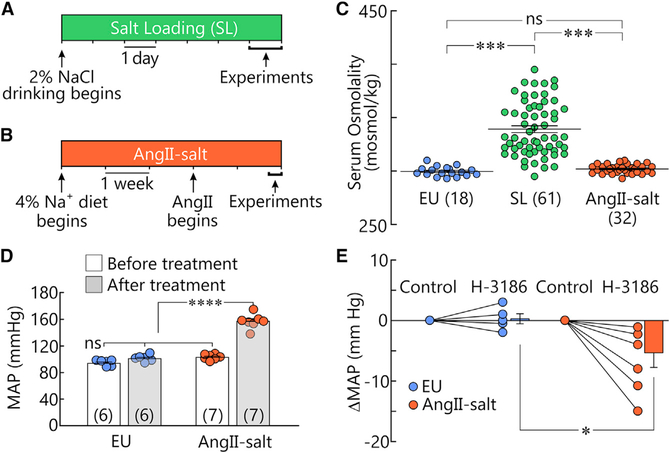
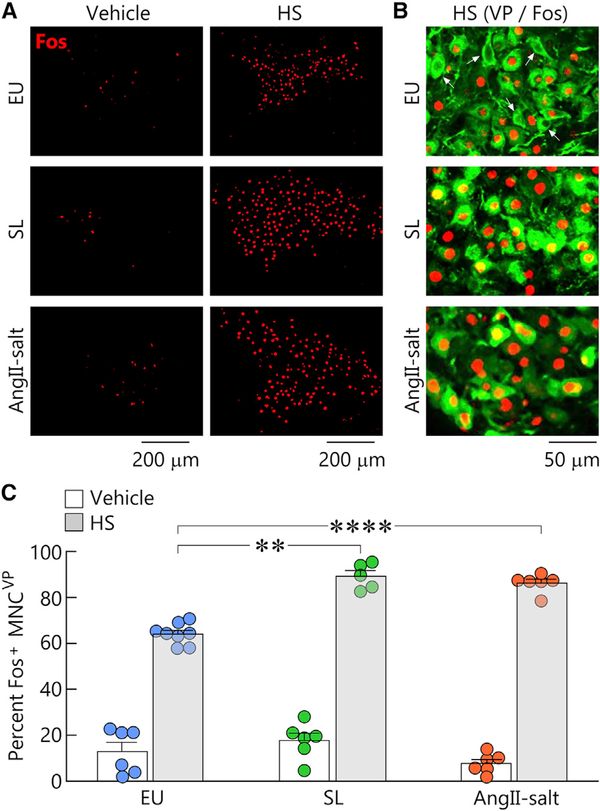
High dietary salt increases arterial pressure partly through activation of magnocellular neurosecretory cells (MNC) that secrete the antidiuretic and vasoconstrictor hormone vasopressin (VP) into the circulation. Here, we show that the intrinsic and synaptic excitation of MNC caused by hypertonicity are differentially potentiated in two models of salt-dependent hypertension in rats. One model combined salty chow with a chronic subpressor dose of angiotensin II (AngII-salt), the other involved replacing drinking water with 2% NaCl (salt loading, SL). In both models, we observed a significant increase in the quantal amplitude of EPSCs on MNC. However, model-specific changes were also observed. AngII-salt increased the probability of glutamate release by osmoreceptor afferents and increased overall excitatory network drive. In contrast, SL specifically increased membrane stiffness and the intrinsic osmosensitivity of MNC. These results reveal that dietary salt increases the excitability of MNC through effects on the cell-autonomous and synaptic osmoresponsiveness of MNC.
高盐饮食会通过激活分泌抗利尿激素和血管收缩素的大细胞神经分泌细胞(MNC)来增加动脉血压。在这里,我们表明,高渗性引起的 MNC 的内在和突触兴奋在两种大鼠盐依赖性高血压模型中得到了不同程度的增强。一种模型将咸饲料与慢性亚加压素剂量的血管紧张素 II(AngII-盐)结合,另一种模型则用 2%的盐水替代饮用水(盐负荷,SL)。在这两种模型中,我们观察到 MNC 上 EPSC 的量子幅度显著增加。然而,也观察到了特定于模型的变化。AngII-盐通过渗透压感受器传入增加了谷氨酸释放的概率,并增加了整体兴奋性网络驱动。相比之下,SL 特异性地增加了 MNC 的膜硬度和内在渗透压敏感性。这些结果表明,饮食盐通过影响 MNC 的细胞自主和突触渗透压反应来增加 MNC 的兴奋性。