Department of Neuroscience, Mayo Clinic, Jacksonville, FL, USA.
Department of Neuroscience, Mayo Clinic, Jacksonville, FL, USA; Neuroscience Graduate Program, Mayo Clinic Graduate School of Biomedical Sciences, Jacksonville, FL, USA.
Cell Rep. 2021 Mar 16;34(11):108843. doi: 10.1016/j.celrep.2021.108843.
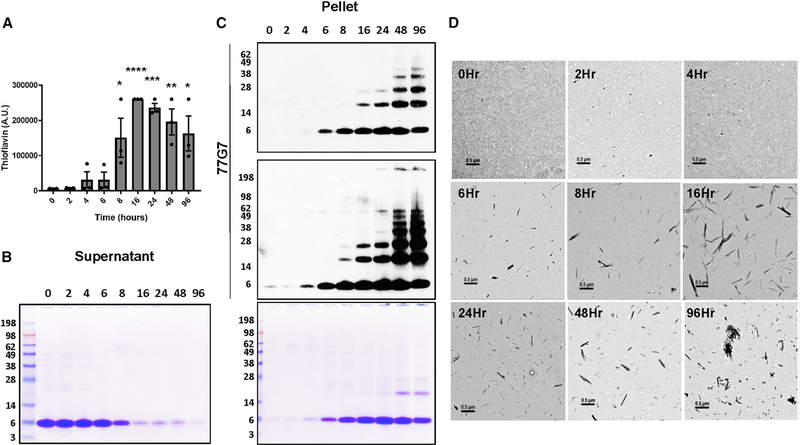
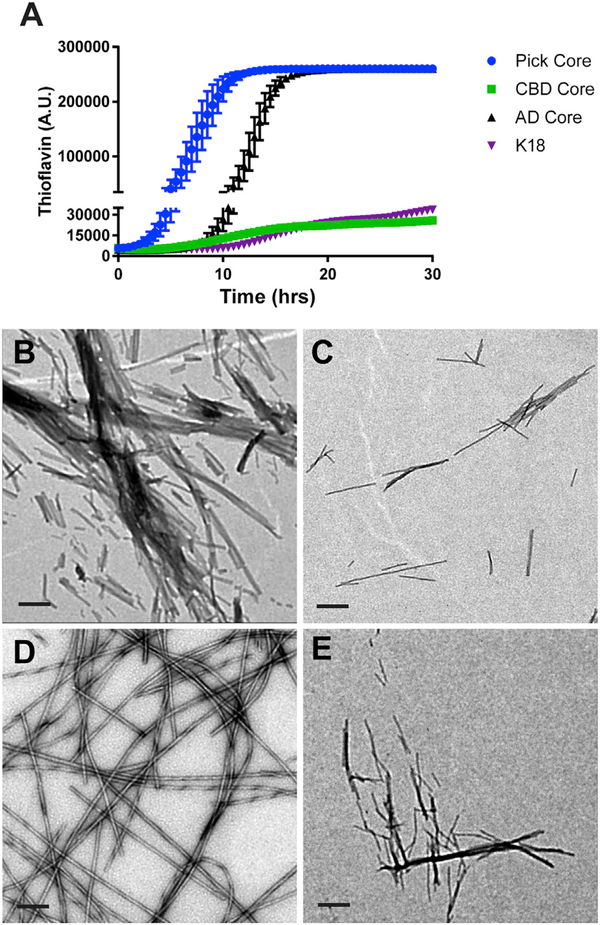
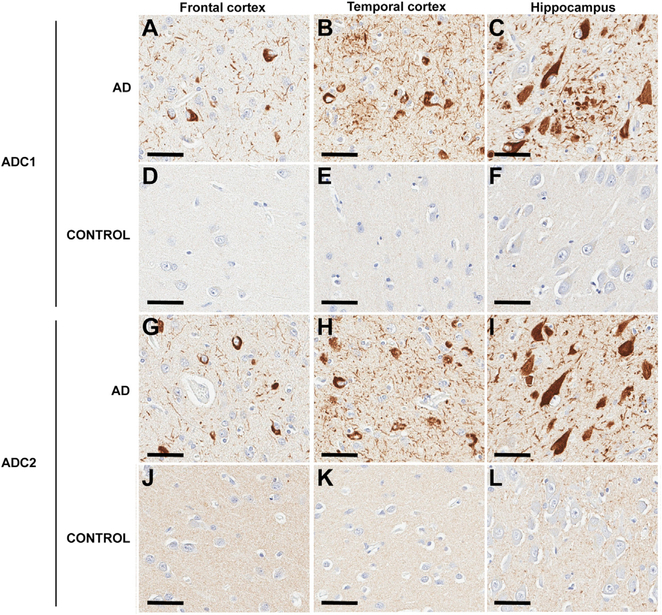
Tau accumulation is a major pathological hallmark of Alzheimer's disease (AD) and other tauopathies, but the mechanism(s) of tau aggregation remains unclear. Taking advantage of the identification of tau filament cores by cryoelectron microscopy, we demonstrate that the AD tau core possesses the intrinsic ability to spontaneously aggregate in the absence of an inducer, with antibodies generated against AD tau core filaments detecting AD tau pathology. The AD tau core also drives aggregation of full-length wild-type tau, increases seeding potential, and templates abnormal forms of tau present in brain homogenates and antemortem cerebrospinal fluid (CSF) from patients with AD in an ultrasensitive real-time quaking-induced conversion (QuIC) assay. Finally, we show that the filament cores in corticobasal degeneration (CBD) and Pick's disease (PiD) similarly assemble into filaments under physiological conditions. These results document an approach to modeling tau aggregation and have significant implications for in vivo investigation of tau transmission and biomarker development.
tau 聚集是阿尔茨海默病(AD)和其他 tau 病的主要病理学标志,但 tau 聚集的机制仍不清楚。利用冷冻电子显微镜鉴定 tau 丝核,我们证明 AD tau 核具有在没有诱导剂的情况下自发聚集的内在能力,针对 AD tau 核丝的抗体可检测 AD tau 病变。AD tau 核还可驱动全长野生型 tau 的聚集,增加接种潜力,并在超灵敏实时震动诱导转化(QuIC)测定中模板化脑匀浆和 AD 患者生前脑脊液(CSF)中存在的异常形式的 tau。最后,我们发现皮质基底节变性(CBD)和皮克病(PiD)中的丝核在生理条件下也可组装成丝。这些结果为 tau 聚集建模提供了一种方法,并对 tau 传播的体内研究和生物标志物开发具有重要意义。