Lin Kevin Z, Liu Han, Roeder Kathryn
Carnegie Mellon University, Department of Statistics & Data Science, Pittsburgh, PA.
Northwestern University, Department of Electrical Engineering and Computer Science, Evanston, IL.
J Am Stat Assoc. 2021;116(533):54-67. doi: 10.1080/01621459.2020.1738234. Epub 2020 Apr 13.
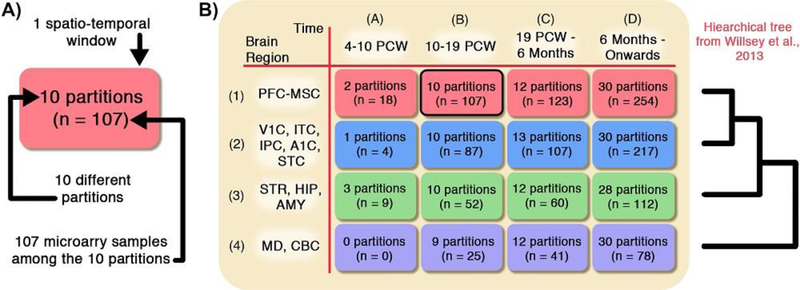
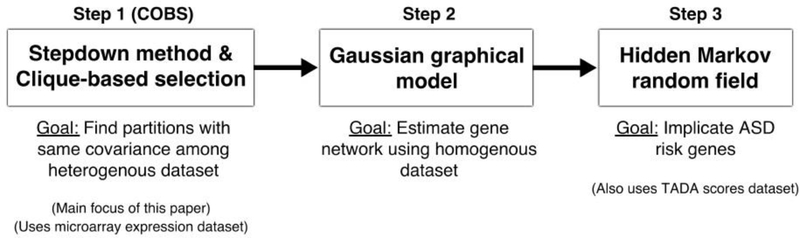
Risk for autism can be influenced by genetic mutations in hundreds of genes. Based on findings showing that genes with highly correlated gene expressions are functionally interrelated, "guilt by association" methods such as DAWN have been developed to identify these autism risk genes. Previous research analyze the BrainSpan dataset, which contains gene expression of brain tissues from varying regions and developmental periods. Since the spatiotemporal properties of brain tissue is known to affect the gene expression's covariance, previous research have focused only on a specific subset of samples to avoid the issue of heterogeneity. This analysis leads to a potential loss of power when detecting risk genes. In this article, we develop a new method called COBS (COvariance-Based sample Selection) to find a larger and more homogeneous subset of samples that share the same population covariance matrix for the downstream DAWN analysis. To demonstrate COBS's effectiveness, we use genetic risk scores from two sequential data freezes obtained in 2014 and 2020. We show COBS improves DAWN's ability to predict risk genes detected in the newer data freeze when using the risk scores of the older data freeze as input.
数百个基因的基因突变会影响患自闭症的风险。基于研究结果表明,具有高度相关基因表达的基因在功能上是相互关联的,诸如DAWN之类的“关联定罪”方法已被开发出来以识别这些自闭症风险基因。先前的研究分析了BrainSpan数据集,该数据集包含来自不同区域和发育时期的脑组织的基因表达。由于已知脑组织的时空特性会影响基因表达的协方差,因此先前的研究仅关注特定的样本子集以避免异质性问题。这种分析在检测风险基因时会导致潜在的效能损失。在本文中,我们开发了一种名为COBS(基于协方差的样本选择)的新方法,以找到一个更大且更同质的样本子集,该子集共享相同的总体协方差矩阵用于下游的DAWN分析。为了证明COBS的有效性,我们使用了2014年和2020年获得的两个连续数据冻结版本中的遗传风险评分。我们表明,当使用较旧数据冻结版本的风险评分作为输入时,COBS提高了DAWN预测在较新数据冻结版本中检测到的风险基因的能力。