Lee Jisun, Park Jinyoung, Lee Hyun Jung, Kim Mi Ju, Lee Yoon Hee, Chong Gun Oh, Hong Dae Gy, Lee Taek Hoo
Department of Obstetrics and Gynecology, School of Medicine, Kyungpook National University, Kyungpook National University Hospital, Daegu, Republic of Korea.
Department of Surgery, School of Medicine, Kyungpook National University, Kyungpook National University Hospital, Daegu, Republic of Korea.
Int J Womens Health. 2021 Mar 10;13:317-326. doi: 10.2147/IJWH.S285335. eCollection 2021.
The objective of this study is to evaluate the preoperative hematological parameters to predict ovarian torsion in patients with ovarian mature cystic teratoma. We also analyzed the diagnostic value of these makers to predict ovarian necrosis in cases of torsion as well as the effect of torsion on ovarian reserve.
This is a retrospective study of 132 patients who received either laparoscopic or laparotomy surgery for OMCT at a single university hospital. Clinical characteristics and preoperative hematological parameters were compared between patients with or without torsion. Patients with torsion were further classified as infarction and non-infarction group. Preoperative parameters were compared between the two groups as well.
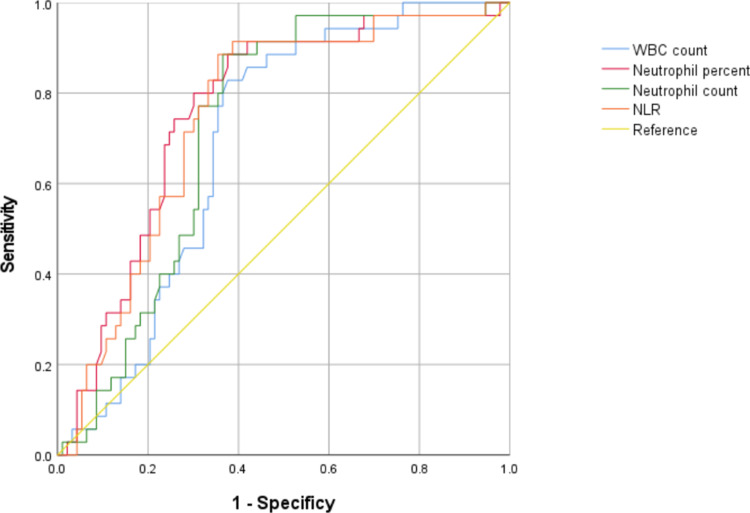
White blood cell (WBC) count, neutrophil percent, neutrophil count, and neutrophil to lymphocyte ratio (NLR) were higher in the torsion group (n=37) than the non-torsion group (n=95) (<0.05 for all). Although statistically insignificant, the preoperative anti-Mullerian hormone (AMH) was lower in the torsion group than the non-torsion group (4.07 ± 3.38 vs 6.1 ± 3.6, =0.122). In cases of torsion, the infarction group showed higher WBC count and lymphocyte count but lower hemoglobin level and platelet to lymphocyte ratio (PLR) than the non-infarction group (<0.05 for all).
The WBC count, neutrophil percent, neutrophil count, and NLR were higher in the cases of OMCT with torsion, and these parameters may be useful to diagnose OMCT with torsion. Also, adnexal torsion may deteriorate ovarian reserved as indicated by decreased AMH in torsion group.
本研究旨在评估术前血液学参数以预测卵巢成熟囊性畸胎瘤患者的卵巢扭转情况。我们还分析了这些指标对预测扭转病例中卵巢坏死的诊断价值以及扭转对卵巢储备功能的影响。
这是一项对在一所大学医院接受腹腔镜或剖腹手术治疗卵巢成熟囊性畸胎瘤的132例患者的回顾性研究。比较了有或无扭转患者的临床特征和术前血液学参数。将发生扭转的患者进一步分为梗死组和非梗死组。也对两组的术前参数进行了比较。
扭转组(n = 37)的白细胞(WBC)计数、中性粒细胞百分比、中性粒细胞计数和中性粒细胞与淋巴细胞比值(NLR)高于非扭转组(n = 95)(所有均P<0.05)。虽然无统计学意义,但扭转组的术前抗苗勒管激素(AMH)低于非扭转组(4.07±3.38 vs 6.1±3.6,P = 0.122)。在扭转病例中,梗死组的白细胞计数和淋巴细胞计数高于非梗死组,但血红蛋白水平和血小板与淋巴细胞比值(PLR)低于非梗死组(所有均P<0.05)。
发生扭转的卵巢成熟囊性畸胎瘤病例中白细胞计数、中性粒细胞百分比、中性粒细胞计数和NLR较高,这些参数可能有助于诊断发生扭转的卵巢成熟囊性畸胎瘤。此外,如扭转组中AMH降低所示,附件扭转可能会使卵巢储备功能恶化。