Hou Min, Xu Gaolian, Ran Maosheng, Luo Wei, Wang Hui
School of Public Health, College of Medicine, Shanghai Jiao Tong University, Shanghai, China.
Nano Biomedical Research Center, School of Biomedical Engineering, Shanghai Jiao Tong University, Shanghai, China.
Front Neurosci. 2021 Feb 24;15:619051. doi: 10.3389/fnins.2021.619051. eCollection 2021.
Alternations in gut microbiota and a number of genes have been implicated as risk factors for the development of Alzheimer disease (AD). However, the interactions between the altered bacteria and risk genetic variants remain unclear.
We aimed to explore associations of the risk genetic variants with altered gut bacteria in the onset of AD.
We collected baseline data and stool and blood samples from 30 AD patients and 47 healthy controls in a case-control study. The rs42358/rs4512 (), rs3851179 (), rs744373 (), rs9331888 (), rs670139 (), rs3764650 (), rs3865444 (), rs9349407 (), rs11771145 (), and rs3818361/rs6656401 () were sequenced, and microbiota composition was characterized using 16S rRNA gene sequencing. The associations of the altered gut bacteria with the risk genetics were analyzed.
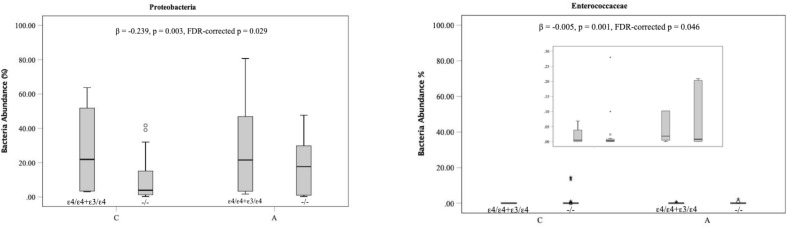
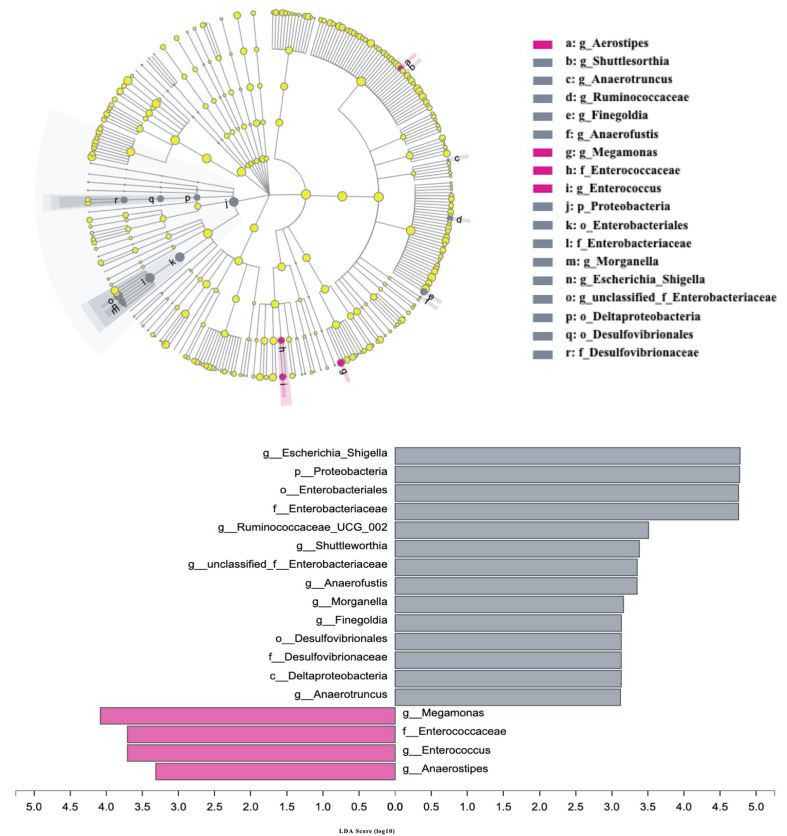
Apolipoprotein ε4 allele and rs744373 were risk loci for the AD among 12 genetic variants. Phylum Proteobacteria; orders Enterobacteriales, Deltaproteobacteria, and Desulfovibrionales; families Enterobacteriaceae and Desulfovibrionaceae; and genera , , , , , , and were increased in AD subjects, whereas family Enterococcaceae and genera , , and were more abundant in controls ( < 0.05). Among the altered microbiota, APOE ε4 allele was positively associated with pathogens: Proteobacteria.
The interaction of APOE ε4 gene and the AD-promoting pathogens might be an important factor requiring for the promotion of AD. Targeting to microbiota might be an effective therapeutic strategy for AD susceptible to APOE ε4 allele. This needs further investigation.
肠道微生物群的改变和一些基因已被认为是阿尔茨海默病(AD)发生发展的危险因素。然而,肠道细菌改变与风险基因变异之间的相互作用仍不清楚。
我们旨在探讨风险基因变异与AD发病过程中肠道细菌改变之间的关联。
在一项病例对照研究中,我们收集了30例AD患者和47例健康对照的基线数据、粪便和血液样本。对rs42358/rs4512()、rs3851179()、rs744373()、rs9331888()、rs670139()、rs3764650()、rs3865444()、rs9349407()、rs11771145()以及rs3818361/rs6656401()进行测序,并使用16S rRNA基因测序对微生物群组成进行表征。分析肠道细菌改变与风险遗传学之间的关联。
在12个基因变异中,载脂蛋白ε4等位基因和rs744373是AD的风险位点。AD患者中变形菌门、肠杆菌目、δ变形菌纲、脱硫弧菌目、肠杆菌科和脱硫弧菌科以及属、、、、、、增加,而对照组中肠球菌科以及属、、更为丰富(P<0.05)。在改变的微生物群中,APOE ε4等位基因与病原体变形菌门呈正相关。
APOE ε4基因与促进AD的病原体之间的相互作用可能是促进AD发生的一个重要因素。针对微生物群可能是对APOE ε4等位基因易感的AD的一种有效治疗策略。这需要进一步研究。