Lazou Thomai P, Gelasakis Athanasios I, Chaintoutis Serafeim C, Iossifidou Eleni G, Dovas Chrysostomos I
Laboratory of Hygiene of Foods of Animal Origin - Veterinary Public Health, Faculty of Health Sciences, School of Veterinary Medicine, Aristotle University of Thessaloniki, Thessaloniki, Greece.
Laboratory of Anatomy and Physiology of Farm Animals, Department of Animal Science, School of Animal Biosciences, Agricultural University of Athens, Athens, Greece.
Front Microbiol. 2021 Mar 1;12:604933. doi: 10.3389/fmicb.2021.604933. eCollection 2021.
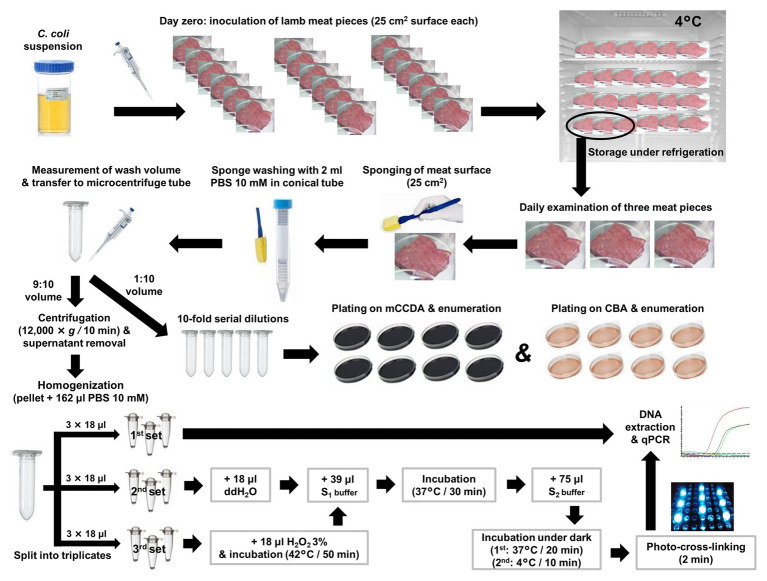
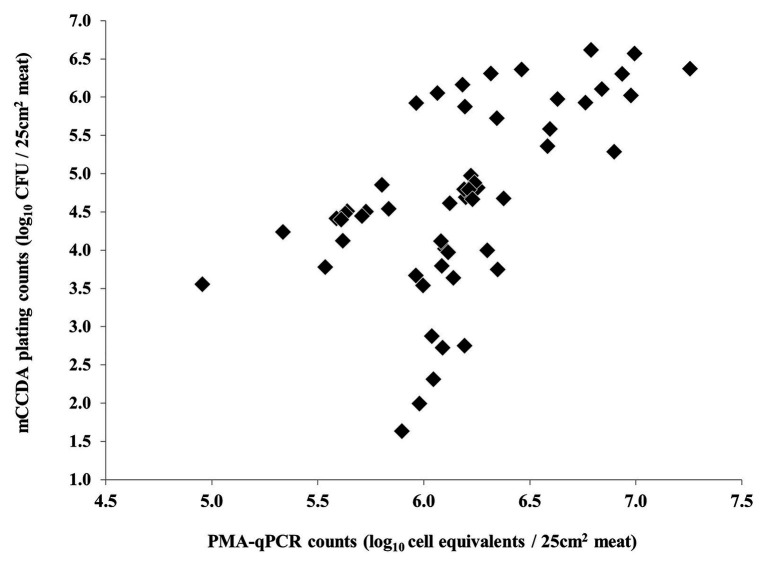
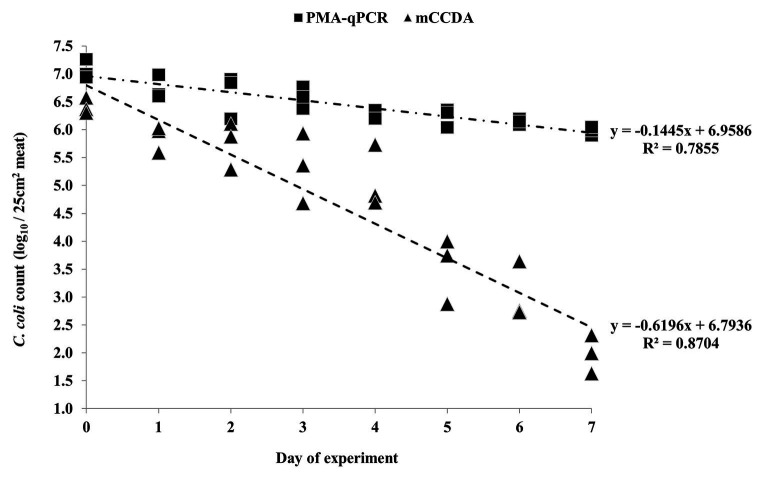
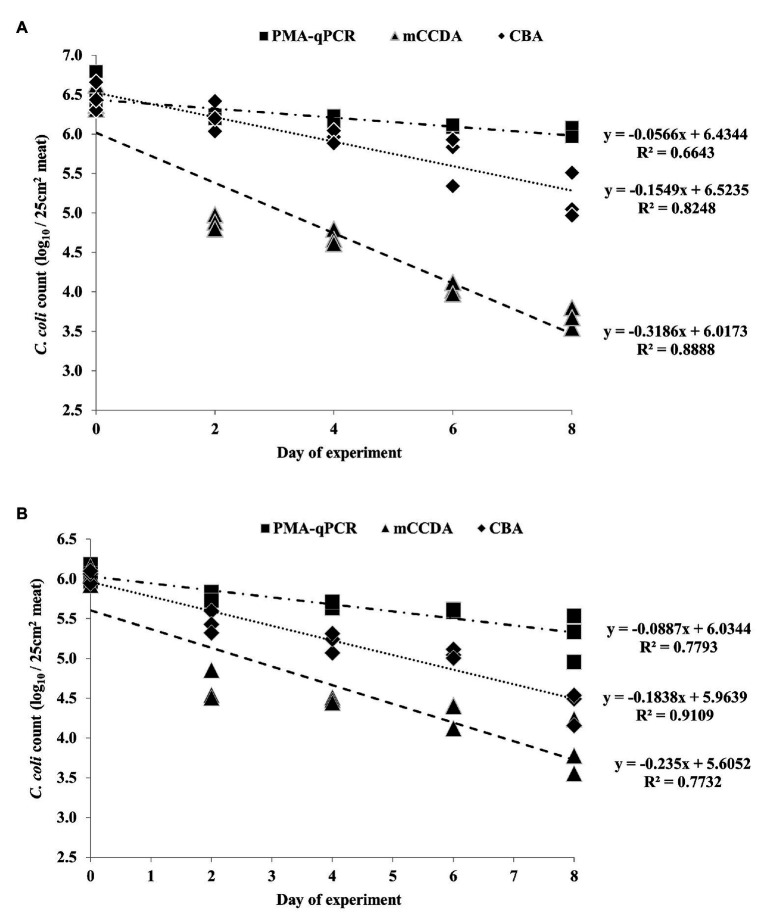
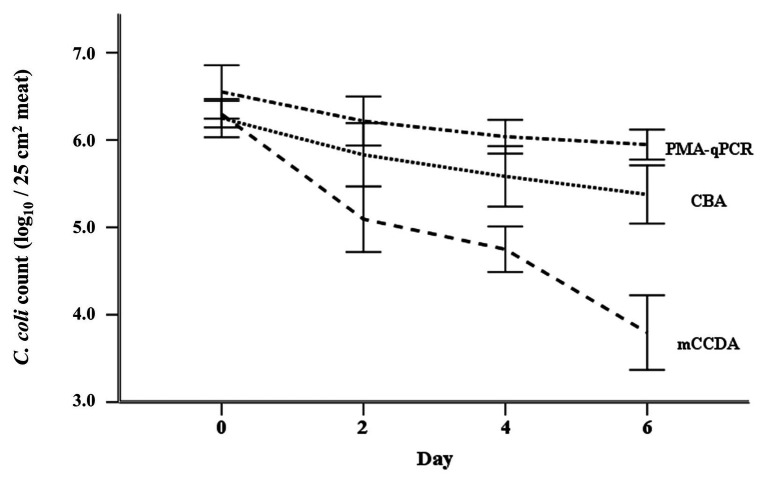
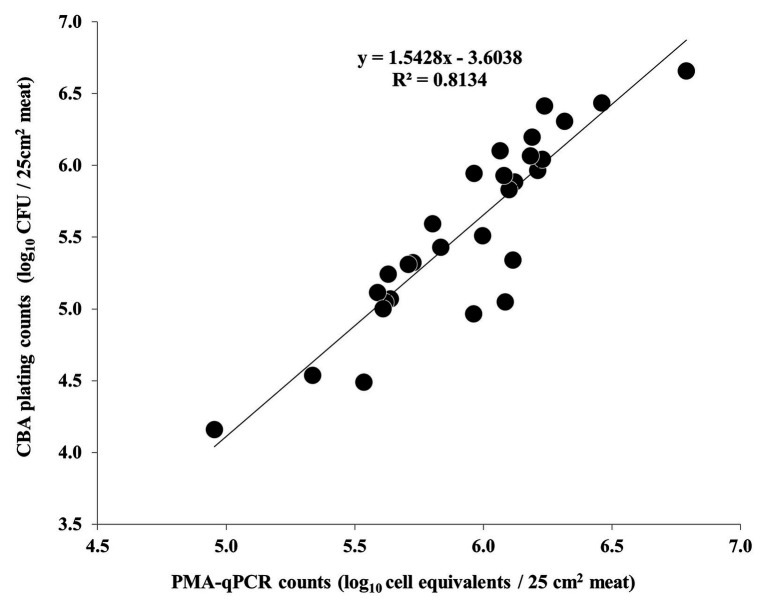
The aim of the present study was to address method-dependent implications during the quantification of viable cells on meat over time. Traditional colony counting on selective and non-selective culture media along with an optimized viability real-time PCR utilizing propidium monoazide-quantitative PCR (PMA-qPCR), spheroplast formation and an internal sample process control (ISPC), were comparatively evaluated for monitoring the survival of on fresh lamb meat during refrigeration storage under normal atmospheric conditions. On day zero of three independent experiments, lamb meat pieces were artificially inoculated with and then stored under refrigeration for up to 8 days. Three meat samples were tested on different days and the mean counts were determined per quantification method. An overall reduction of the viable on lamb meat was observed regardless of the applied quantification scheme, but the rate of reduction followed a method-dependent pattern, the highest being observed for colony counting on modified charcoal cefoperazone deoxycholate agar (mCCDA). Univariate ANOVA indicated that the mean counts of viable using PMA-qPCR were significantly higher compared to Columbia blood agar (CBA) plating (0.32 log cell equivalents, = 0.015) and significantly lower when mCCDA was compared to CBA plating (0.88 log CFU, < 0.001), indicating that selective culture on mCCDA largely underestimated the number of culturable cells during the course of meat storage. PMA-qPCR outperformed the classical colony counting in terms of quantifying both the culturable and viable but non-culturable (VBNC) cells, which were generated over time on meat and are potentially infectious and equally important from a public health perspective as their culturable counterparts.
本研究的目的是解决随着时间推移对肉类中活细胞进行定量时方法相关的影响。对在选择性和非选择性培养基上进行传统菌落计数,以及利用单叠氮碘化丙啶定量PCR(PMA-qPCR)、原生质球形成和内部样品过程控制(ISPC)的优化活力实时PCR进行了比较评估,以监测在正常大气条件下冷藏储存期间新鲜羊肉上的存活情况。在三个独立实验的第零天,将羊肉块人工接种,然后在冷藏条件下储存长达8天。在不同日期对三个肉类样品进行检测,并根据每种定量方法确定平均计数。无论采用何种定量方案,羊肉上的活菌总体上都有所减少,但减少速率遵循方法依赖模式,在改良的木炭头孢哌酮脱氧胆酸盐琼脂(mCCDA)上进行菌落计数时观察到的减少速率最高。单因素方差分析表明,与哥伦比亚血琼脂(CBA)平板培养相比,使用PMA-qPCR的活菌平均计数显著更高(0.32 log细胞当量, = 0.015),而与CBA平板培养相比,mCCDA的活菌平均计数显著更低(0.88 log CFU, < 0.001),这表明在肉类储存过程中,mCCDA上的选择性培养在很大程度上低估了可培养细胞的数量。在对可培养和活的但不可培养(VBNC)细胞进行定量方面,PMA-qPCR优于传统菌落计数,这些细胞随着时间在肉类上产生,具有潜在传染性,从公共卫生角度来看与它们的可培养对应物同样重要。