Karlsson Ida, Persson Paula, Friberg Hanna
Department of Crop Production Ecology, Swedish University of Agricultural Sciences, Uppsala, Sweden.
Department of Forest Mycology and Plant Pathology, Swedish University of Agricultural Sciences, Uppsala, Sweden.
Front Microbiol. 2021 Mar 1;12:628373. doi: 10.3389/fmicb.2021.628373. eCollection 2021.
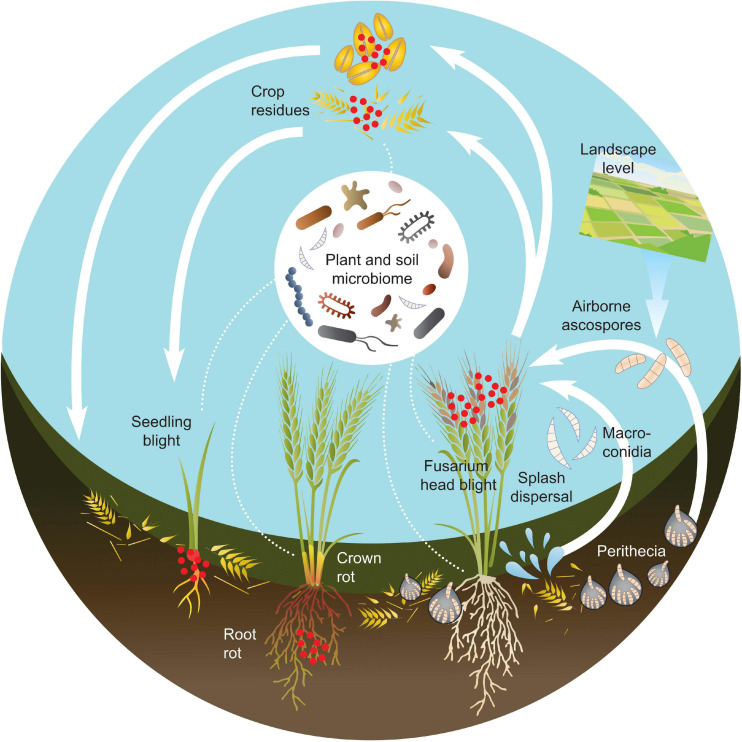
The fungal genus causes several diseases in cereals, including Fusarium head blight (FHB). A number of species are involved in disease development and mycotoxin contamination. Lately, the importance of interactions between plant pathogens and the plant microbiome has been increasingly recognized. In this review, we address the significance of the cereal microbiome for the development of -related diseases. fungi may interact with the host microbiome at multiple stages during their life cycles and in different plant organs including roots, stems, leaves, heads, and crop residues. There are interactions between and other fungi and bacteria as well as among species. Recent studies have provided a map of the cereal microbiome and revealed how different biotic and abiotic factors drive microbiome assembly. This review synthesizes the current understanding of the cereal microbiome and the implications for infection, FHB development, disease control, and mycotoxin contamination. Although annual and regional variations in predominant species are significant, much research has focused on . Surveying the total community in environmental samples is now facilitated with novel metabarcoding methods. Further, infection with multiple species has been shown to affect disease severity and mycotoxin contamination. A better mechanistic understanding of such multiple infections is necessary to be able to predict the outcome in terms of disease development and mycotoxin production. The knowledge on the composition of the cereal microbiome under different environmental and agricultural conditions is growing. Future studies are needed to clearly link microbiome structure to suppression in order to develop novel disease management strategies for example based on conservation biological control approaches.
该真菌属会引发谷物的多种病害,包括镰刀菌穗腐病(FHB)。多个物种参与病害发展和霉菌毒素污染过程。近来,植物病原体与植物微生物组之间相互作用的重要性日益得到认可。在本综述中,我们探讨了谷物微生物组对于与[该真菌属相关病害]发展的重要性。[该真菌属]真菌在其生命周期的多个阶段以及在包括根、茎、叶、穗和作物残体在内的不同植物器官中可能与宿主微生物组相互作用。[该真菌属]与其他真菌和细菌之间以及[该真菌属]物种之间存在相互作用。近期研究绘制了谷物微生物组图谱,并揭示了不同生物和非生物因素如何驱动微生物组的组装。本综述综合了当前对谷物微生物组的理解以及对[该真菌属]感染、FHB发展、病害控制和霉菌毒素污染的影响。尽管优势物种的年度和区域差异显著,但许多研究都集中在[该真菌属]上。现在,利用新型宏条形码方法便于对环境样本中的整个[该真菌属]群落进行检测。此外,已表明感染多种[该真菌属]物种会影响病害严重程度和霉菌毒素污染。为了能够预测病害发展和霉菌毒素产生方面的结果,有必要对这种多重感染有更好的机制理解。关于不同环境和农业条件下谷物微生物组组成的知识正在不断增加。未来需要开展研究,将微生物组结构与[该真菌属]抑制明确联系起来,以便制定新的病害管理策略,例如基于保护生物防治方法的策略。