National Demonstration Center for Experimental Aquaculture Education, Huazhong Agricultural University, Wuhan, China.
Key Laboratory of Freshwater Animal Breeding, Ministry of Agriculture and Rural Affairs, College of Fisheries, Huazhong Agricultural University, Wuhan, China.
Front Immunol. 2021 Feb 26;12:625928. doi: 10.3389/fimmu.2021.625928. eCollection 2021.
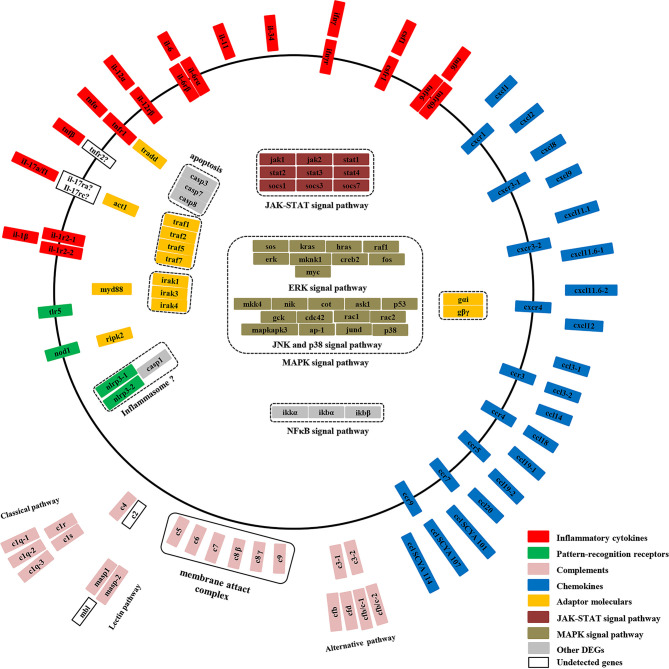
is a highly destructive pathogen in cultured yellow catfish, thus it was very necessary to study the immune response of yellow catfish against bacterial infection. In this study, RNA-Seq technology was used to study the immune response in two distinct tissues of yellow catfish at eight different time points (h) after infection. The number of differentially expressed genes (DEGs) in the spleen and liver was low at 3 h and 6 h post-infection, respectively. Afterwards, the most number of DEGs in the spleen was detected at 72 h, while the number of DEGs in the liver maintained a high level from 24 h to 120 h. The GO and KEGG enrichment analyses of DEGs at different time points uncovered that cytokines were continuously transcribed at 6 h to 120 h; whereas the liver is the main organ that secretes the components of the complement system, and metabolic regulation was activated from 12 h to 120 h. Moreover, an overview of the inflammation response of yellow catfish was exhibited including pattern-recognition receptors, inflammatory cytokines, chemokines, complements, and inflammation-related signal pathways. The similar expression tendency of nine genes by qRT-PCR validated the accuracy of transcriptome analyses. The different transcriptomic profiles obtained from the spleen and liver will help to better understand the dynamic immune response of fish against bacterial infection, and will provide basic information for establishing effective measures to prevent and control diseases in fish.
是一种在养殖黄颡鱼中具有高度破坏性的病原体,因此研究黄颡鱼对细菌感染的免疫反应非常必要。在这项研究中,使用 RNA-Seq 技术研究了感染后 8 个不同时间点(h)黄颡鱼两个不同组织中的免疫反应。脾脏和肝脏中的差异表达基因(DEGs)数量在感染后 3 h 和 6 h 时分别较低。之后,在 72 h 时检测到脾脏中 DEGs 的数量最多,而肝脏中 DEGs 的数量从 24 h 到 120 h 保持高水平。在不同时间点的 DEGs 的 GO 和 KEGG 富集分析表明,细胞因子在 6 h 至 120 h 之间持续转录;而肝脏是分泌补体系统成分的主要器官,代谢调节从 12 h 到 120 h 被激活。此外,还展示了黄颡鱼炎症反应的概述,包括模式识别受体、炎症细胞因子、趋化因子、补体和炎症相关信号通路。qRT-PCR 验证了九个基因的相似表达趋势,表明转录组分析的准确性。从脾脏和肝脏获得的不同转录组图谱将有助于更好地理解鱼类对细菌感染的动态免疫反应,并为制定预防和控制鱼类疾病的有效措施提供基础信息。