Moradi Arman, Maleki Majid, Ghaemmaghami Zahra, Khajali Zahra, Noohi Feridoun, Moghadam Maryam Hosseini, Kalyinia Samira, Mowla Seyed Javad, Seidah Nabil G, Malakootian Mahshid
Department of Molecular Genetics, Faculty of Biological Sciences, Tarbiat Modares University, Tehran, Iran.
Cardiogenetic Research Center, Rajaie Cardiovascular Medical and Research Center, Iran University of Medical Sciences, Tehran, Iran.
Front Genet. 2021 Feb 11;12:625959. doi: 10.3389/fgene.2021.625959. eCollection 2021.
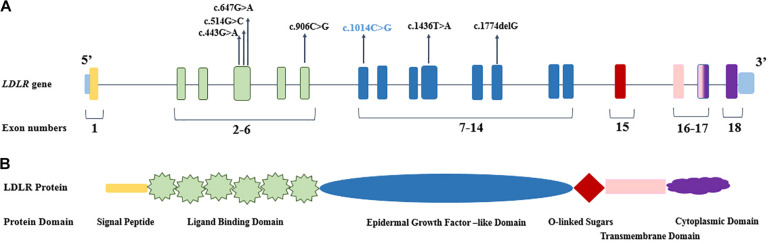
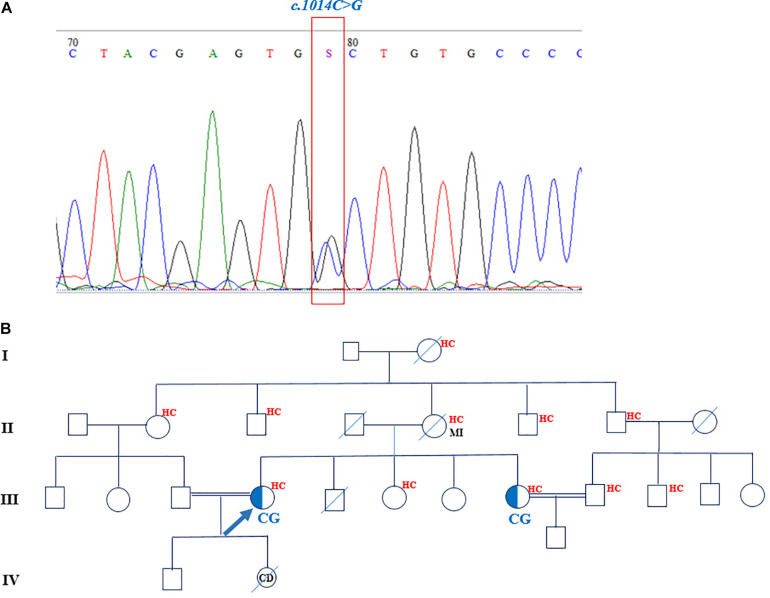
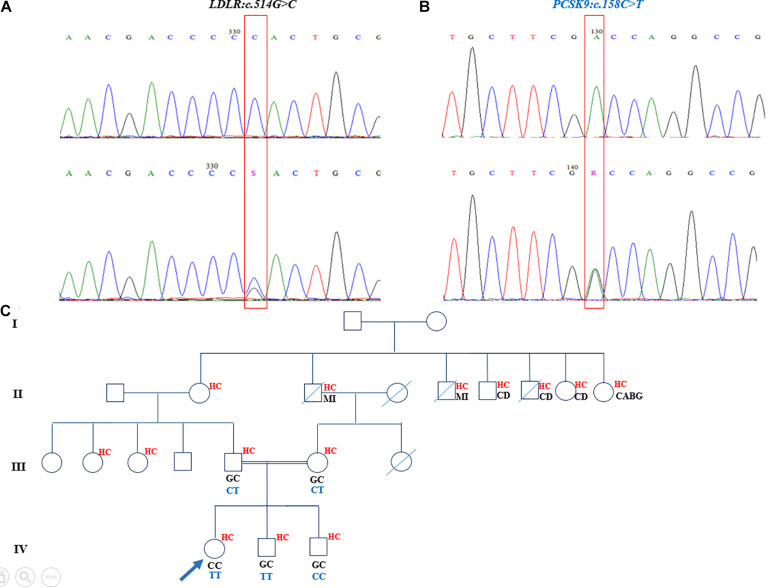
Familial hypercholesterolemia (FH) is a common, yet underdiagnosed, genetic disorder characterized by lifelong elevated low-density lipoprotein cholesterol levels, which can increase the risk of early-onset coronary artery disease (CAD). In the present study, we screened the nucleotide variations of the genes, as well as a part of the gene, in Iranian patients with FH and premature CAD to find the genetic cause of the disorder. Fifteen unrelated individuals with a clinical diagnosis of FH and premature CAD were recruited. Direct DNA sequencing was applied to screen the whole coding exons and exon-intron boundaries of the and genes and the main parts of their introns, together with exon 26 of the gene. The pathogenicity of the identified mutations was investigated via either segregation analyses in the family or predictive software. Six different point mutations (p.Cys148Tyr, p.Cys216Tyr, p.Cys302Trp, p.Cys338Trp, p.Leu479Gln, and p.G593Afs72) in and a double mutation (p.Asp172His and p.Ala53Val) in both and genes were identified in seven families with clinically diagnosed FH (43%), whereas no pathogenic mutations were found in eight families with clinically diagnosed FH. This study is the first to identify 1 pathogenic mutation in the gene (c.1014C > G [p.Cys338Trp]) and to cosegregate it from the affected individual in the family. No mutations were found in the gene, whereas several silent mutations/polymorphisms were identified in the and genes. Genetic testing and reports on nucleotide alterations in the Iranian population are still limited. Our findings not only further confirm the significant role of FH in the incidence of premature CAD but also enlarge the spectrum of and variations and exhibit the heterogeneity of FH in Iranians. In patients with no mutation in the examined genes, the disease could be begotten either by a polygenic cause or by gene defects occurring in other related genes and regions not targeted in this study.
家族性高胆固醇血症(FH)是一种常见但诊断不足的遗传性疾病,其特征是低密度脂蛋白胆固醇水平终生升高,这会增加早发性冠状动脉疾病(CAD)的风险。在本研究中,我们对伊朗FH和早发性CAD患者的相关基因以及部分另一基因的核苷酸变异进行了筛查,以找出该疾病的遗传原因。招募了15名临床诊断为FH和早发性CAD的无亲缘关系个体。采用直接DNA测序法对相关基因的全部编码外显子、外显子 - 内含子边界及其内含子的主要部分,以及另一基因的第26外显子进行筛查。通过家系中的分离分析或预测软件研究已鉴定突变的致病性。在7个临床诊断为FH的家系(43%)中,在相关基因中鉴定出6种不同的点突变(p.Cys148Tyr、p.Cys216Tyr、p.Cys302Trp、p.Cys338Trp、p.Leu479Gln和p.G593Afs72),在相关基因和另一基因中鉴定出一个双突变(p.Asp172His和p.Ala53Val),而在8个临床诊断为FH的家系中未发现致病突变。本研究首次在相关基因中鉴定出1个致病突变(c.1014C > G [p.Cys338Trp]),并在家族中与患病个体共分离。在另一基因中未发现突变,而在相关基因和另一基因中鉴定出了一些沉默突变/多态性。伊朗人群中关于核苷酸改变的基因检测和报告仍然有限。我们的研究结果不仅进一步证实了FH在早发性CAD发病中的重要作用,还扩大了相关基因和另一基因变异的谱图,并展示了伊朗人FH的异质性。在所检测基因无突变的患者中,疾病可能由多基因原因或本研究未靶向的其他相关基因和区域发生的基因缺陷引起。