Wang Gaoming, Li Xiaokun, Yao Yu, Jiang Zhisheng, Zhou Hai, Xie Kai, Luo Jing, Shen Yi
Department of Cardiothoracic Surgery, Jinling Hospital, School of Medicine, Nanjing Medical University, Nanjing, Jiangsu 210000, P.R. China.
Department of Thoracic Surgery, Xuzhou Central Hospital, Xuzhou, Jiangsu 221000, P.R. China.
Oncol Lett. 2021 Apr;21(4):297. doi: 10.3892/ol.2021.12558. Epub 2021 Feb 17.
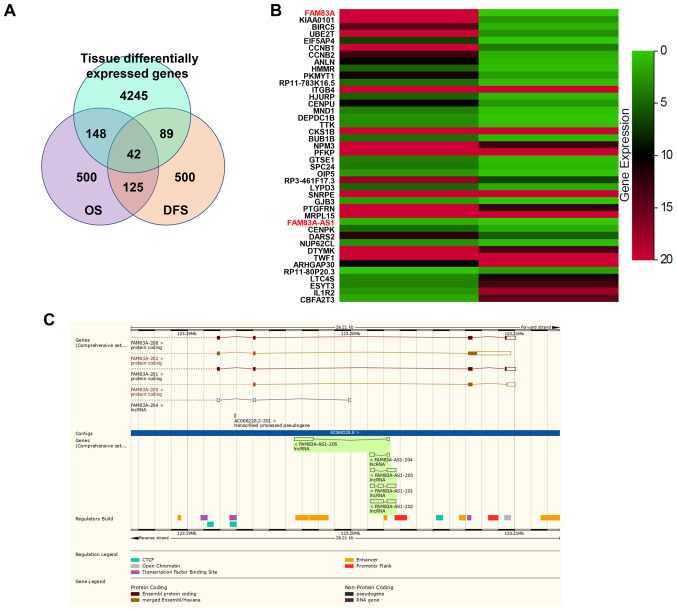
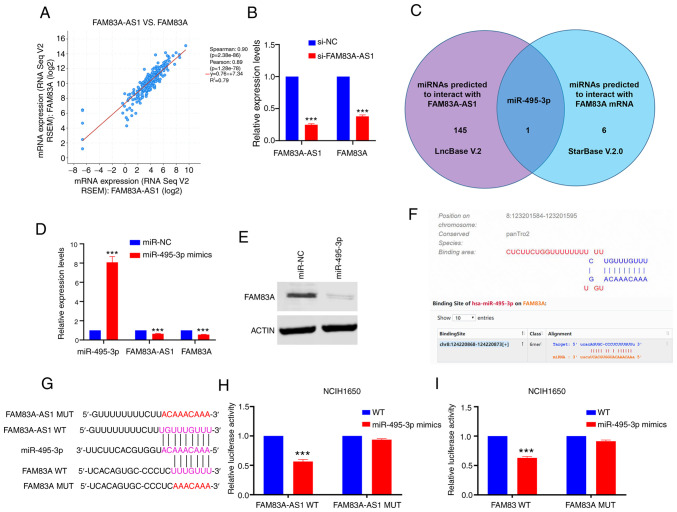
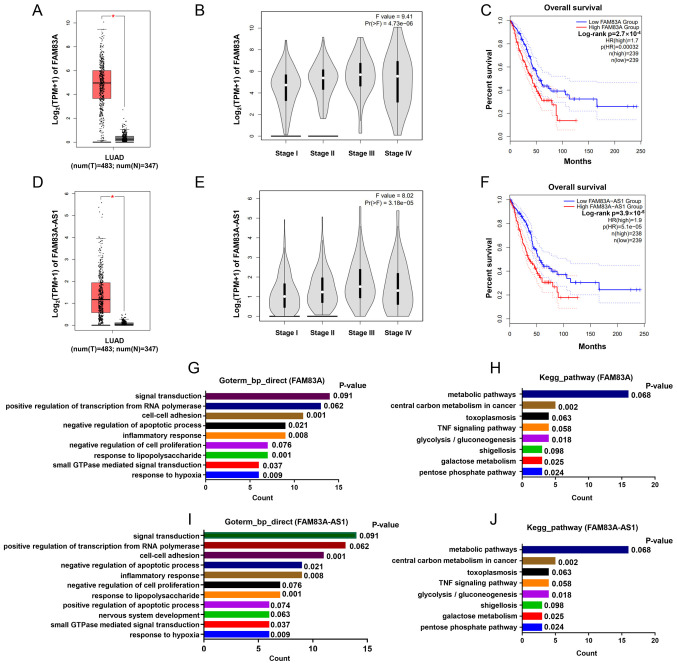
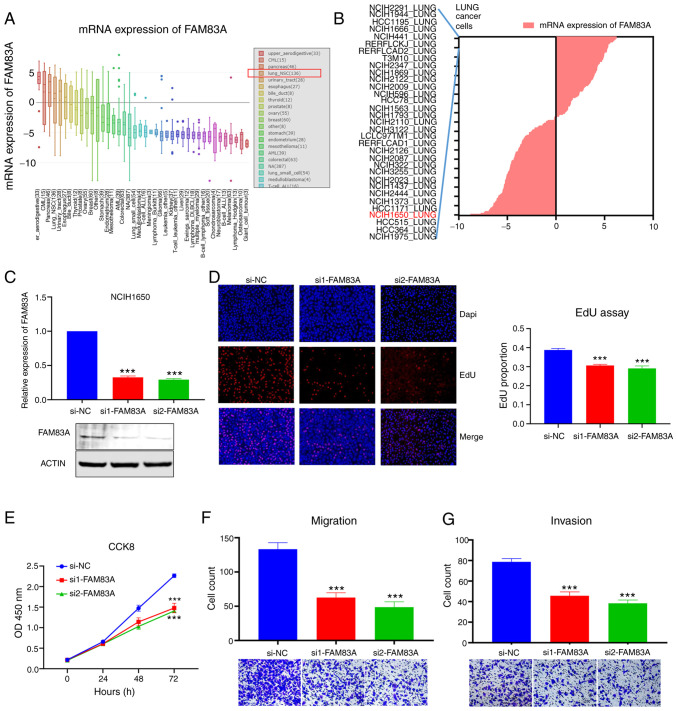
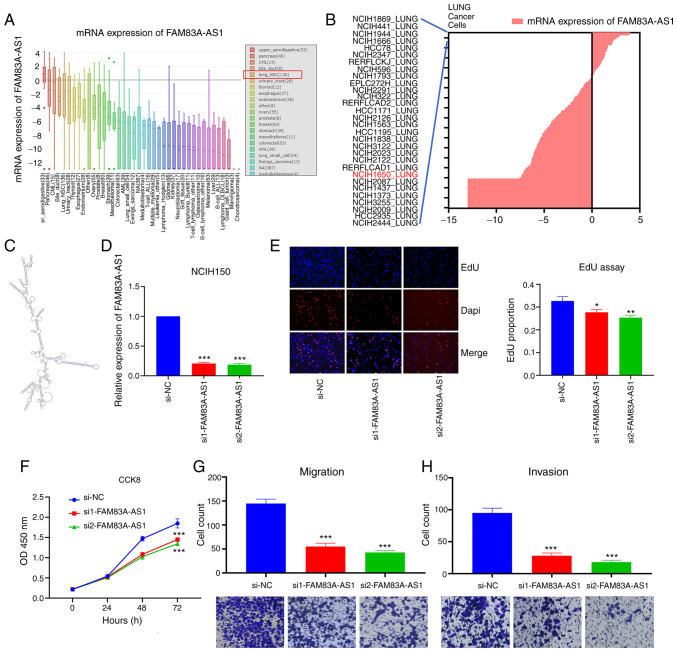
Lung adenocarcinoma (LUAD) is the most common subtype of lung cancer. Nevertheless, the detailed molecular mechanisms of the progression of LUAD remain largely unknown. The present bioinformatics analysis reported that FAM83A and FAM83A-AS1 were upregulated in LUAD tissues and associated with prognosis in patients with LUAD. The purpose of the current study was to investigate the role of FAM83A and its antisense long non-coding (lnc)RNA FAM83A-AS1 in LUAD. Gene Expression Profiling Interactive Analysis was used to screen for potential oncogenes in LUAD and to analyze the clinical significance of FAM83A and FAM83A-AS1. Small interfering RNAs were constructed and transfected into LUAD cells to knock down the expression of FAM83A and FAM83A-AS1. EdU, Cell Counting Kit-8, Transwell and Matrigel assays were performed to detect the proliferation, migration and invasion of LUAD cells. The interaction between FAM83A-AS1, microRNA (miR)-495-3p and FAM83A was explored using a luciferase reporter assay. FAM83A and FAM83A-AS1 were both overexpressed in LUAD tissues compared with adjacent normal tissues. High expression of FAM83A and FAM83A-AS1 predicted worse survival and more advanced clinical stage. Knockdown of FAM83A or FAM83A-AS1 could inhibit the proliferation, migration and invasion of LUAD cells. Moreover, lncRNA FAM83A-AS1 regulated the expression of FAM83A by functioning as competing endogenous RNA for miR-495-3p. These results implicated that FAM83A and FAM83A-AS1 both played oncogenic roles in LUAD and FAM83A-AS1 could regulate the expression of FAM83A by sponging miR-495-3p. The study revealed a novel regulatory mechanism of tumor development in LUAD and FAM83A and FAM83A-AS1 may be novel biomarkers and therapeutic targets for LUAD.
肺腺癌(LUAD)是肺癌最常见的亚型。然而,LUAD进展的详细分子机制在很大程度上仍不清楚。目前的生物信息学分析报告称,FAM83A和FAM83A-AS1在LUAD组织中上调,并与LUAD患者的预后相关。本研究的目的是探讨FAM83A及其反义长链非编码(lnc)RNA FAM83A-AS1在LUAD中的作用。利用基因表达谱交互式分析筛选LUAD中的潜在癌基因,并分析FAM83A和FAM83A-AS1的临床意义。构建小干扰RNA并转染到LUAD细胞中,以敲低FAM83A和FAM83A-AS1的表达。进行EdU、细胞计数试剂盒-8、Transwell和基质胶实验,以检测LUAD细胞的增殖、迁移和侵袭能力。利用荧光素酶报告基因实验探究FAM83A-AS1、微小RNA(miR)-495-3p和FAM83A之间的相互作用。与相邻正常组织相比,FAM83A和FAM83A-AS1在LUAD组织中均过表达。FAM83A和FAM83A-AS1的高表达预示着较差的生存率和更晚期的临床分期。敲低FAM83A或FAM83A-AS1可抑制LUAD细胞的增殖、迁移和侵袭。此外,lncRNA FAM83A-AS1通过作为miR-495-3p的竞争性内源RNA发挥作用,从而调节FAM83A的表达。这些结果表明,FAM83A和FAM83A-AS1在LUAD中均发挥致癌作用,且FAM83A-AS1可通过海绵吸附miR-495-3p来调节FAM83A的表达。该研究揭示了LUAD肿瘤发生发展的一种新的调控机制,FAM83A和FAM83A-AS1可能是LUAD新的生物标志物和治疗靶点。