
基于年龄、性别和就业状况的韩国和欧洲员工自我报告的肌肉骨骼疼痛的不平等负担
The Unequal Burden of Self-Reported Musculoskeletal Pains Among South Korean and European Employees Based on Age, Gender, and Employment Status.
作者信息
Bahk Jinwook, Khang Young-Ho, Lim Sinye
机构信息
Department of Public Health, Keimyung University, Daegu, Republic of Korea.
Department of Health Policy and Management, Seoul National University College of Medicine, Seoul, Republic of Korea.
出版信息
Saf Health Work. 2021 Mar;12(1):57-65. doi: 10.1016/j.shaw.2020.10.007. Epub 2020 Oct 24.
BACKGROUND
The objective of this study was to elucidate the relationships musculoskeletal pains with combined vulnerability in terms of age, gender, and employment status.
METHODS
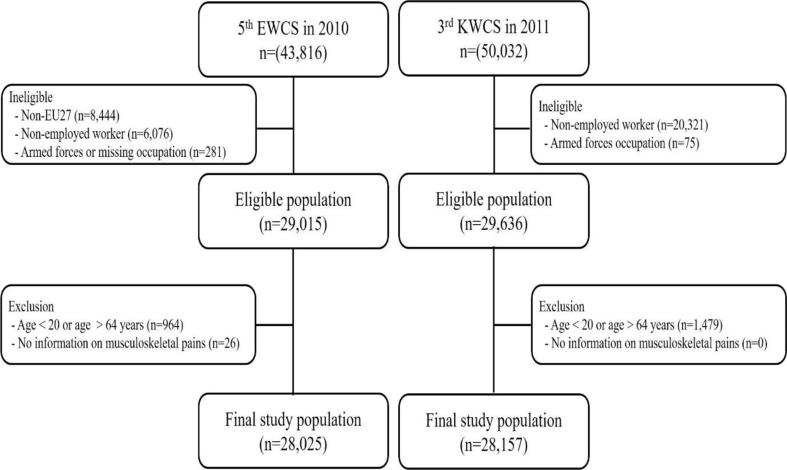
The fifth European Working Conditions Survey (EWCS) in 2010 (43,816 participants aged 15 years and over) analyzed for European employees and the third Korean Working Conditions Survey (KWCS) in 2011 (50,032 participants aged 15 years and older) analyzed for Korean employees. In this study, three well known vulnerable factors to musculoskeletal pains (older age, female gender, and precarious employment status) were combined and defined as combined vulnerability. Associations of musculoskeletal pains with combined vulnerability were assessed with prevalence ratios (PRs) and 95% confidence intervals (CIs) estimated by Poisson regression models with robust estimates of variance.
RESULTS
The prevalences of musculoskeletal pains were lower but the absolute and relative differences between combined vulnerabilities were higher among Korean employees compared with the European employees. Furthermore, the increased risk of having musculoskeletal pains according to combined vulnerability was modestly explained by socioeconomic factors and exposure to ergonomic risk factors, especially in Republic of Korea.
CONCLUSIONS
The results of this study showed that the labor market may be more unfavorable for female and elderly workers in Republic of Korea. Any prevention strategies to ward off musculoskeletal pains, therefore, should be found and implemented to mitigate or buffer against the most vulnerable work population, older, female, and precarious employment status, in Republic of Korea.
背景
本研究的目的是阐明肌肉骨骼疼痛与年龄、性别和就业状况综合脆弱性之间的关系。
方法
对2010年第五次欧洲工作条件调查(EWCS,43816名15岁及以上参与者)中的欧洲员工进行分析,以及对2011年第三次韩国工作条件调查(KWCS,50032名15岁及以上参与者)中的韩国员工进行分析。在本研究中,将三个众所周知的肌肉骨骼疼痛脆弱因素(年龄较大、女性、不稳定就业状况)合并并定义为综合脆弱性。采用泊松回归模型并对方差进行稳健估计,通过患病率比(PRs)和95%置信区间(CIs)评估肌肉骨骼疼痛与综合脆弱性之间的关联。
结果
与欧洲员工相比,韩国员工中肌肉骨骼疼痛的患病率较低,但综合脆弱性之间的绝对和相对差异较高。此外,综合脆弱性导致的肌肉骨骼疼痛风险增加在一定程度上可由社会经济因素和接触工效学风险因素来解释,尤其是在韩国。
结论
本研究结果表明,韩国的劳动力市场对女性和老年工人可能更为不利。因此,应找到并实施任何预防肌肉骨骼疼痛的策略,以减轻或缓冲韩国最脆弱的工作人群(年龄较大、女性、不稳定就业状况)所面临的风险。

 Zotero 插件