Heins R Conor, Mirza M Berk, Parr Thomas, Friston Karl, Kagan Igor, Pooresmaeili Arezoo
Department of Collective Behaviour, Max Planck Institute for Animal Behavior, Konstanz, Germany.
Perception and Cognition Group, European Neuroscience Institute, A Joint Initiative of the University Medical Centre Göttingen and the Max-Planck-Society, Göttingen, Germany.
Front Artif Intell. 2020 Oct 28;3:509354. doi: 10.3389/frai.2020.509354. eCollection 2020.
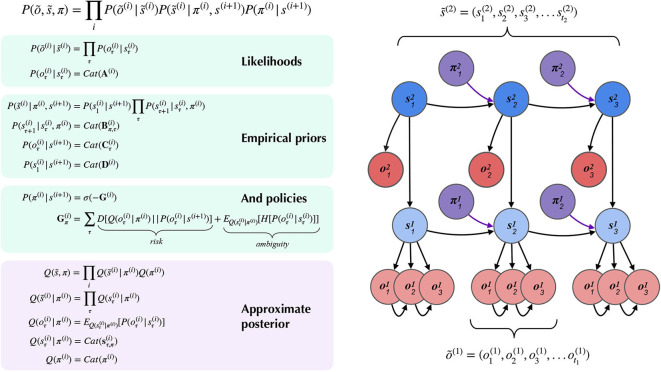
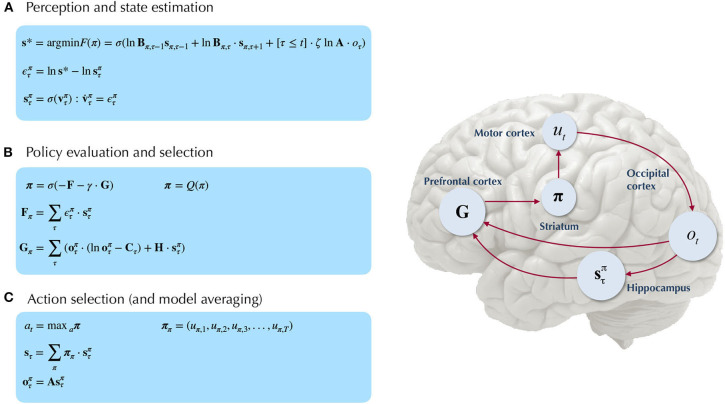
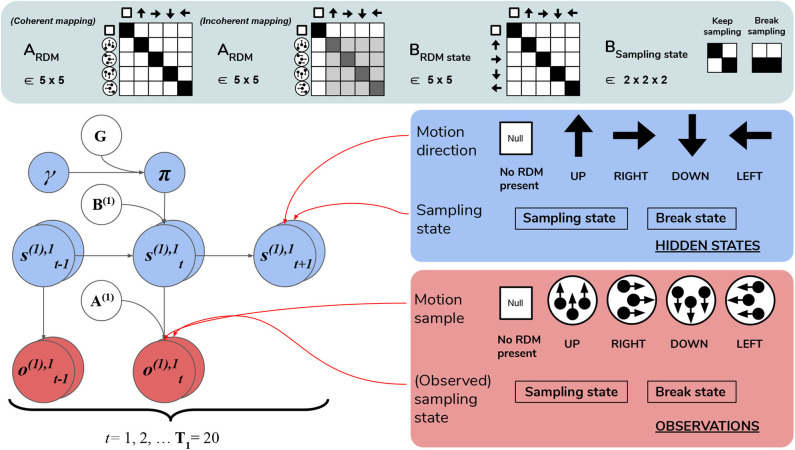
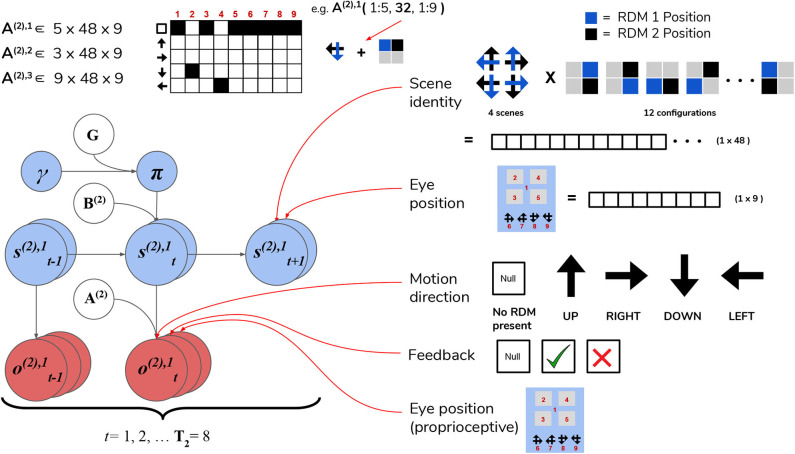
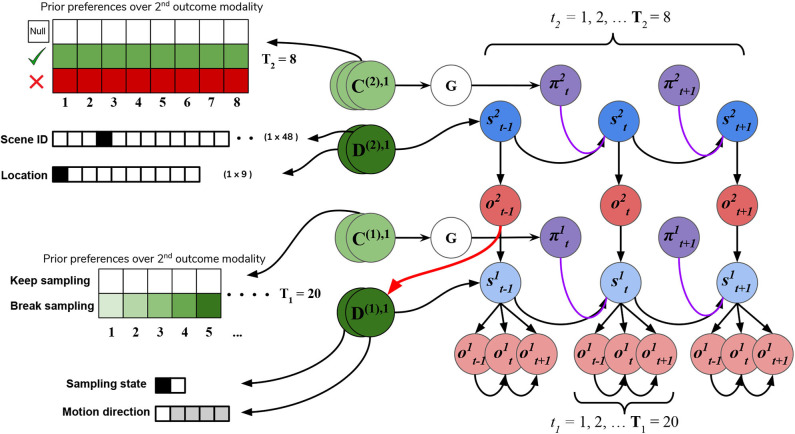
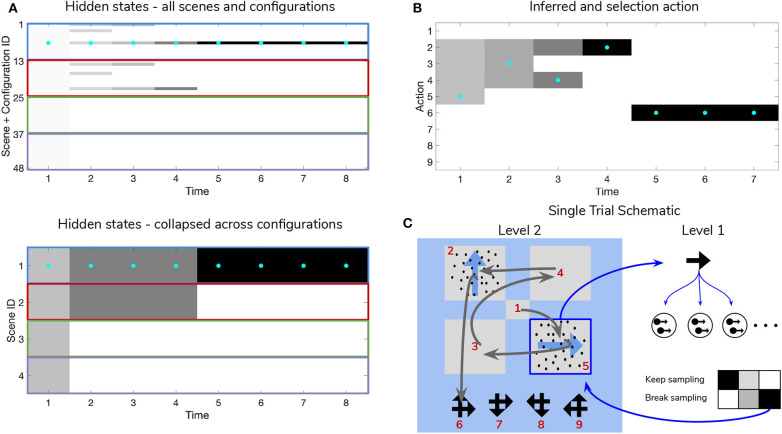
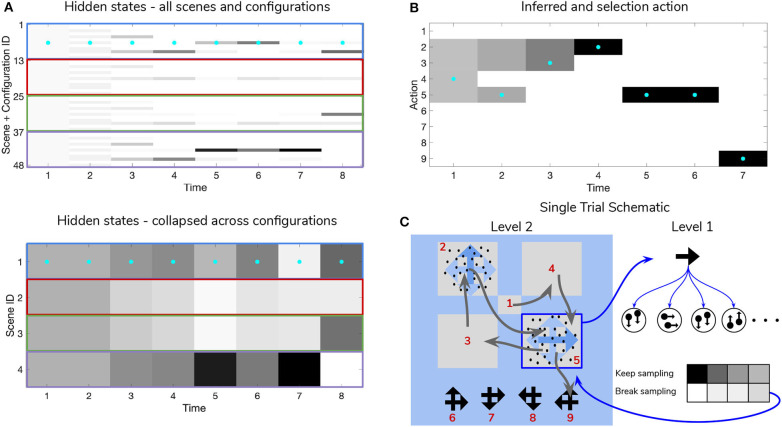
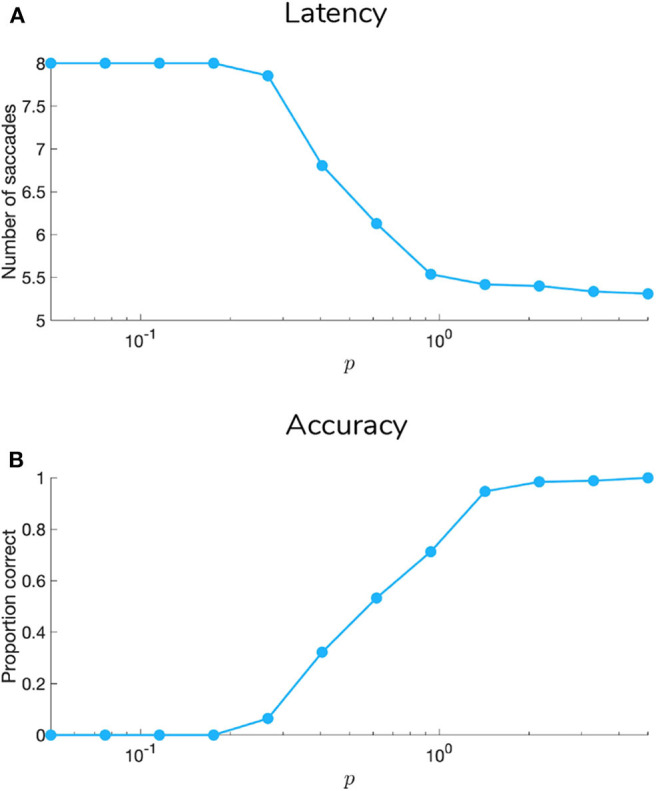
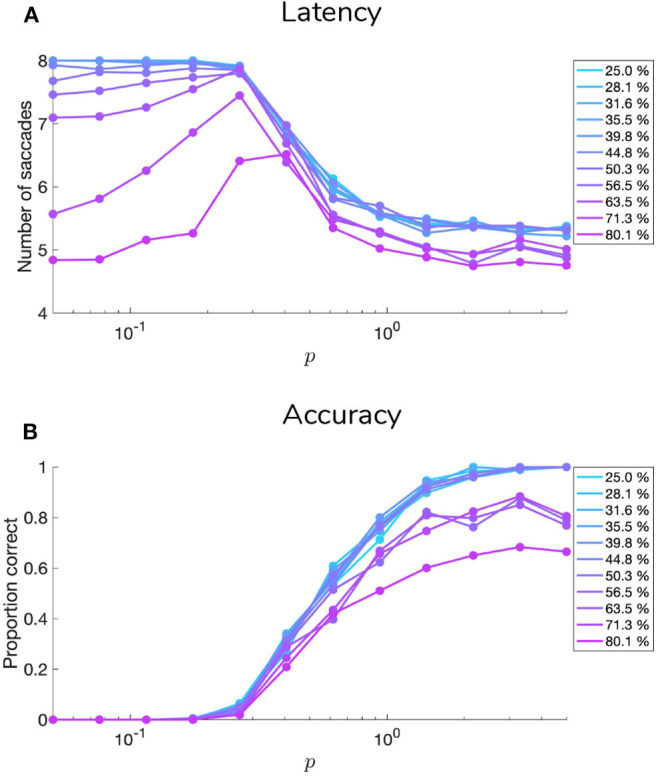
Adaptive agents must act in intrinsically uncertain environments with complex latent structure. Here, we elaborate a model of visual foraging-in a hierarchical context-wherein agents infer a higher-order visual pattern (a "scene") by sequentially sampling ambiguous cues. Inspired by previous models of scene construction-that cast perception and action as consequences of approximate Bayesian inference-we use active inference to simulate decisions of agents categorizing a scene in a hierarchically-structured setting. Under active inference, agents develop probabilistic beliefs about their environment, while actively sampling it to maximize the evidence for their internal generative model. This approximate evidence maximization (i.e., self-evidencing) comprises drives to both maximize rewards and resolve uncertainty about hidden states. This is realized via minimization of a free energy functional of posterior beliefs about both the world as well as the actions used to sample or perturb it, corresponding to perception and action, respectively. We show that active inference, in the context of hierarchical scene construction, gives rise to many empirical evidence accumulation phenomena, such as noise-sensitive reaction times and epistemic saccades. We explain these behaviors in terms of the principled drives that constitute the , the key quantity for evaluating policies under active inference. In addition, we report novel behaviors exhibited by these active inference agents that furnish new predictions for research on evidence accumulation and perceptual decision-making. We discuss the implications of this hierarchical active inference scheme for tasks that require planned sequences of information-gathering actions to infer compositional latent structure (such as visual scene construction and sentence comprehension). This work sets the stage for future experiments to investigate active inference in relation to other formulations of evidence accumulation (e.g., drift-diffusion models) in tasks that require planning in uncertain environments with higher-order structure.
适应性智能体必须在具有复杂潜在结构的内在不确定环境中行动。在此,我们阐述一种视觉觅食模型——在分层情境下——智能体通过顺序采样模糊线索来推断高阶视觉模式(一个“场景”)。受先前场景构建模型的启发——这些模型将感知和行动视为近似贝叶斯推理的结果——我们使用主动推理来模拟智能体在分层结构环境中对场景进行分类的决策。在主动推理下,智能体对其环境形成概率性信念,同时积极对其进行采样,以最大化其内部生成模型的证据。这种近似证据最大化(即自我证明)包括最大化奖励和解决关于隐藏状态的不确定性的驱动力。这是通过最小化关于世界以及用于采样或扰动它的行动的后验信念的自由能泛函来实现的,分别对应于感知和行动。我们表明,在分层场景构建的背景下,主动推理会产生许多经验性证据积累现象,如对噪声敏感的反应时间和认知扫视。我们根据构成主动推理的原则性驱动力来解释这些行为,主动推理是在主动推理下评估策略的关键量。此外,我们报告了这些主动推理智能体表现出的新行为,这些行为为证据积累和感知决策研究提供了新的预测。我们讨论了这种分层主动推理方案对于需要计划信息收集行动序列以推断组合潜在结构的任务(如视觉场景构建和句子理解)的意义。这项工作为未来的实验奠定了基础,这些实验将在需要在具有高阶结构的不确定环境中进行规划的任务中,研究主动推理与其他证据积累公式(如漂移扩散模型)的关系。