Friston Karl, Adams Rick A, Perrinet Laurent, Breakspear Michael
The Wellcome Trust Centre for Neuroimaging, University College London London, UK.
Front Psychol. 2012 May 28;3:151. doi: 10.3389/fpsyg.2012.00151. eCollection 2012.
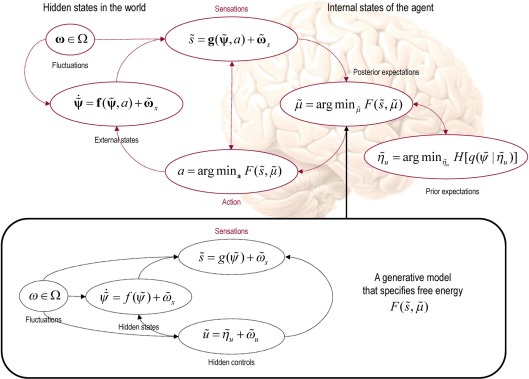
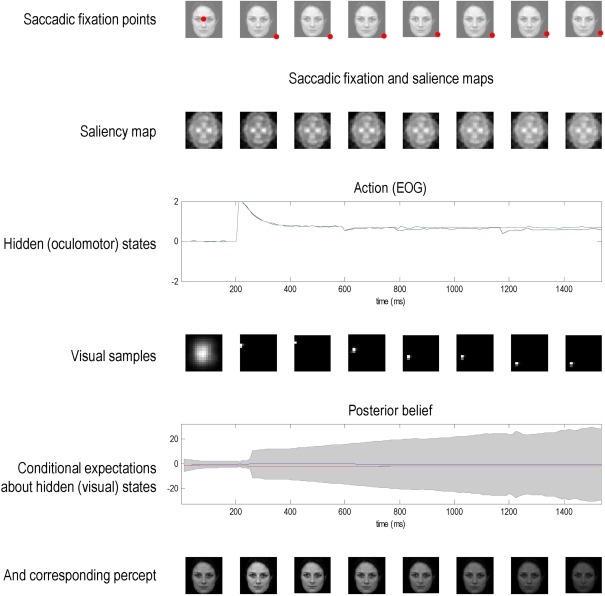
If perception corresponds to hypothesis testing (Gregory, 1980); then visual searches might be construed as experiments that generate sensory data. In this work, we explore the idea that saccadic eye movements are optimal experiments, in which data are gathered to test hypotheses or beliefs about how those data are caused. This provides a plausible model of visual search that can be motivated from the basic principles of self-organized behavior: namely, the imperative to minimize the entropy of hidden states of the world and their sensory consequences. This imperative is met if agents sample hidden states of the world efficiently. This efficient sampling of salient information can be derived in a fairly straightforward way, using approximate Bayesian inference and variational free-energy minimization. Simulations of the resulting active inference scheme reproduce sequential eye movements that are reminiscent of empirically observed saccades and provide some counterintuitive insights into the way that sensory evidence is accumulated or assimilated into beliefs about the world.
如果知觉与假设检验相对应(格雷戈里,1980年);那么视觉搜索可能被理解为产生感官数据的实验。在这项工作中,我们探讨了这样一种观点,即扫视眼动是最优实验,在这些实验中收集数据以检验关于这些数据如何产生的假设或信念。这提供了一个合理的视觉搜索模型,该模型可以从自组织行为的基本原理推导得出:即,将世界隐藏状态及其感官结果的熵降至最低的必要性。如果主体有效地对世界的隐藏状态进行采样,那么这一必要性就能得到满足。使用近似贝叶斯推理和变分自由能最小化,可以以一种相当直接的方式得出对显著信息的这种有效采样。由此产生的主动推理方案的模拟再现了类似于经验观察到的扫视的顺序眼动,并对感官证据如何积累或融入关于世界的信念的方式提供了一些违反直觉的见解。