Department of Clinical Sciences, Division of Surgery, Danderyd Hospital, Karolinska Institute, Stockholm, Sweden.
Department of Surgery, Örebro & Institute of Molecular Medicine and Surgery, Örebro University and University Hospital, Karolinska Institute, Stockholm, Sweden.
World J Surg. 2021 Jun;45(6):1630-1641. doi: 10.1007/s00268-021-06054-y. Epub 2021 Mar 17.
Research on risk factors for anastomotic leakage (AL) alone within an Enhanced Recovery After Surgery (ERAS) protocol has not yet been conducted. The aim of this study was to identify risk factors for AL and study short-term outcome after AL in patients operated with anterior resection (AR).
All prospectively and consecutively recorded patients operated with AR in the Swedish part of the international ERAS® Interactive Audit System (EIAS) between January 2010 and February 2020 were included. The cohort was evaluated regarding risk factors for AL and short-term outcomes, including uni- and multivariate analysis. Pre-, intra- and postoperative compliance to ERAS®Society guidelines was calculated and evaluated.
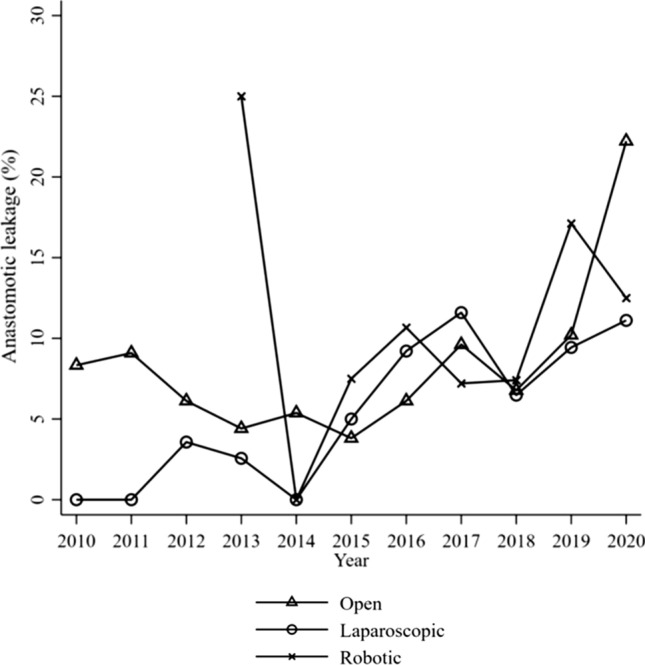
Altogether 1900 patients were included, 155 (8.2%) with AL and 1745 without AL. Male gender, obesity, peritoneal contamination, year of surgery 2016-2020, duration of primary surgery and age remained significant predictors for AL in multivariate analysis. There was no significant difference in overall pre- and intraoperative compliance to ERAS®Society guidelines between groups. Only preadmission patient education remained as a significant ERAS variable associated with less AL. AL was associated with longer length of stay (LOS), higher morbidity rate and higher rate of reoperations.
Male gender, obesity, peritoneal contamination, duration of surgery, surgery later in study period, age and preadmission patient education were associated with AL in patients operated on with AR. Overall pre- and intraoperative compliance to the ERAS protocol was high in both groups and not associated with AL.
在加速康复外科(ERAS)方案中,单独针对吻合口漏(AL)的危险因素的研究尚未进行。本研究旨在确定接受前切除术(AR)的患者发生 AL 的危险因素,并研究 AL 后的短期结果。
纳入 2010 年 1 月至 2020 年 2 月期间在瑞典部分国际 ERAS® Interactive Audit System(EIAS)中接受 AR 的所有前瞻性连续记录患者。对 AL 患者的危险因素和短期结局进行评估,包括单因素和多因素分析。计算并评估了术前、术中及术后对 ERAS® Society 指南的依从性。
共纳入 1900 例患者,其中 155 例(8.2%)发生 AL,1745 例未发生 AL。多因素分析显示,男性、肥胖、腹膜污染、手术年份 2016-2020、手术时间和年龄仍然是 AL 的显著预测因素。两组患者的术前和术中对 ERAS® Society 指南的总体依从性没有显著差异。只有入院前患者教育仍然是与 AL 发生率降低相关的重要 ERAS 变量。AL 与住院时间延长(LOS)、更高的发病率和更高的再手术率相关。
在接受 AR 的患者中,男性、肥胖、腹膜污染、手术时间、研究后期手术、年龄和入院前患者教育与 AL 相关。两组患者的术前和术中对 ERAS 方案的总体依从性均较高,与 AL 无关。