Department of Health Policy, Vanderbilt University School of Medicine Vanderbilt University Medical Center, Nashville, TN, USA.
Department of Biostatistics, Vanderbilt University Medical Center, Nashville, TN, USA.
Med Decis Making. 2021 May;41(4):453-464. doi: 10.1177/0272989X21995805. Epub 2021 Mar 18.
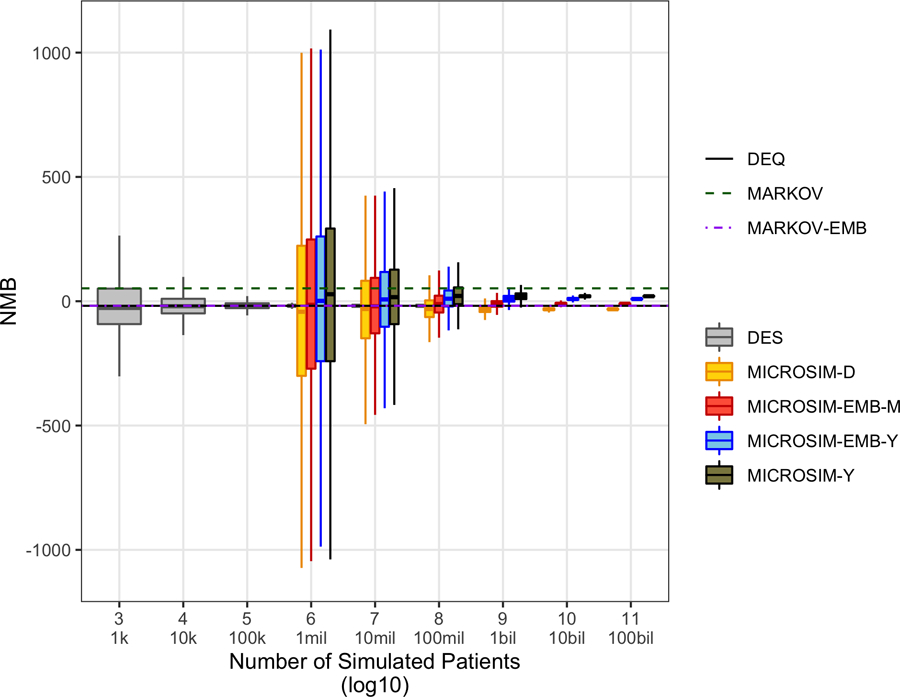
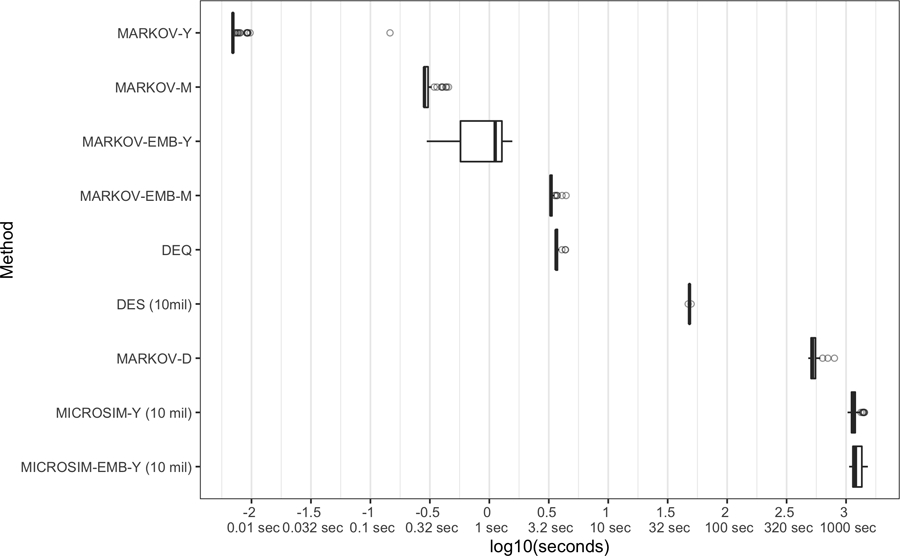
We discuss tradeoffs and errors associated with approaches to modeling health economic decisions. Through an application in pharmacogenomic (PGx) testing to guide drug selection for individuals with a genetic variant, we assessed model accuracy, optimal decisions, and computation time for an identical decision scenario modeled 4 ways: using 1) coupled-time differential equations (DEQ), 2) a cohort-based discrete-time state transition model (MARKOV), 3) an individual discrete-time state transition microsimulation model (MICROSIM), and 4) discrete event simulation (DES). Relative to DEQ, the net monetary benefit for PGx testing (v. a reference strategy of no testing) based on MARKOV with rate-to-probability conversions using commonly used formulas resulted in different optimal decisions. MARKOV was nearly identical to DEQ when transition probabilities were embedded using a transition intensity matrix. Among stochastic models, DES model outputs converged to DEQ with substantially fewer simulated patients (1 million) v. MICROSIM (1 billion). Overall, properly embedded Markov models provided the most favorable mix of accuracy and runtime but introduced additional complexity for calculating cost and quality-adjusted life year outcomes due to the inclusion of "jumpover" states after proper embedding of transition probabilities. Among stochastic models, DES offered the most favorable mix of accuracy, reliability, and speed.
我们讨论了与建模健康经济决策相关的权衡和误差。通过在药物基因组学(PGx)测试中的应用来指导具有遗传变异的个体的药物选择,我们评估了 4 种方式建模的相同决策场景的模型准确性、最优决策和计算时间:使用 1)耦合时间微分方程(DEQ)、2)基于队列的离散时间状态转移模型(MARKOV)、3)个体离散时间状态转移微观模拟模型(MICROSIM)和 4)离散事件模拟(DES)。与 DEQ 相比,基于 MARKOV 的 PGx 测试(与不进行测试的参考策略相比)的净货币收益,使用常用公式进行速率到概率的转换,导致了不同的最优决策。当使用转移强度矩阵嵌入转移概率时,MARKOV 与 DEQ 几乎相同。在随机模型中,DES 模型输出与 DEQ 收敛,模拟患者数量(100 万)远少于 MICROSIM(10 亿)。总体而言,正确嵌入的 Markov 模型提供了最有利的准确性和运行时组合,但由于正确嵌入转移概率后包含了“跳跃”状态,因此在计算成本和质量调整生命年结果时引入了额外的复杂性。在随机模型中,DES 提供了最有利的准确性、可靠性和速度组合。