Department of Endocrinology and Metabolism, West China Hospital of Sichuan University, Chengdu, Sichuan 610041, China.
Cochrane China Center, MAGIC China Center, Chinese Evidence-based Medicine Center, West China Hospital of Sichuan University, Chengdu, Sichuan 610041, China.
Chin Med J (Engl). 2021 Mar 11;134(11):1317-1323. doi: 10.1097/CM9.0000000000001407.
Recent cardiovascular outcome trials (CVOTs) changed the therapeutic strategy of guidelines for type 2 diabetes. We compared the characteristics of patients from real-world hospital settings with those of participants in recent pragmatic randomized trials.
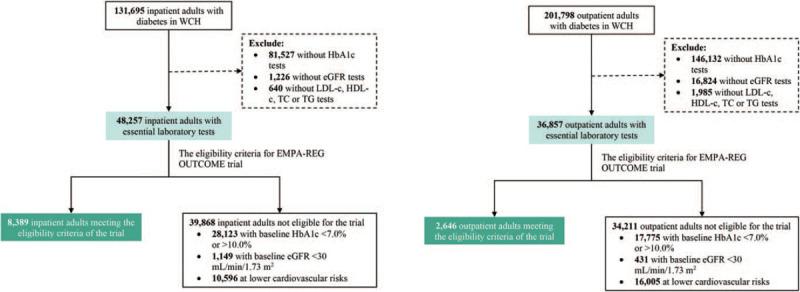
This electronic medical record (EMR)-based retrospective observational study investigated the data of patients with diabetes from inpatient and outpatient settings in West China Hospital of Sichuan University from January 1, 2011, to June 30, 2019. We identified patients meeting the inclusion criteria of a pragmatic randomized trial (EMPA-REG OUTCOME) based on EMRs and compared their baseline characteristics with those of the trial participants. The cutoff for the clinical significance of each characteristic was set as its minimal clinically important difference based on expert consultation.
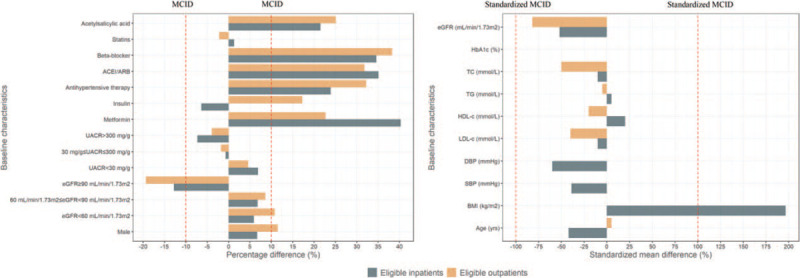
We included 48,257 inpatients and 36,857 outpatients with diabetes and found that 8389 (17.4%) inpatients and 2646 (7.2%) outpatients met the inclusion criteria for the EMPA-REG OUTCOME trial. Compared with the trial population, the real-world inpatients meeting the eligibility criteria of the EMPA-REG OUTCOME had similar age, blood pressure, and lipid profiles but comprised of fewer males, metformin users, anti-hypertensive drug users, and aspirin users, and had a lower body mass index. The group of outpatients meeting the eligibility criteria had fewer males, similar age, fewer metformin users, fewer insulin users, fewer anti-hypertensive drug users, and fewer aspirin users compared with the trial population.
The trial population in EMPA-REG OUTCOME represents only a small portion of patients with diabetes from the inpatient and outpatient departments of a Chinese tertiary medical center. Evidence localization in different clinical settings and validation are essential to enabling extrapolation of the results from CVOTs in patients with diabetes to Chinese clinical practice.
最近的心血管结局试验(CVOTs)改变了 2 型糖尿病指南的治疗策略。我们比较了真实世界医院环境中的患者特征与近期实用随机试验参与者的特征。
这项基于电子病历(EMR)的回顾性观察研究调查了 2011 年 1 月 1 日至 2019 年 6 月 30 日期间来自四川大学华西医院住院和门诊的糖尿病患者的数据。我们根据 EMR 确定了符合实用随机试验(EMPA-REG OUTCOME)纳入标准的患者,并将其基线特征与试验参与者的特征进行比较。根据专家咨询,将每个特征的临床意义最小差异设定为截断值。
我们纳入了 48257 名住院患者和 36857 名门诊患者,发现 8389 名(17.4%)住院患者和 2646 名(7.2%)门诊患者符合 EMPA-REG OUTCOME 试验的纳入标准。与试验人群相比,符合 EMPA-REG OUTCOME 试验入选标准的真实世界住院患者年龄、血压和血脂谱相似,但男性、二甲双胍使用者、抗高血压药物使用者和阿司匹林使用者较少,体重指数较低。符合纳入标准的门诊患者中,男性较少,年龄相似,二甲双胍使用者、胰岛素使用者、抗高血压药物使用者和阿司匹林使用者较少。
EMPA-REG OUTCOME 试验的试验人群仅代表中国三级医疗中心住院和门诊部门的一小部分糖尿病患者。在不同临床环境中进行证据本地化和验证对于将 CVOT 结果外推到中国临床实践至关重要。