Ontario Institute for Studies in Education, University of Toronto, Toronto, Ontario, Canada.
Division of Infectious Diseases, St. Michael's Hospital, Toronto, Ontario, Canada.
PLoS One. 2021 Mar 18;16(3):e0248626. doi: 10.1371/journal.pone.0248626. eCollection 2021.
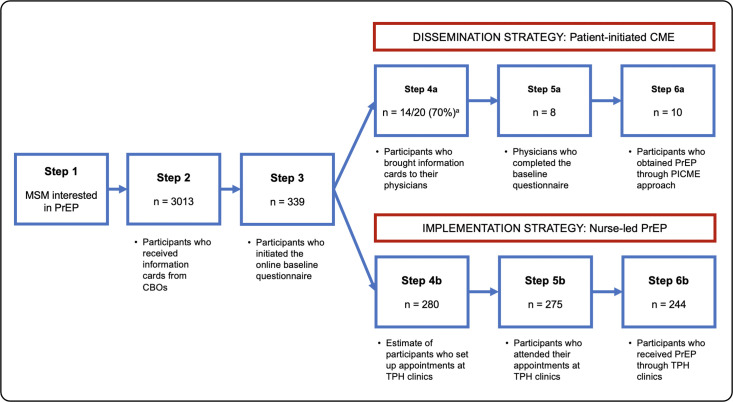
Pre-exposure prophylaxis (PrEP) is traditionally prescribed by HIV specialist physicians. Given finite specialist resources, there is a need to scale up PrEP delivery by decentralizing services via other healthcare professionals. We aimed to assess the feasibility of delivering PrEP to men who have sex with men (MSM) through primary care physicians and sexual health clinic nurses. We piloted a multi-component, implementation and dissemination research program to increase provision of PrEP through primary care physicians and sexual health clinic nurses in Toronto, Canada. Community-based organizations (CBOs) provided prospective participants with information cards that contained links to an online module on engaging providers in a conversation about PrEP. In our patient-initiated continuing medical education (PICME) strategy, participants saw their family doctors and gave them the card, which also contained a link to a Continuing Medical Education module. In the nurse-led strategy, participants visited one of two participating clinics to obtain PrEP. We administered an optional online questionnaire to patients and providers at baseline and six months. CBOs distributed 3043 cards. At least 339 men accessed the online module and 196 completed baseline questionnaires. Most (55%) intended to visit nurses while 21% intended to consult their physicians. Among 45 men completing follow-up questionnaires at 6 months, 31% reported bringing cards to their physicians and obtaining PrEP through them; sexual health clinics delivered PrEP to 244 patients. Participants who went through the PICME approach reported no changes in relationships with their providers. Nurses showed fidelity to PrEP prescribing guidelines. Nurse-led PrEP and patient-initiated continuing medical education (PICME) for primary care physicians are feasible strategies to increase PrEP uptake. Nurse-led PrEP delivery was preferred by most patients.
暴露前预防(PrEP)传统上由艾滋病病毒专家医生开具。鉴于专家资源有限,需要通过将服务去中心化来扩大 PrEP 的提供,以扩大服务范围。我们旨在评估通过初级保健医生和性健康诊所护士向男男性行为者(MSM)提供 PrEP 的可行性。我们通过加拿大多伦多的一个多部分实施和传播研究计划来试点,以增加初级保健医生和性健康诊所护士提供 PrEP 的机会。社区组织(CBO)向潜在参与者提供信息卡,其中包含有关在线模块的链接,该模块涉及与提供者进行有关 PrEP 的对话。在我们的患者发起的继续医学教育(PICME)策略中,参与者去看他们的家庭医生,并将卡片交给他们,卡片中还包含继续医学教育模块的链接。在护士主导的策略中,参与者访问两个参与诊所之一以获取 PrEP。我们在基线和六个月时向患者和提供者提供了可选的在线问卷。CBO 分发了 3043 张卡片。至少有 339 名男性访问了在线模块,196 名完成了基线问卷。大多数(55%)打算去看护士,而 21%的人打算咨询他们的医生。在 45 名完成 6 个月随访问卷的男性中,31%的人报告说将卡片带给他们的医生并通过他们获得了 PrEP;性健康诊所为 244 名患者提供了 PrEP。通过 PICME 方法的参与者报告说他们与提供者的关系没有变化。护士严格遵守 PrEP 处方指南。针对初级保健医生的护士主导的 PrEP 和患者发起的继续医学教育(PICME)是增加 PrEP 使用率的可行策略。大多数患者更喜欢护士主导的 PrEP 交付。