Department of Epidemiology and Biostatistics, Institute of Public Health, College of Medicine and Health Sciences, University of Gondar, Gondar, Ethiopia.
Department of Human Physiology, College of Medicine and Health Sciences, University of Gondar, Gondar, Ethiopia.
PLoS One. 2021 Mar 18;16(3):e0247992. doi: 10.1371/journal.pone.0247992. eCollection 2021.
According to the 2017 estimate, around 214 million reproductive-age women in developing regions who want to avoid pregnancy do not use a modern contraceptive method. Although there are studies done on factors associated with modern contraceptive utilization in individual East African countries, as to our search of the literature, there is limited evidence on the pooled prevalence and determinants of modern contraceptive utilization in the East African region. Therefore, this study aimed to estimate the pooled prevalence and determinants of modern contraceptive utilization in the East African region.
The pooled prevalence of modern contraceptive utilization and the strength of determinants were estimated using STATA version 14. Intra-class Correlation Coefficient (ICC), Median Odds Ratio (MOR), Proportional Change in Variance (PCV), and deviance were used for model fitness and comparison. The multilevel logistic regression model was fitted to identify determinants of modern contraceptive use in the region. Adjusted Odds Ratio with its 95% Confidence Interval was presented, and variables with a p-value ≤of 0.05 were declared significant determinants of modern contraceptive utilization.
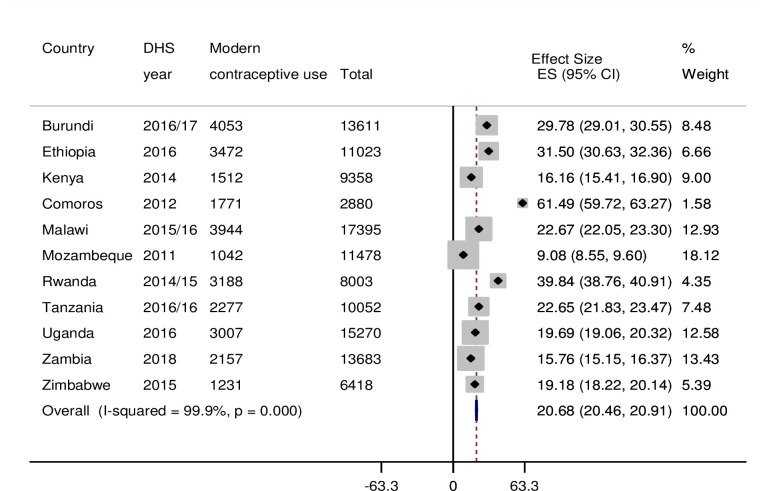
Overall, about 20.68% (95%CI:-20.46.,20.91)of women used modern contraceptive, ranging from 9.08% in Mozambique to 61.49% in Comoros. In the multilevel logistic regression model; maternal age group 25-34 (AOR: 0.79, 95%CI:0.76,0.82) and 35-49 (AOR:0.49, 95%CI:0.46,0.51). Being married (AOR:0.85, 95%CI:0.82,0.88), mothers with primary education (AOR:1.48, 95%CI:1.43,1.54) and secondary and above education level (AOR:1.60, 95%CI:1.52,1.69), husbands with primary education (AOR:2.43, 95%CI:2.35,2.51) and secondary and above education level (AOR:2.92, 95%CI:2.76,3.05). The mothers who had occupation (AOR:2.11, 95%CI:1.23,1.33), mothers from households with middle wealth index (AOR:1.23, 95%CI:1.19,1.28) and rich wealth index (AOR:1.28, 95%CI:1.23,1.33) were found to be significant determinants of modern contraceptive use.
We found that modern contraceptive utilization in the 12 East Africa countries was low compared to SDG target 2030(75%). The governmental and non-governmental organizations should scale up their public health programs to the poor and marginalized communities to scale up modern contraceptive utilization uptake in the region. In addition, reforming the health system and reproductive health education through mass media to create awareness of modern contraceptive use benefits are effective strategies to improve modern contraceptive use among East Africa women.
根据 2017 年的估计,发展中地区约有 2.14 亿育龄妇女希望避免怀孕,但她们没有使用现代避孕方法。尽管已经有研究针对个别东非国家与现代避孕方法利用相关的因素进行了研究,但就我们对文献的检索,东非地区现代避孕方法利用的综合流行率和决定因素的证据有限。因此,本研究旨在评估东非地区现代避孕方法利用的综合流行率和决定因素。
使用 STATA 版本 14 来估计现代避孕方法利用的综合流行率和决定因素的强度。使用组内相关系数(ICC)、中位数优势比(MOR)、方差比例变化(PCV)和偏差来评估模型拟合度和比较。使用多水平逻辑回归模型来确定该地区现代避孕方法使用的决定因素。呈现调整后的优势比及其 95%置信区间,p 值≤0.05 的变量被宣布为现代避孕方法利用的显著决定因素。
总体而言,约有 20.68%(95%CI:-20.46,20.91)的妇女使用现代避孕药具,范围从莫桑比克的 9.08%到科摩罗的 61.49%。在多水平逻辑回归模型中;25-34 岁的产妇年龄组(AOR:0.79,95%CI:0.76,0.82)和 35-49 岁的产妇年龄组(AOR:0.49,95%CI:0.46,0.51)。已婚(AOR:0.85,95%CI:0.82,0.88)、母亲受过小学教育(AOR:1.48,95%CI:1.43,1.54)和中学及以上教育水平(AOR:1.60,95%CI:1.52,1.69)、丈夫受过小学教育(AOR:2.43,95%CI:2.35,2.51)和中学及以上教育水平(AOR:2.92,95%CI:2.76,3.05)。有职业的母亲(AOR:2.11,95%CI:1.23,1.33)、来自中等财富指数家庭的母亲(AOR:1.23,95%CI:1.19,1.28)和富裕财富指数家庭的母亲(AOR:1.28,95%CI:1.23,1.33)被发现是现代避孕方法利用的显著决定因素。
我们发现,与 2030 年可持续发展目标(75%)相比,东非 12 个国家的现代避孕药具使用率较低。政府和非政府组织应将其公共卫生方案扩大到贫困和边缘社区,以提高该地区现代避孕药具的使用率。此外,通过大众媒体改革卫生系统和生殖健康教育,提高对现代避孕药具使用益处的认识,是提高东非妇女现代避孕药具使用的有效策略。