You Shoujiang, Wang Yupin, Lu Zian, Chu Dandan, Han Qiao, Xu Jiaping, Liu Chun-Feng, Cao Yongjun, Zhong Chongke
Department of Neurology and Suzhou Clinical Research Center of Neurological Disease, The Second Affiliated Hospital of Soochow University, No. 1055 Sanxiang Road, Suzhou, 215004, Jiangsu, China.
Department of Epidemiology, School of Public Health and Jiangsu Key Laboratory of Preventive and Translational Medicine for Geriatric Diseases, Medical College of Soochow University, 199 Renai Road, Industrial Park District, Suzhou, 215123, Jiangsu, China.
J Intensive Care. 2021 Mar 18;9(1):28. doi: 10.1186/s40560-021-00540-0.
Dynamic change of heart rate in the acute phase and clinical outcomes after intracerebral hemorrhage (ICH) remains unknown. We aimed to investigate the associations of heart rate trajectories and variability with functional outcome and mortality in patients with acute ICH.
This prospective study was conducted among 332 patients with acute ICH. Latent mixture modeling was used to identify heart rate trajectories during the first 72 h of hospitalization after ICH onset. Mean and coefficient of variation of heart rate measurements were calculated. The study outcomes included unfavorable functional outcome, ordinal shift of modified Rankin Scale score, and all-cause mortality.
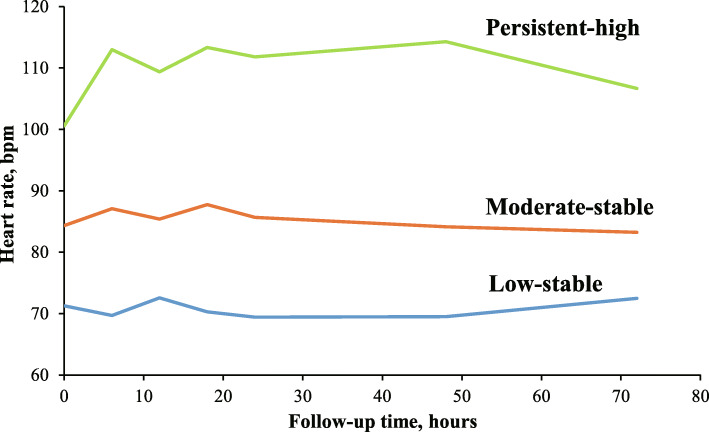
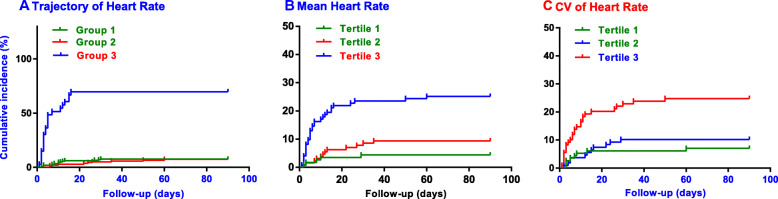
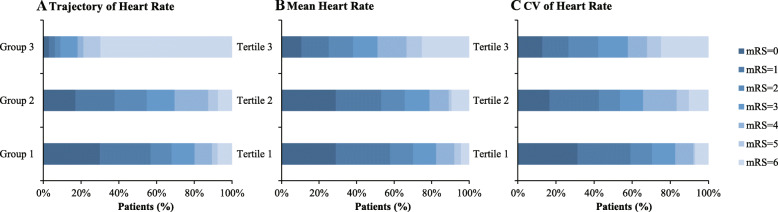
We identified 3 distinct heart rate trajectory patterns (persistent-high, moderate-stable, and low-stable). During 3-month follow-up, 103 (31.0%) patients had unfavorable functional outcome and 46 (13.9%) patients died. In multivariable-adjusted model, compared with patients in low-stable trajectory, patients in persistent-high trajectory had the highest odds of poor functional outcome (odds ratio 15.06, 95% CI 3.67-61.78). Higher mean and coefficient of variation of heart rate were also associated with increased risk of unfavorable functional outcome (P trend < 0.05), and the corresponding odds ratios (95% CI) comparing two extreme tertiles were 4.69 (2.04-10.75) and 2.43 (1.09-5.39), respectively. Likewise, similar prognostic effects of heart rate dynamic changes on high modified Rankin Scale score and all-cause mortality were observed.
Persistently high heart rate and higher variability in the acute phase were associated with increased risk of unfavorable functional outcome in patients with acute ICH.
脑出血(ICH)急性期心率的动态变化及临床结局仍不清楚。我们旨在研究急性脑出血患者心率轨迹和变异性与功能结局及死亡率之间的关联。
对332例急性脑出血患者进行了这项前瞻性研究。采用潜在混合模型确定脑出血发病后住院的前72小时内的心率轨迹。计算心率测量值的平均值和变异系数。研究结局包括不良功能结局、改良Rankin量表评分的序数变化和全因死亡率。
我们确定了3种不同的心率轨迹模式(持续高、中度稳定和低稳定)。在3个月的随访中,103例(31.0%)患者出现不良功能结局,46例(13.9%)患者死亡。在多变量调整模型中,与低稳定轨迹的患者相比,持续高轨迹的患者功能结局不良的几率最高(优势比15.06,95%CI 3.67-61.78)。较高的心率平均值和变异系数也与不良功能结局风险增加相关(P趋势<0.05),比较两个极端三分位数的相应优势比(95%CI)分别为4.69(2.04-10.75)和2.43(1.09-5.39)。同样,观察到心率动态变化对高改良Rankin量表评分和全因死亡率有类似的预后影响。
急性脑出血患者急性期持续高心率和较高变异性与不良功能结局风险增加相关。