Public Health Department, School of Medical Sciences of University of Campinas, Rua Tessália Vieira de Camargo, Nº 126, Barão Geraldo, Campinas, SP, Brazil.
Federal University of Minas Gerais, School of Nursing, Department of Maternal and Child Nursing and Public Health, Belo Horizonte, MG, Brazil.
Sleep Med. 2022 Mar;91:205-210. doi: 10.1016/j.sleep.2021.02.052. Epub 2021 Mar 1.
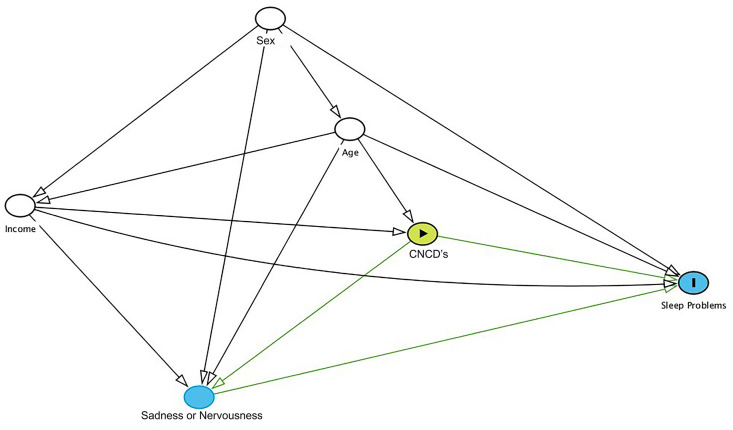
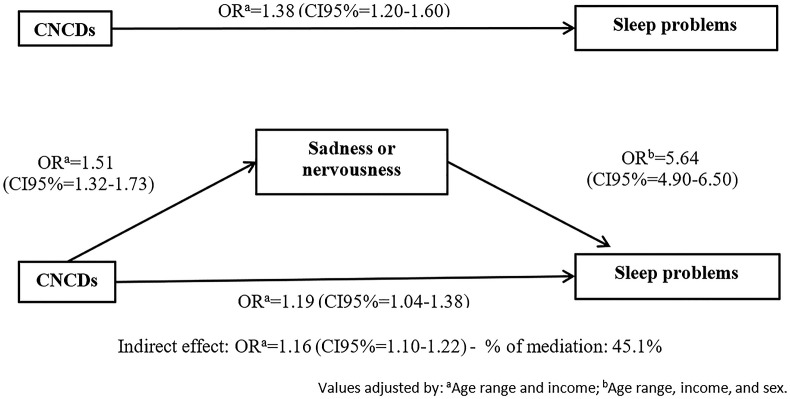
This study aimed to investigate the effect of Chronic Noncommunicable Diseases (CNCDs) on the onset or increase in sleep problems during the COVID-19 pandemic period. The role of the report of sadness or nervousness during the pandemic was also evaluated as a mediator of this association. Data from a behavior survey during COVID-19, conducted in Brazil with 45,161 people (18 years old or older), from April 24 to May 24, 2020, were used. The outcome variable was the onset or increase in sleep problems, and the exposure variable was the presence of CNCDs. The adjusted Odds Ratio of the association between CNCDs and sleep was estimated, and a mediation analysis was performed to test the effect of the report of sadness or nervousness on this association, using the Karlson Holm Breen method. The increase in sleep problems was reported by 44.9% of the population, and 33.9% reported at least one CNCD. The chance of sleep problems was higher among people with diabetes (1.34; 1.05-1.71), hypertension (1.26; 1.06-1.50), and with coronary heart diseases (1.36; 1.13-1.65) or respiratory diseases (1.42; 1.04-1.93). Compared to people without CNCDs, individuals with at least one CNCD had a 36% greater chance of impaired sleep (1.36; 1.19-1.55). The report of sadness or nervousness explained 45.1% of the association between CNCD and sleep. Our findings alert us to care for the emotional state and sleep of chronic patients during the waves of the COVID-19 pandemic, and indicate the need for sleep monitoring in this population.
本研究旨在探讨慢性非传染性疾病(CNCDs)在 COVID-19 大流行期间对睡眠问题的发生或增加的影响。还评估了大流行期间悲伤或紧张感的报告作为这种关联的中介因素的作用。使用了 2020 年 4 月 24 日至 5 月 24 日期间在巴西进行的一项关于 COVID-19 的行为调查的数据,该调查共涉及 45161 名(18 岁及以上)人。结果变量为睡眠问题的发生或增加,暴露变量为存在 CNCDs。使用 Karlson Holm Breen 方法,估计了 CNCDs 与睡眠之间关联的调整后比值比,并进行了中介分析,以测试悲伤或紧张感报告对这种关联的影响。报告睡眠问题的人群比例为 44.9%,报告至少有一种 CNCD 的人群比例为 33.9%。患有糖尿病(1.34;1.05-1.71)、高血压(1.26;1.06-1.50)和冠心病(1.36;1.13-1.65)或呼吸道疾病(1.42;1.04-1.93)的人睡眠问题的几率更高。与没有 CNCDs 的人相比,至少有一种 CNCD 的人睡眠受损的几率增加了 36%(1.36;1.19-1.55)。悲伤或紧张感的报告解释了 CNCD 与睡眠之间关联的 45.1%。我们的研究结果提醒我们在 COVID-19 大流行的浪潮中关注慢性患者的情绪状态和睡眠,并表明需要对该人群进行睡眠监测。