Department of Physiotherapy, Institute of Health Sciences, College of Medical Sciences, University of Rzeszów, Rzeszów, Poland.
Sci Rep. 2021 Mar 18;11(1):6349. doi: 10.1038/s41598-021-85587-7.
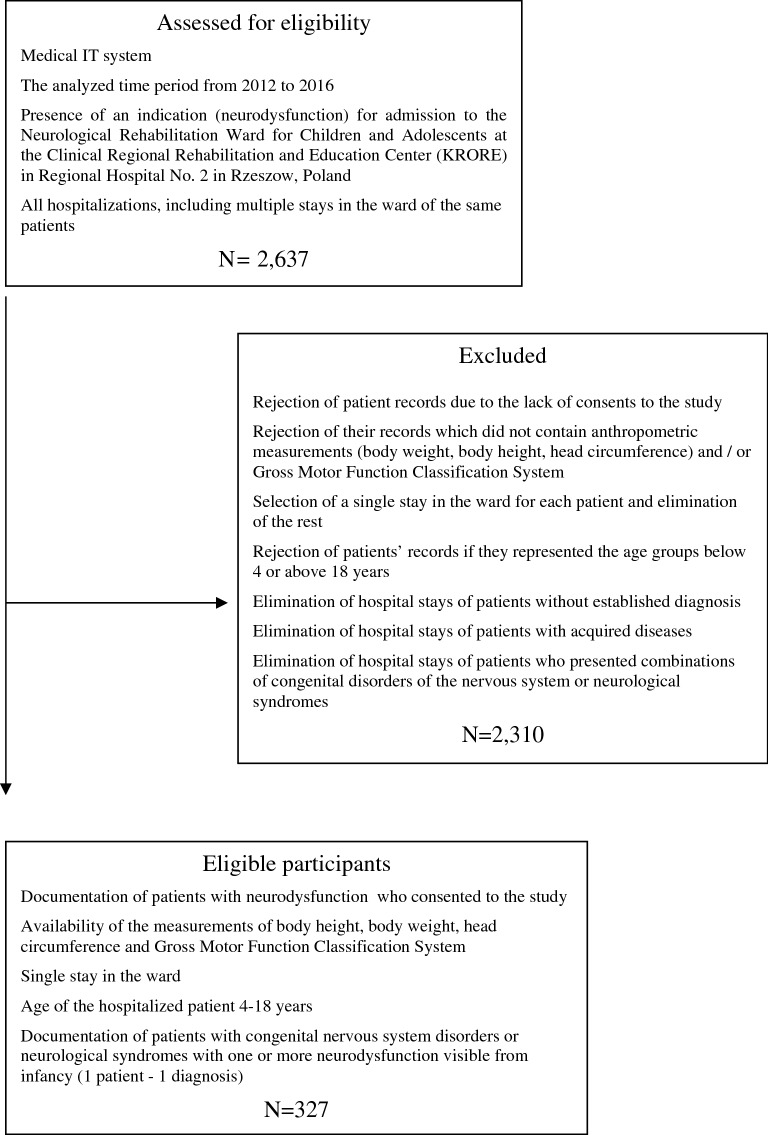
In Poland the issue of microsomic body structure (micro-SBS) and macrosomic body structure (macro-SBS) has so far been overlooked. Up until now only a small amount of data have been published, most often as an overview of the problem. The current study was designed to investigate the co-occurrence of microsomic/macrosomic body structure (micro/macro-SBS) and congenital nervous system disorders or neurological syndromes with symptoms visible from infancy, based on essential data acquired during admission procedures at a neurological rehabilitation ward for children and adolescents. The study applied a retrospective analysis of data collected during hospitalization of 327 children and adolescents, aged 4-18 years who had been affected since infancy by congenital disorders of the nervous system and/or neurological syndromes associated with a minimum of one neurodysfunction. To identify subjects with microsomic or macrosomic body structure in the group of children and adolescents, the adopted criteria took into account z-score values for body height (z-score Ht), body weight (z-score Wt), head circumference (z-score HC), BMI (z-score BMI) and head circumference index (z-score HCI). The rates of micro/macro-SBS in the study group amounted to 7.3% and 0.6%, respectively. The findings show a more frequent co-occurrence of, as well as statistically significant correlations between, micro/macro-SBS and type of spasticity (cerebral palsy) (p = 0.024) as well as hydrocephalus not treated surgically (p < 0.001). Macro-SBS was found to more frequently co-occur with hemiplegia and hydrocephalus not treated surgically.
在波兰,目前还忽视了微小体型结构(micro-SBS)和巨大体型结构(macro-SBS)的问题。到目前为止,只有少量数据已公布,通常只是对问题的概述。本研究旨在根据儿童神经康复病房入院程序中获得的基本数据,调查微小/巨大体型结构(micro/macro-SBS)与先天性神经系统疾病或从婴儿期开始出现症状的神经病变综合征的同时发生情况。该研究对 327 名年龄在 4-18 岁之间的儿童和青少年的住院数据进行了回顾性分析,这些儿童和青少年从婴儿期开始就患有先天性神经系统疾病和/或与至少一种神经功能障碍相关的神经病变综合征。为了在儿童和青少年组中识别出具有微小体型或巨大体型结构的患者,采用的标准考虑了身高(身高 z 分数)、体重(体重 z 分数)、头围(头围 z 分数)、BMI(BMI z 分数)和头围指数(头围指数 z 分数)的 z 分数值。研究组中微/巨 SBS 的发生率分别为 7.3%和 0.6%。研究结果表明,微/巨 SBS 与痉挛型脑瘫(p=0.024)和未手术治疗的脑积水(p<0.001)之间的同时发生更为频繁,且具有统计学显著相关性。巨大体型结构更常与偏瘫和未手术治疗的脑积水同时发生。