Department of Internal and Geriatric Medicine, Henri Mondor Hospital, Assistance Publique-Hôpitaux de Paris, Créteil, France.
National Reference Center for Hypereosinophilic Syndromes, CEREO, France.
Sci Rep. 2021 Mar 18;11(1):6388. doi: 10.1038/s41598-021-85852-9.
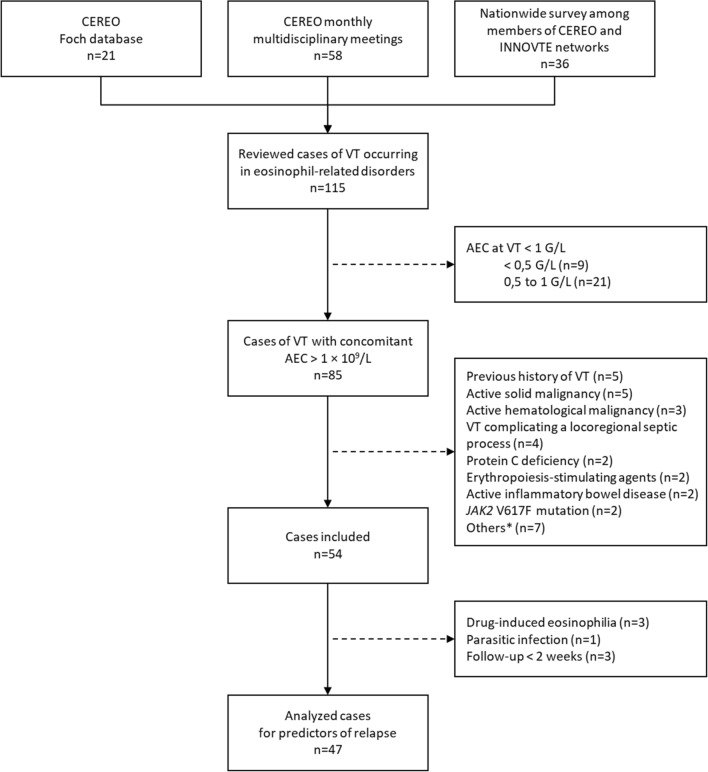
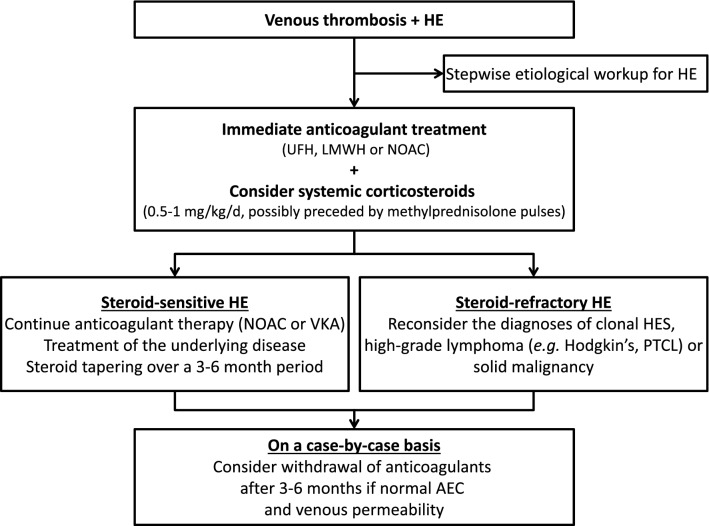
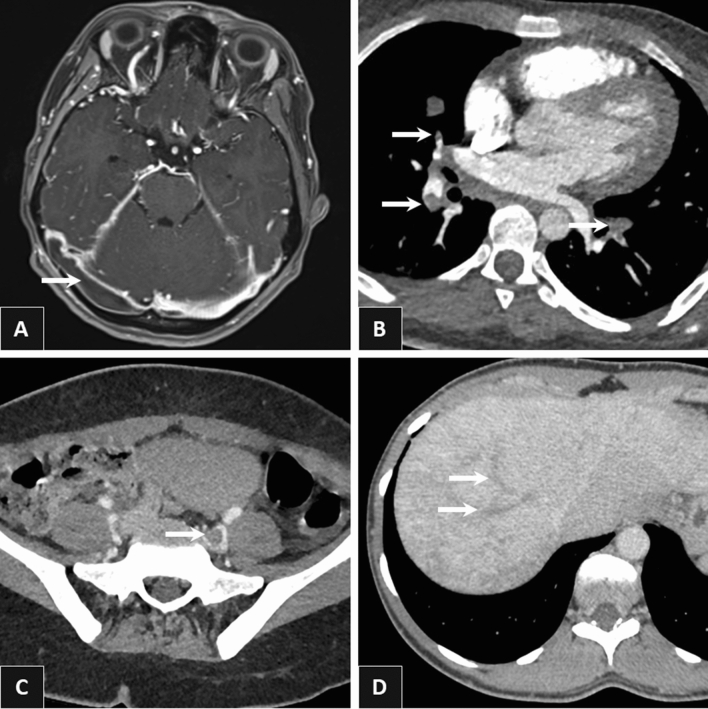
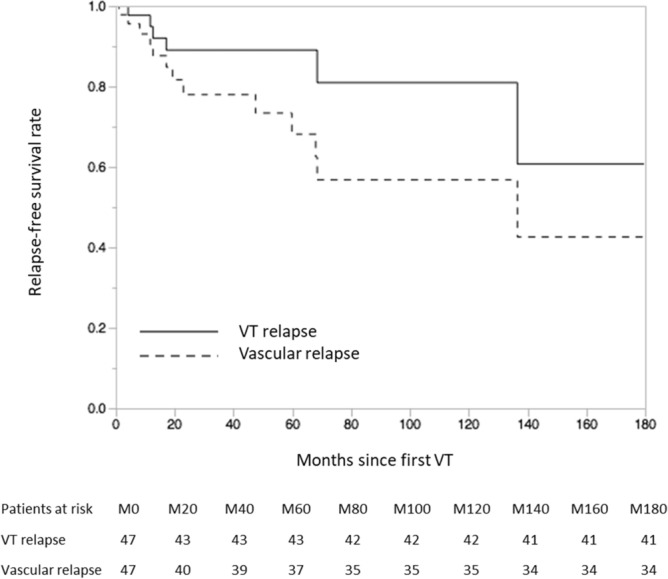
Eosinophils have widespread procoagulant effects. Eosinophilic cardiovascular toxicity mostly consists of endomyocardial damage or eosinophilic vasculitis, while reported cases of venous thrombosis (VT) are scarce. We aimed to report on the clinical features and treatment outcomes of patients with unexplained VT and eosinophilia, and to identify predictors of relapse. This retrospective, multicenter, observational study included patients aged over 15 years with VT, concomitant blood eosinophilia ≥ 1G/L and without any other moderate-to-strong contributing factors for VT. Fifty-four patients were included. VT was the initial manifestation of eosinophil-related disease in 29 (54%) patients and included pulmonary embolism (52%), deep venous thrombosis (37%), hepatic (11%) and portal vein (9%) thromboses. The median [IQR] absolute eosinophil count at VT onset was 3.3G/L [1.6-7.4]. Underlying eosinophil-related diseases included FIP1L1-PDGFRA-associated chronic myeloid neoplasm (n = 4), Eosinophilic Granulomatosis with Polyangiitis (n = 9), lymphocytic (n = 1) and idiopathic (n = 29) variants of hypereosinophilic syndrome. After a median [IQR] follow-up of 24 [10-62] months, 7 (13%) patients had a recurrence of VT. In multivariate analysis, persistent eosinophilia was the sole variable associated with a shorter time to VT relapse (HR 7.48; CI95% [1.94-29.47]; p = 0.015). Long-term normalization of eosinophil count could prevent the recurrence of VT in a subset of patients with unexplained VT and eosinophilia ≥ 1G/L.
嗜酸性粒细胞具有广泛的促凝作用。嗜酸性粒细胞性心血管毒性主要包括心肌损伤或嗜酸性粒细胞血管炎,而报告的静脉血栓形成(VT)病例则很少见。我们旨在报告原因不明的 VT 和嗜酸性粒细胞增多症患者的临床特征和治疗结果,并确定复发的预测因素。这项回顾性、多中心、观察性研究纳入了年龄在 15 岁以上的伴有 VT、同时伴有血嗜酸性粒细胞计数≥1G/L 且无其他中度至强促 VT 因素的患者。共纳入 54 例患者。29 例(54%)患者的 VT 是嗜酸性粒细胞相关疾病的首发表现,包括肺栓塞(52%)、深静脉血栓形成(37%)、肝(11%)和门静脉(9%)血栓形成。VT 发病时的嗜酸性粒细胞绝对计数中位数[IQR]为 3.3G/L [1.6-7.4]。嗜酸性粒细胞相关疾病包括 FIP1L1-PDGFRA 相关慢性髓性白血病(n=4)、嗜酸性粒细胞肉芽肿伴多血管炎(n=9)、淋巴细胞性(n=1)和特发性(n=29)高嗜酸性粒细胞综合征变体。中位[IQR]随访 24 [10-62]个月后,7 例(13%)患者 VT 复发。多变量分析显示,持续性嗜酸性粒细胞增多是与 VT 复发时间较短相关的唯一变量(HR 7.48;95%CI [1.94-29.47];p=0.015)。长期嗜酸性粒细胞计数正常化可预防部分原因不明的 VT 和嗜酸性粒细胞计数≥1G/L 患者 VT 复发。