Graduate School of Science, Osaka University, 1-1 Machikaneyama-cho, Toyonaka, Osaka, 560-0043, Japan.
The Institute of Scientific and Industrial Research, Osaka University, 8-1 Mihogaoka, Ibaraki, Osaka, 567-0047, Japan.
Sci Rep. 2021 Mar 18;11(1):6320. doi: 10.1038/s41598-021-85816-z.
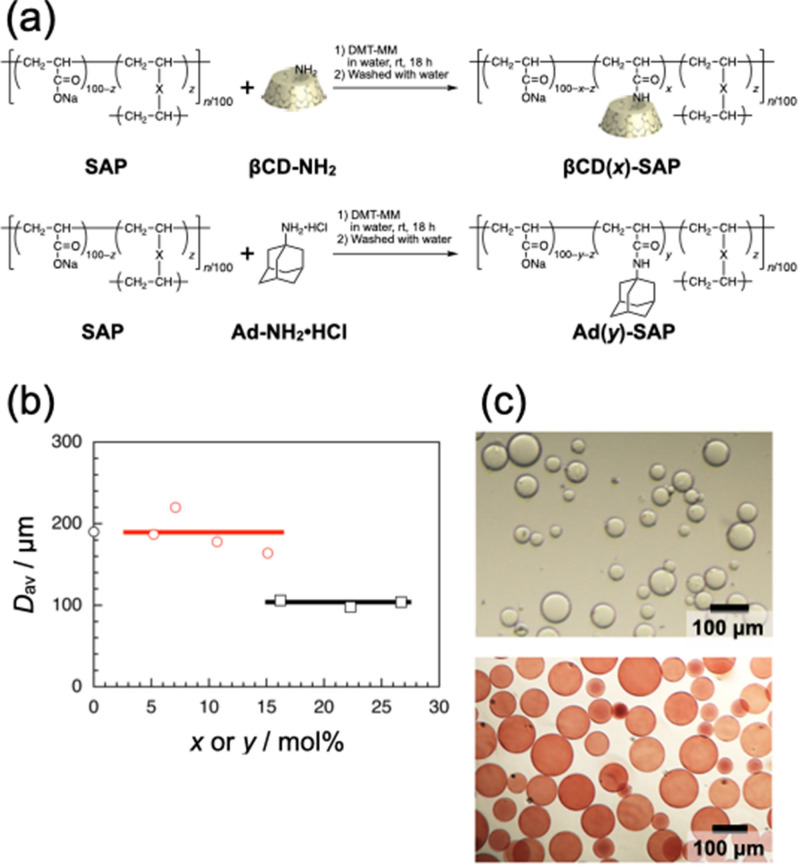
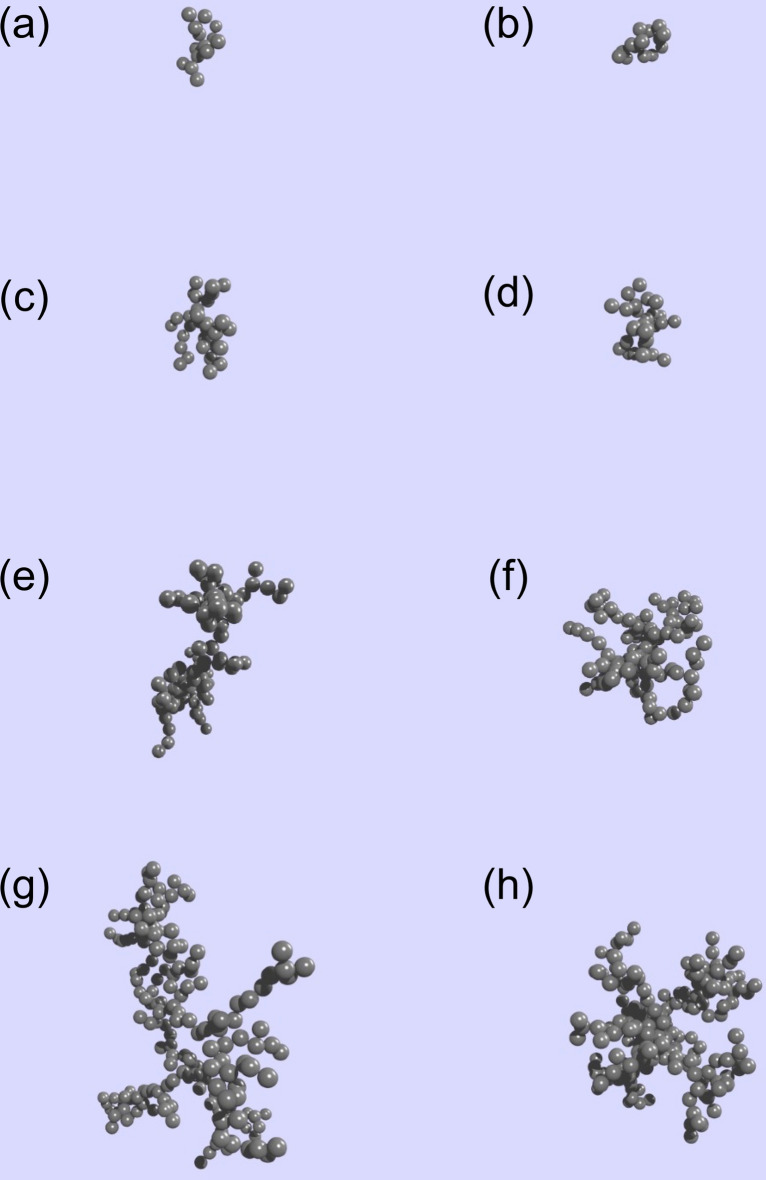
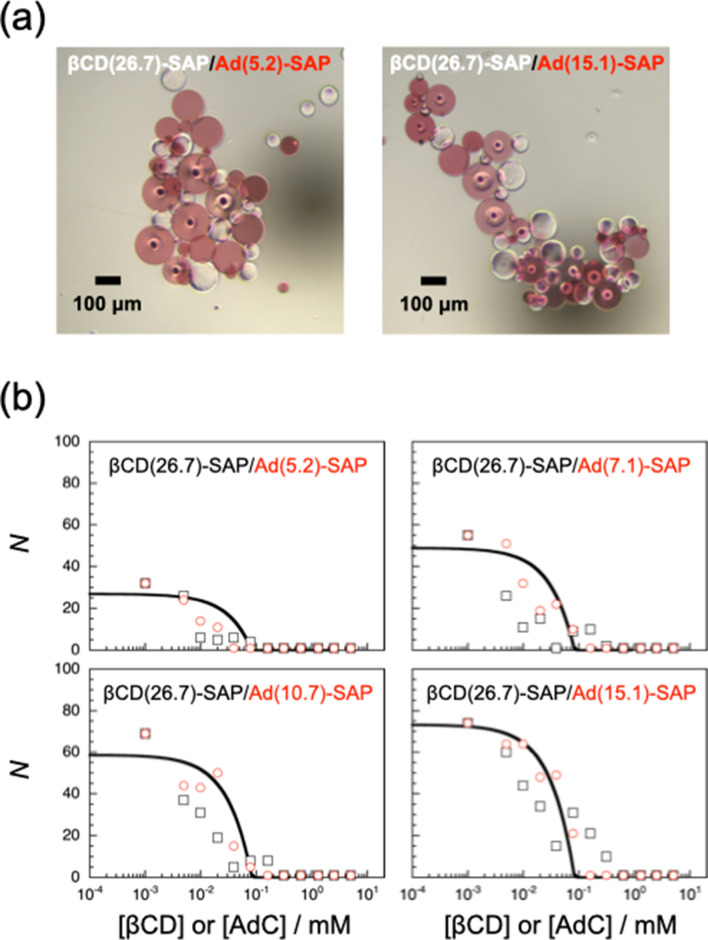
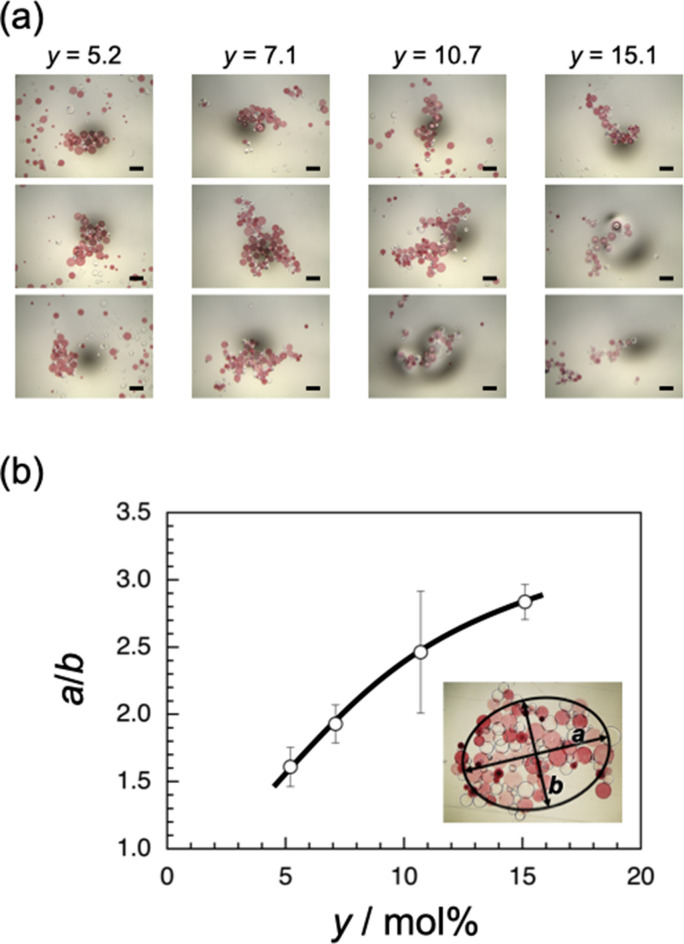
Biological macroscopic assemblies have inspired researchers to utilize molecular recognition to develop smart materials in these decades. Recently, macroscopic self-assemblies based on molecular recognition have been realized using millimeter-scale hydrogel pieces possessing molecular recognition moieties. During the study on macroscopic self-assembly based on molecular recognition, we noticed that the shape of assemblies might be dependent on the host-guest pair. In this study, we were thus motivated to study the macroscopic shape of assemblies formed through host-guest interaction. We modified crosslinked poly(sodium acrylate) microparticles, i.e., superabsorbent polymer (SAP) microparticles, with β-cyclodextrin (βCD) and adamantyl (Ad) residues (βCD(x)-SAP and Ad(y)-SAP microparticles, respectively, where x and y denote the mol% contents of βCD and Ad residues). Then, we studied the self-assembly behavior of βCD(x)-SAP and Ad(y)-SAP microparticles through the complexation of βCD with Ad residues. There was a threshold of the βCD content in βCD(x)-SAP microparticles for assembly formation between x = 22.3 and 26.7. On the other hand, the shape of assemblies was dependent on the Ad content, y; More elongated assemblies were formed at a higher y. This may be because, at a higher y, small clusters formed in an early stage can stick together even upon collisions at a single contact point to form elongated aggregates, whereas, at a smaller y, small clusters stick together only upon collisions at multiple contact points to give rather circular assemblies. On the basis of these observations, the shape of assembly formed from microparticles can be controlled by varying y.
几十年来,生物宏观组装体激发了研究人员利用分子识别来开发智能材料。最近,基于分子识别的宏观自组装体已通过具有分子识别部分的毫米级水凝胶片得以实现。在研究基于分子识别的宏观自组装体时,我们注意到组装体的形状可能取决于主客体对。在这项研究中,我们因此有动力研究通过主客体相互作用形成的组装体的宏观形状。我们用β-环糊精(βCD)和金刚烷(Ad)残基对交联的聚(丙烯酸钠)微球(即超吸收聚合物(SAP)微球)进行了修饰(βCD(x)-SAP 和 Ad(y)-SAP 微球,其中 x 和 y 分别表示βCD 和 Ad 残基的摩尔%含量)。然后,我们通过βCD 与 Ad 残基的络合研究了βCD(x)-SAP 和 Ad(y)-SAP 微球的自组装行为。在 x = 22.3 到 26.7 之间,βCD(x)-SAP 微球之间的组装形成存在一个βCD 含量的阈值。另一方面,组装体的形状取决于 Ad 含量 y;y 值越高,组装体越细长。这可能是因为,在 y 值较高时,早期形成的小簇即使在单点接触时发生碰撞也可以粘在一起,形成细长的聚集体,而在 y 值较小时,小簇只有在多点接触时才粘在一起,形成较圆的组装体。基于这些观察结果,可以通过改变 y 值来控制由微球形成的组装体的形状。