Wrotek Sylwia, LeGrand Edmund K, Dzialuk Artur, Alcock Joe
Department of Immunology, Nicolaus Copernicus University, Torun, Poland.
Department of Biomedical and Diagnostic Sciences, College of Veterinary Medicine, University of Tennessee Knoxville, TN, USA.
Evol Med Public Health. 2020 Nov 23;9(1):26-35. doi: 10.1093/emph/eoaa044. eCollection 2021.
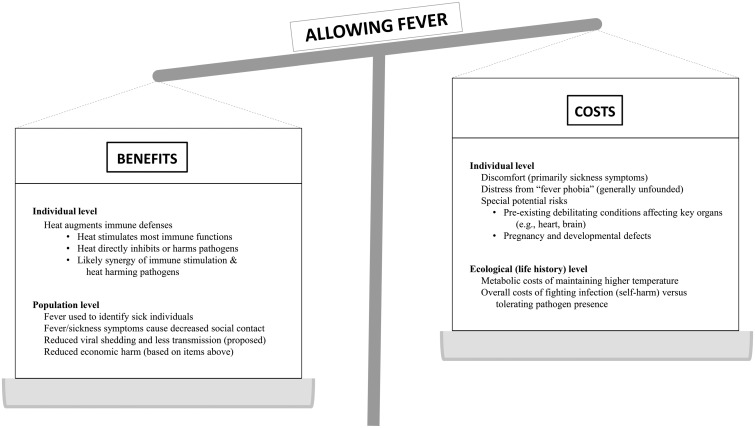
Although fever is one of the main presenting symptoms of COVID-19 infection, little public attention has been given to fever as an evolved defense. Fever, the regulated increase in the body temperature, is part of the evolved systemic reaction to infection known as the acute phase response. The heat of fever augments the performance of immune cells, induces stress on pathogens and infected cells directly, and combines with other stressors to provide a nonspecific immune defense. Observational trials in humans suggest a survival benefit from fever, and randomized trials published before COVID-19 do not support fever reduction in patients with infection. Like public health measures that seem burdensome and excessive, fevers involve costly trade-offs but they can prevent infection from getting out of control. For infections with novel SARS-CoV-2, the precautionary principle applies: unless evidence suggests otherwise, we advise that fever should be allowed to run its course. Lay summary: For COVID-19, many public health organizations have advised treating fever with medicines such as acetaminophen or ibuprofen. Even though this is a common practice, lowering body temperature has not improved survival in laboratory animals or in patients with infections. Blocking fever can be harmful because fever, along with other sickness symptoms, evolved as a defense against infection. Fever works by causing more damage to pathogens and infected cells than it does to healthy cells in the body. During pandemic COVID-19, the benefits of allowing fever to occur probably outweigh its harms, for individuals and for the public at large.
尽管发热是新冠病毒感染的主要症状之一,但作为一种进化而来的防御机制,发热很少受到公众关注。发热是体温的有调节升高,是被称为急性期反应的对感染的进化而来的全身反应的一部分。发热产生的热量增强了免疫细胞的功能,直接对病原体和被感染细胞施加压力,并与其他应激源共同提供非特异性免疫防御。对人类的观察性试验表明发热对生存有益,在新冠疫情之前发表的随机试验不支持对感染患者进行退热治疗。就像看似繁重和过度的公共卫生措施一样,发热涉及代价高昂的权衡,但它们可以防止感染失控。对于新型严重急性呼吸综合征冠状病毒2(SARS-CoV-2)感染,预防原则适用:除非有其他证据表明,我们建议应让发热自然发展。
对于新冠病毒感染,许多公共卫生组织建议用对乙酰氨基酚或布洛芬等药物治疗发热。尽管这是一种常见做法,但降低体温并未提高实验动物或感染患者的生存率。抑制发热可能有害,因为发热与其他疾病症状一样,是作为一种抗感染防御机制进化而来的。发热的作用机制是对病原体和被感染细胞造成的损害大于对体内健康细胞造成的损害。在新冠疫情期间,允许发热出现的益处可能大于其危害,对个人和广大公众而言皆是如此。