Godde C M, Mason-D'Croz D, Mayberry D E, Thornton P K, Herrero M
Commonwealth Scientific and Industrial Research Organisation, Agriculture and Food, St Lucia, QLD, 4067, Australia.
CGIAR Research Programme on Climate Change, Agriculture and Food Security (CCAFS), ILRI, Nairobi, Kenya.
Glob Food Sec. 2021 Mar;28:100488. doi: 10.1016/j.gfs.2020.100488.
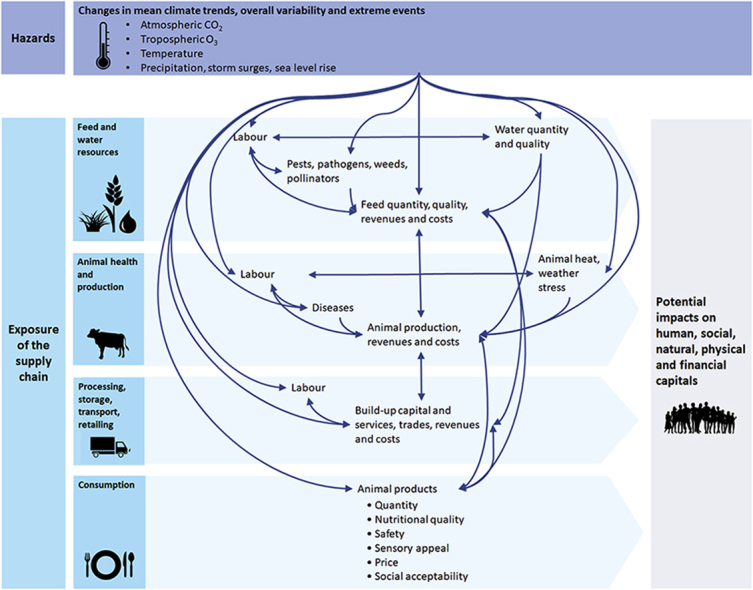
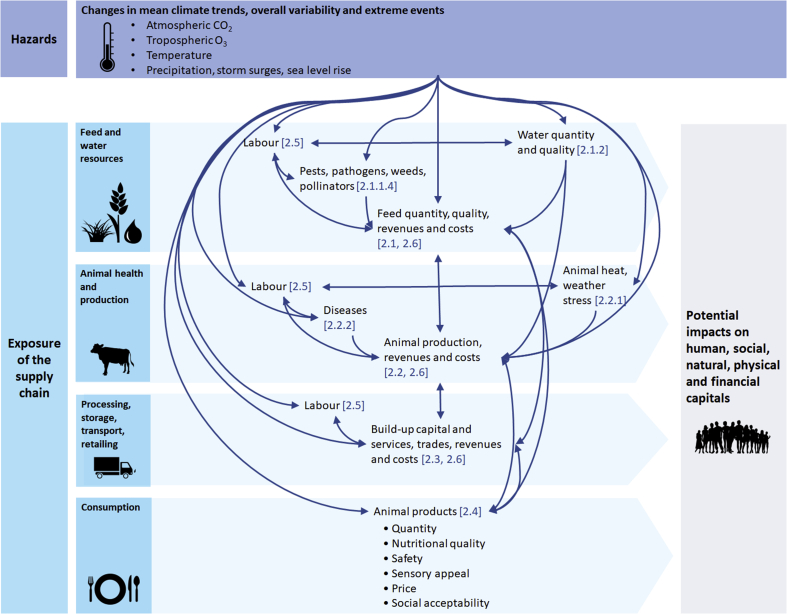
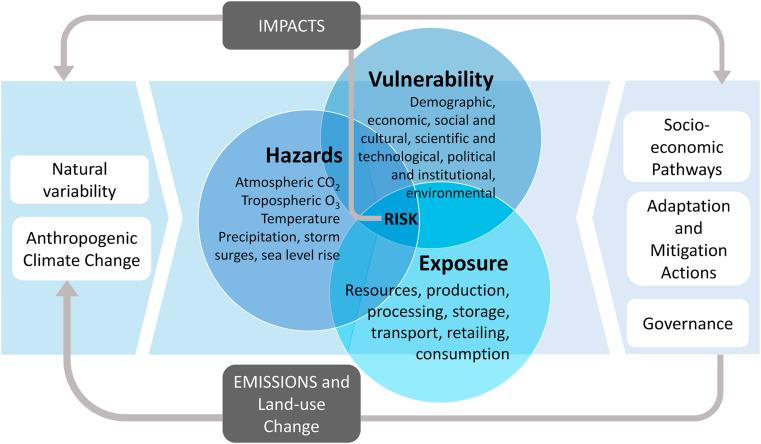
The potential impacts of climate change on current livestock systems worldwide are a major concern, and yet the topic is covered to a limited extent in global reports such as the ones produced by the Intergovernmental Panel on Climate Change. In this article, we review the risk of climate-related impacts along the land-based livestock food supply chain. Although a quantification of the net impacts of climate change on the livestock sector is beyond the reach of our current understanding, there is strong evidence that there will be impacts throughout the supply chain, from farm production to processing operations, storage, transport, retailing and human consumption. The risks of climate-related impacts are highly context-specific but expected to be higher in environments that are already hot and have limited socio-economic and institutional resources for adaptation. Large uncertainties remain as to climate futures and the exposure and responses of the interlinked human and natural systems to climatic changes over time. Consequently, adaptation choices will need to account for a wide range of possible futures, including those with low probability but large consequences.
气候变化对全球当前畜牧系统的潜在影响是一个重大关切问题,然而在诸如政府间气候变化专门委员会发布的全球报告中,该主题的涵盖程度有限。在本文中,我们审视了陆地畜牧食品供应链上与气候相关影响的风险。尽管气候变化对畜牧部门的净影响量化超出了我们目前的理解范围,但有强有力的证据表明,从农场生产到加工操作、储存、运输、零售及人类消费,整个供应链都会受到影响。与气候相关影响的风险高度因具体情况而异,但预计在已经炎热且适应方面社会经济和体制资源有限的环境中风险更高。关于气候未来以及相互关联的人类和自然系统随时间对气候变化的暴露和应对,仍存在很大的不确定性。因此,适应选择将需要考虑到广泛的可能未来,包括那些概率低但后果严重的未来。