Veterinary Parasitology and Ecology Group, University of Bristol, Bristol Life Sciences Building, Bristol, BS8 1TQ, UK.
Glob Chang Biol. 2014 Oct;20(10):3092-102. doi: 10.1111/gcb.12589. Epub 2014 May 2.
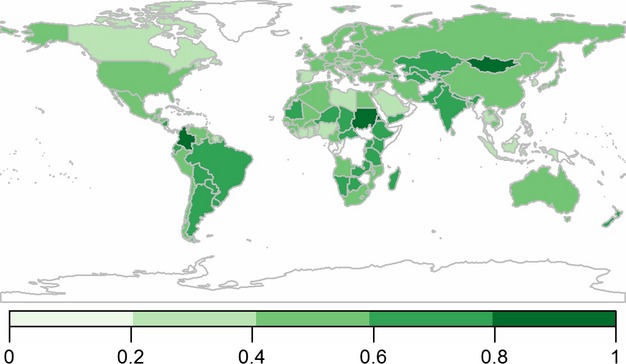
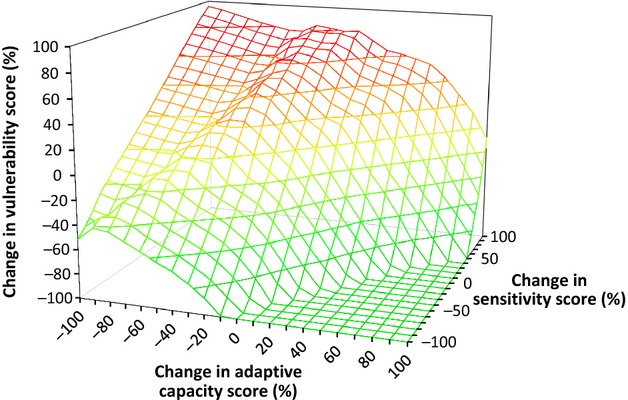
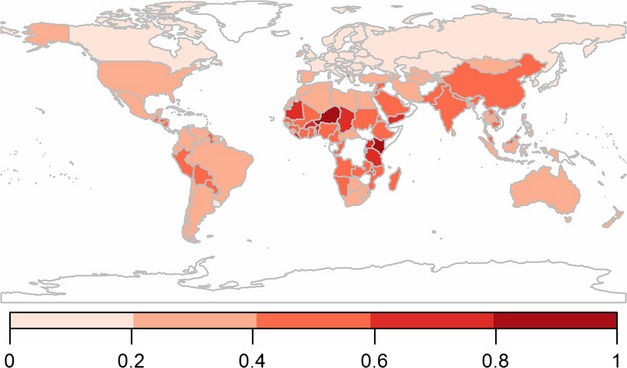
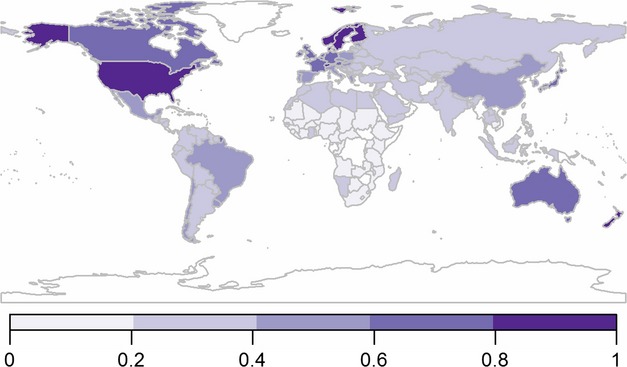
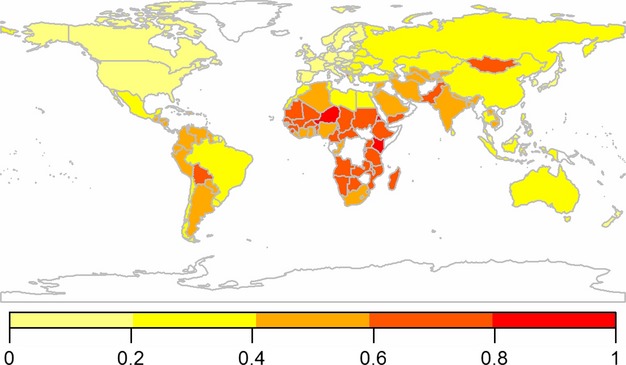
Livestock production is an important contributor to sustainable food security for many nations, particularly in low-income areas and marginal habitats that are unsuitable for crop production. Animal products account for approximately one-third of global human protein consumption. Here, a range of indicators, derived from FAOSTAT and World Bank statistics, are used to model the relative vulnerability of nations at the global scale to predicted climate and population changes, which are likely to impact on their use of grazing livestock for food. Vulnerability analysis has been widely used in global change science to predict impacts on food security and famine. It is a tool that is useful to inform policy decision making and direct the targeting of interventions. The model developed shows that nations within sub-Saharan Africa, particularly in the Sahel region, and some Asian nations are likely to be the most vulnerable. Livestock-based food security is already compromised in many areas on these continents and suffers constraints from current climate in addition to the lack of economic and technical support allowing mitigation of predicted climate change impacts. Governance is shown to be a highly influential factor and, paradoxically, it is suggested that current self-sufficiency may increase future potential vulnerability because trade networks are poorly developed. This may be relieved through freer trade of food products, which is also associated with improved governance. Policy decisions, support and interventions will need to be targeted at the most vulnerable nations, but given the strong influence of governance, to be effective, any implementation will require considerable care in the management of underlying structural reform.
畜牧业生产是许多国家可持续粮食安全的重要贡献者,特别是在低收入地区和不适宜作物生产的边缘生境。动物产品约占全球人类蛋白质消费的三分之一。在这里,使用来自粮农组织统计数据库和世界银行统计数据的一系列指标,对各国在全球范围内对预测气候和人口变化的相对脆弱性进行建模,这些变化可能会影响其对放牧牲畜作为食物的利用。脆弱性分析已广泛应用于全球变化科学,以预测对粮食安全和饥荒的影响。它是一种有用的工具,可以为政策决策提供信息,并指导干预措施的针对性。所开发的模型表明,撒哈拉以南非洲的国家,特别是萨赫勒地区的国家,以及一些亚洲国家可能是最脆弱的。这些大陆的许多地区已经存在基于畜牧业的粮食安全问题,除了缺乏经济和技术支持以减轻预测的气候变化影响之外,目前的气候也对其造成了限制。治理被证明是一个非常重要的因素,具有讽刺意味的是,目前的自给自足可能会增加未来的潜在脆弱性,因为贸易网络发展不佳。这可以通过更自由的粮食产品贸易来缓解,这也与改善治理有关。政策决策、支持和干预措施需要针对最脆弱的国家,但考虑到治理的强烈影响,为了有效实施,任何实施都需要在管理潜在的结构改革方面非常谨慎。