Zhang Li, Pilarowski Genay, Pich Emilio Merlo, Nakatani Atsushi, Dunlop John, Baba Rina, Matsuda Satoru, Daini Masaki, Hattori Yasushi, Matsumoto Shigemitsu, Ito Mitsuhiro, Kimura Haruhide, Bjornsson Hans Tomas
McKusick-Nathans Department of Genetic Medicine, Johns Hopkins University School of Medicine, Baltimore, MD 21205, USA.
Takeda Pharmaceutical Company Limited, Fujisawa, Kanagawa, Japan.
Mol Ther Methods Clin Dev. 2021 Feb 18;20:779-791. doi: 10.1016/j.omtm.2021.02.011. eCollection 2021 Mar 12.
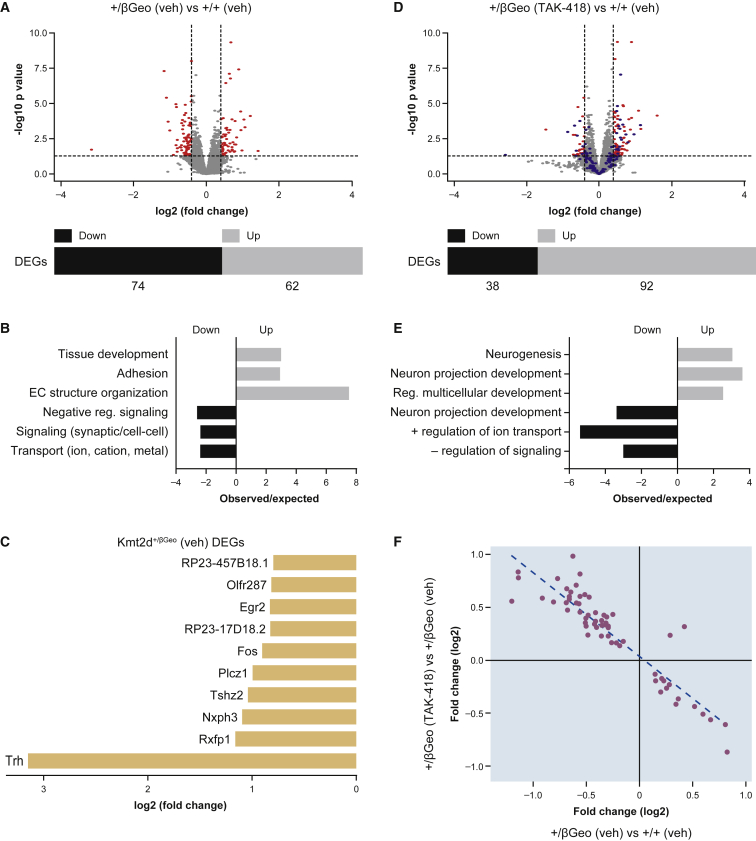
Kabuki syndrome (KS) is a rare cause of intellectual disability primarily caused by loss-of-function mutations in lysine-specific methyltransferase 2D (), which normally adds methyl marks to lysine 4 on histone 3. Previous studies have shown that a mouse model of KS ( ) demonstrates disruption of adult neurogenesis and hippocampal memory. Proof-of-principle studies have shown postnatal rescue of neurological dysfunction following treatments that promote chromatin opening; however, these strategies are non-specific and do not directly address the primary defect of histone methylation. Since lysine-specific demethylase 1A (LSD1/KDM1A) normally removes the H3K4 methyl marks added by KMT2D, we hypothesized that inhibition of KDM1A demethylase activity may ameliorate molecular and phenotypic defects stemming from KMT2D loss. To test this hypothesis, we evaluated a recently developed KDM1A inhibitor (TAK-418) in mice. We found that orally administered TAK-418 increases the numbers of newly born doublecortin (DCX) cells and processes in the hippocampus in a dose-dependent manner. We also observed TAK-418-dependent rescue of histone modification defects in hippocampus both by western blot and chromatin immunoprecipitation sequencing (ChIP-seq). Treatment rescues gene expression abnormalities including those of immediate early genes such as FBJ osteosarcoma oncogene () and FBJ osteosarcoma oncogene homolog B (. After 2 weeks of TAK-418, mice demonstrated normalization of hippocampal memory defects. In summary, our data suggest that KDM1A inhibition is a plausible treatment strategy for KS and support the hypothesis that the epigenetic dysregulation secondary to KMT2D dysfunction plays a major role in the postnatal neurological disease phenotype in KS.
歌舞伎综合征(KS)是导致智力残疾的一种罕见病因,主要由赖氨酸特异性甲基转移酶2D(KMT2D)功能丧失突变引起,该酶通常会在组蛋白3的赖氨酸4上添加甲基标记。先前的研究表明,KS的小鼠模型(Kmt2d−/−)显示出成年神经发生和海马记忆受到破坏。原理验证研究表明,在促进染色质开放的治疗后,出生后神经功能障碍得到挽救;然而,这些策略是非特异性的,并没有直接解决组蛋白甲基化的主要缺陷。由于赖氨酸特异性去甲基化酶1A(LSD1/KDM1A)通常会去除KMT2D添加的H3K4甲基标记,我们假设抑制KDM1A去甲基酶活性可能会改善因KMT2D缺失而产生的分子和表型缺陷。为了验证这一假设,我们在Kmt2d−/−小鼠中评估了一种最近开发的KDM1A抑制剂(TAK-418)。我们发现,口服TAK-418能以剂量依赖的方式增加海马中新生成的双皮质素(DCX)细胞和突起的数量。我们还通过蛋白质免疫印迹法和染色质免疫沉淀测序(ChIP-seq)观察到TAK-418对海马中组蛋白修饰缺陷具有依赖性挽救作用。治疗挽救了基因表达异常,包括立即早期基因如FBJ骨肉瘤癌基因(Fos)和FBJ骨肉瘤癌基因同源物B(Fosb)的表达异常。在给予TAK-418两周后,Kmt2d−/−小鼠的海马记忆缺陷恢复正常。总之,我们的数据表明,抑制KDM1A是一种合理的KS治疗策略,并支持以下假设:KMT2D功能障碍继发的表观遗传失调在KS的出生后神经疾病表型中起主要作用。