Department of Gynecology and Obstetrics, Medical Faculty and University Hospital Carl Gustav Carus, Technische Universität Dresden, Germany.
National Center for Tumour Diseases (NCT), Dresden, Germany.
Mol Oncol. 2021 Dec;15(12):3626-3638. doi: 10.1002/1878-0261.12949. Epub 2021 Apr 2.
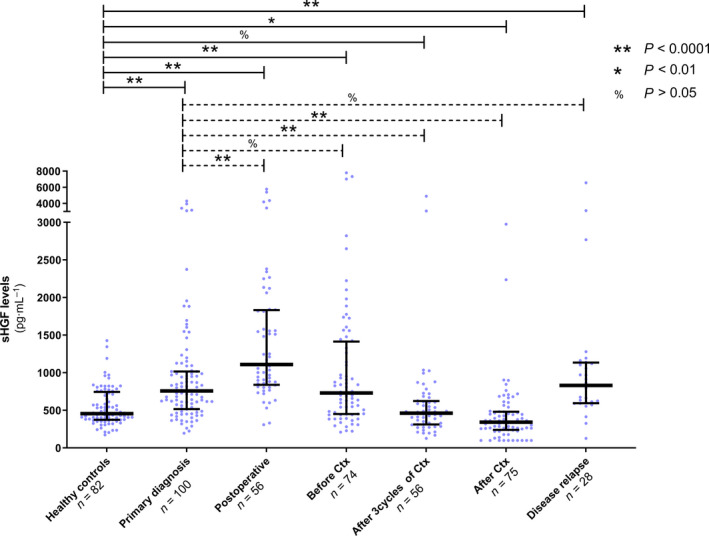
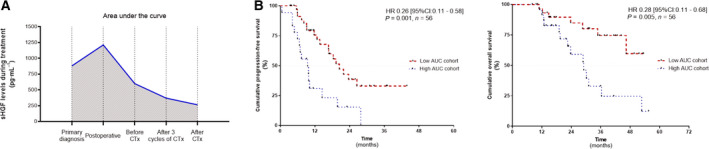
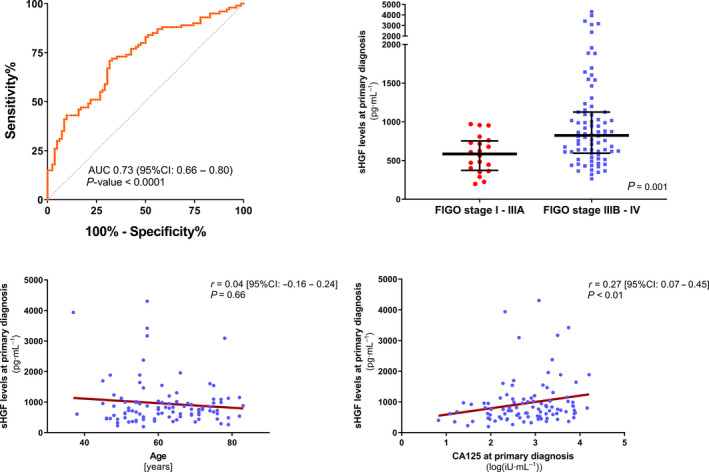
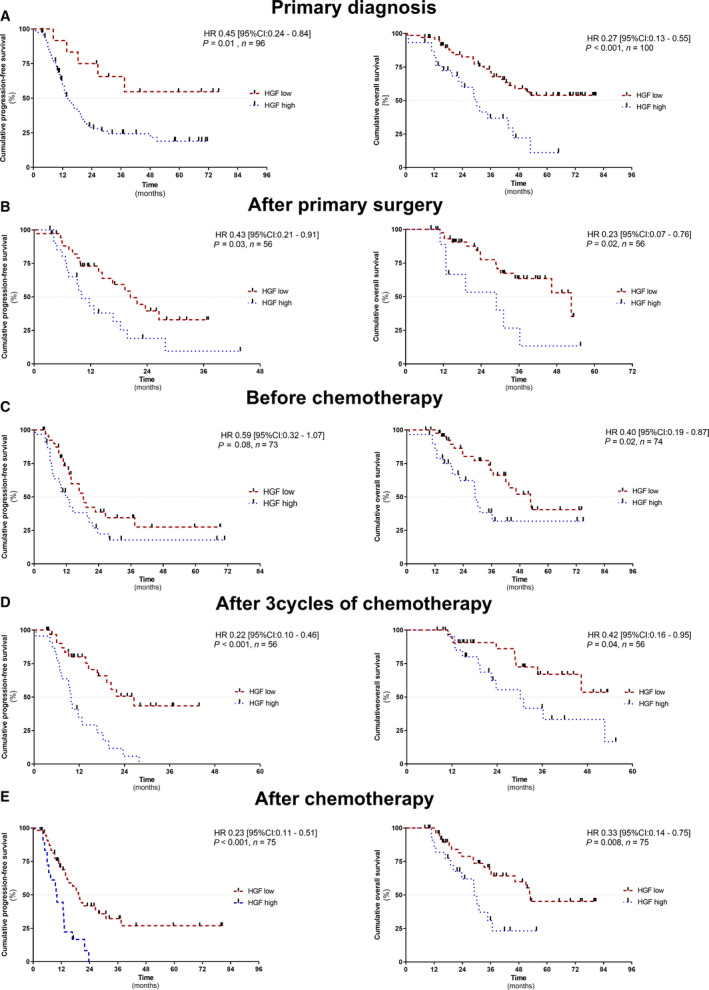
The pleiotropic protein hepatocyte growth factor (HGF) is the only known ligand of the tyrosine kinase mesenchymal-epithelial transition (cMET) receptor. The HGF/cMET pathway mediates invasion and migration of ovarian cancer cells, and upregulation of HGF/cMET pathway components has been associated with poor prognosis. This study investigated the clinical relevance of circulating HGF in serum of patients with ovarian cancer. Serum HGF (sHGF) was determined by enzyme-linked immunosorbent assay in a total of 471 serum samples from 82 healthy controls and 113 patients with ovarian cancer (88.5% with ≥ FIGO III). Patient samples were collected at primary diagnosis and at four follow-up time points throughout treatment and at disease recurrence. Patients with ovarian cancer showed elevated median sHGF levels at primary diagnosis, and sHGF levels transiently increased after surgery and normalized in the course of chemotherapy, even dropping below initial baseline. Higher levels of sHGF were an independent predictor for shorter overall survival (OS) (a) at primary diagnosis (HR = 0.41, 95% CI: 0.22-0.78, P = 0.006), (b) at longitudinal follow-up time points (after surgery and before/during/after chemotherapy), (c) along the patients' individual dynamics (HR = 0.21, 95% CI: 0.07-0.63, P = 0.005), and (d) among a subgroup analysis of patients with BRCA1/2 wild-type ovarian cancer. This is the first study proposing sHGF as an independent prognostic biomarker for ovarian cancer at primary diagnosis and in the course of platinum-based chemotherapy, irrespective of the postoperative residual disease after surgical debulking. sHGF could be implemented into clinical diagnostics as a CA125 auxiliary tumor marker for individualized prognosis stratification and sHGF-guided therapy monitoring.
多效蛋白肝细胞生长因子(HGF)是唯一已知的酪氨酸激酶间质上皮转化(cMET)受体配体。HGF/cMET 通路介导卵巢癌细胞的侵袭和迁移,HGF/cMET 通路成分的上调与预后不良相关。本研究探讨了卵巢癌患者血清中循环 HGF 的临床相关性。在总共 471 份血清样本中,用酶联免疫吸附试验测定了 82 名健康对照者和 113 名卵巢癌患者(88.5%为 FIGO III 期)的血清 HGF(sHGF)。患者样本在初次诊断时采集,并在治疗过程中和疾病复发时在四个随访时间点采集。卵巢癌患者在初次诊断时表现出升高的 sHGF 中位数水平,并且在手术后 sHGF 水平短暂升高,并在化疗过程中恢复正常,甚至降至初始基线以下。较高的 sHGF 水平是总生存期(OS)较短的独立预测因子:(a)在初次诊断时(HR=0.41,95%CI:0.22-0.78,P=0.006);(b)在纵向随访时间点(手术后和化疗前/期间/后);(c)沿患者个体动态变化(HR=0.21,95%CI:0.07-0.63,P=0.005);(d)在 BRCA1/2 野生型卵巢癌的亚组分析中。这是第一项研究,该研究提出 sHGF 是初次诊断和铂类化疗过程中卵巢癌的独立预后生物标志物,与手术减瘤后术后残留疾病无关。sHGF 可作为 CA125 辅助肿瘤标志物,纳入临床诊断,用于个体化预后分层和 sHGF 指导的治疗监测。