Department of Psychiatry, University of Pittsburgh, Pittsburgh, Pennsylvania, USA.
Department of Psychology, Carnegie Mellon University, Pittsburgh, Pennsylvania, USA.
Hum Brain Mapp. 2021 Jun 1;42(8):2445-2460. doi: 10.1002/hbm.25378. Epub 2021 Mar 19.
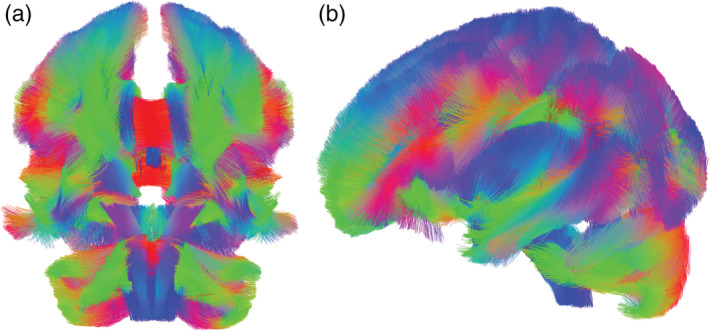
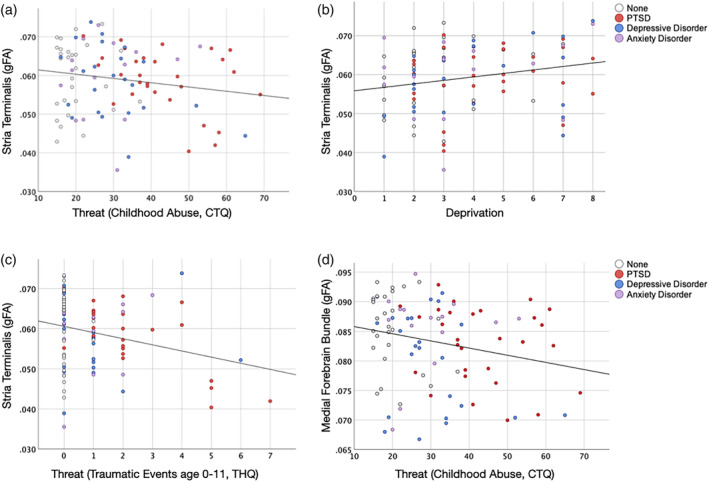
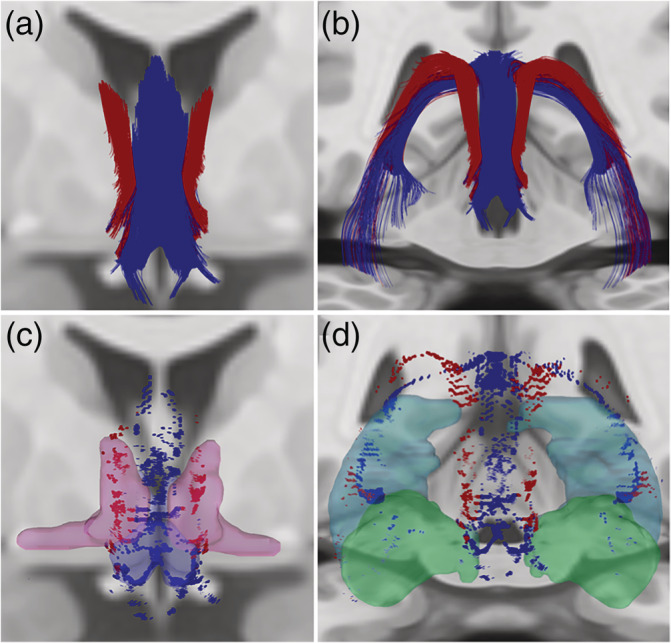
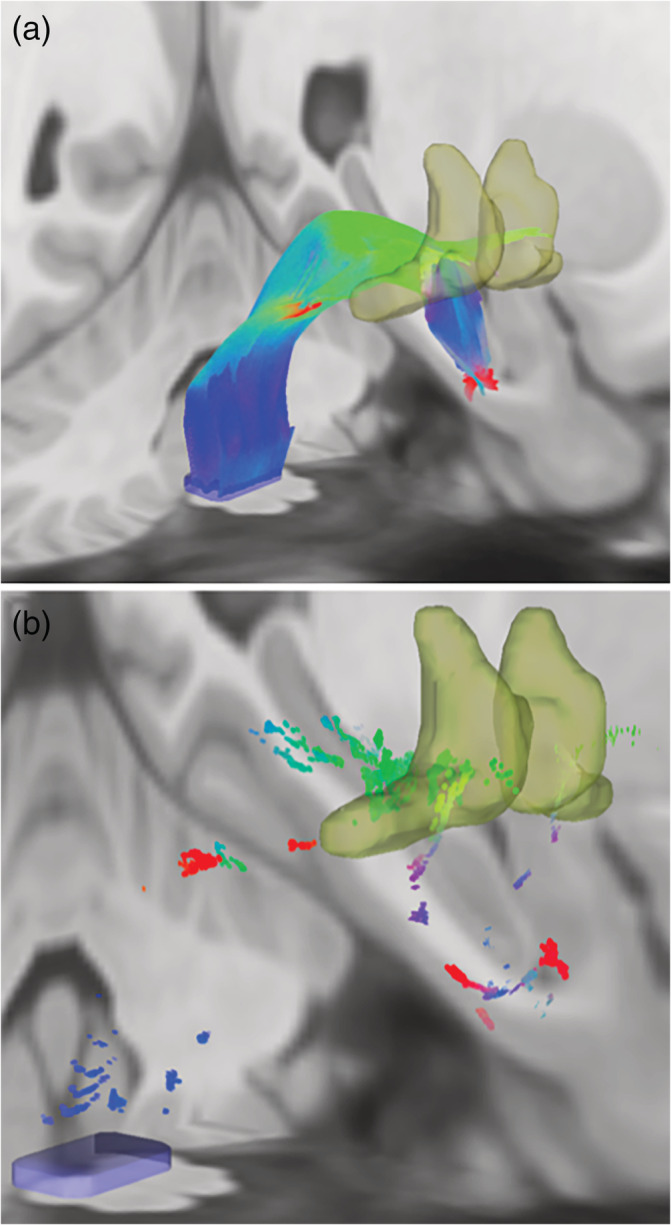
While stress may be a potential mechanism by which childhood threat and deprivation influence mental health, few studies have considered specific stress-related white matter pathways, such as the stria terminalis (ST) and medial forebrain bundle (MFB). Our goal was to examine the relationships between childhood adversity and ST and MFB structural integrity and whether these pathways may provide a link between childhood adversity and affective symptoms and disorders. Participants were young adults (n = 100) with a full distribution of maltreatment history and affective symptom severity. Threat was determined by measures of childhood abuse and repeated traumatic events. Socioeconomic deprivation (SED) was determined by a measure of childhood socioeconomic status (parental education). Participants underwent diffusion spectrum imaging. Human Connectome Project data was used to perform ST and MFB tractography; these tracts were used as ROIs to extract generalized fractional anisotropy (gFA) from each participant. Childhood threat was associated with ST gFA, such that greater threat was associated with less ST gFA. SED was also associated with ST gFA, however, conversely to threat, greater SED was associated with greater ST gFA. Additionally, threat was negatively associated with MFB gFA, and MFB gFA was negatively associated with post-traumatic stress symptoms. Our results suggest that childhood threat and deprivation have opposing influences on ST structural integrity, providing new evidence that the context of childhood adversity may have an important influence on its neurobiological effects, even on the same structure. Further, the MFB may provide a novel link between childhood threat and affective symptoms.
虽然压力可能是童年期威胁和剥夺影响心理健康的一个潜在机制,但很少有研究考虑特定的与压力相关的白质通路,如终纹床核(ST)和内侧前脑束(MFB)。我们的目标是研究童年逆境与 ST 和 MFB 结构完整性之间的关系,以及这些通路是否可能成为童年逆境与情感症状和障碍之间的联系。参与者为有完整受虐史和情感症状严重程度分布的年轻成年人(n=100)。威胁由童年期虐待和反复创伤事件的测量来确定。社会经济剥夺(SED)由童年期社会经济地位(父母教育)的测量来确定。参与者接受了弥散张量成像。人类连接组计划的数据被用来进行 ST 和 MFB 束追踪;这些束被用作 ROI ,从每个参与者中提取广义各向异性分数(gFA)。童年期威胁与 ST 的 gFA 相关,即威胁越大,ST 的 gFA 越低。SED 也与 ST 的 gFA 相关,但与威胁相反,SED 越大,ST 的 gFA 越高。此外,威胁与 MFB 的 gFA 呈负相关,而 MFB 的 gFA 与创伤后应激症状呈负相关。我们的结果表明,童年期威胁和剥夺对 ST 结构完整性有相反的影响,这提供了新的证据,即童年逆境的背景可能对其神经生物学效应有重要影响,即使是对同一结构也是如此。此外,MFB 可能为童年期威胁与情感症状之间提供了新的联系。