Banihashemi Layla, Peng Christine W, Rangarajan Anusha, Karim Helmet T, Wallace Meredith L, Sibbach Brandon M, Singh Jaspreet, Stinley Mark M, Germain Anne, Aizenstein Howard J
Department of Psychiatry, University of Pittsburgh, Pittsburgh, PA, United States.
Department of Bioengineering, University of Pittsburgh, Pittsburgh, PA, United States.
Front Psychol. 2022 Mar 3;13:805049. doi: 10.3389/fpsyg.2022.805049. eCollection 2022.
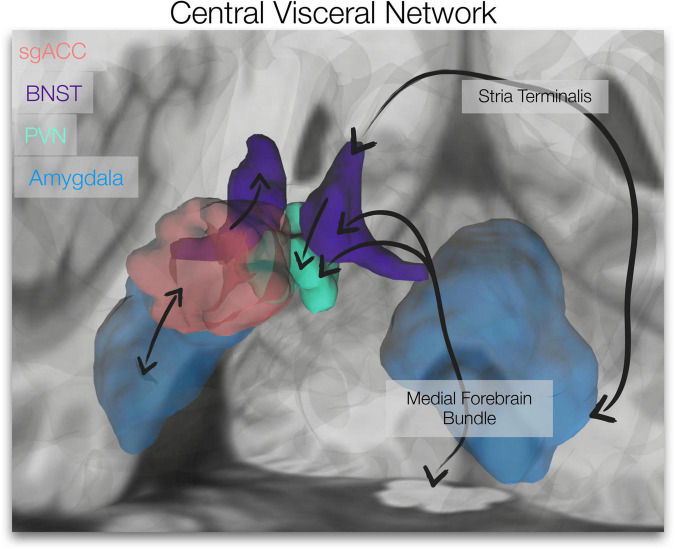
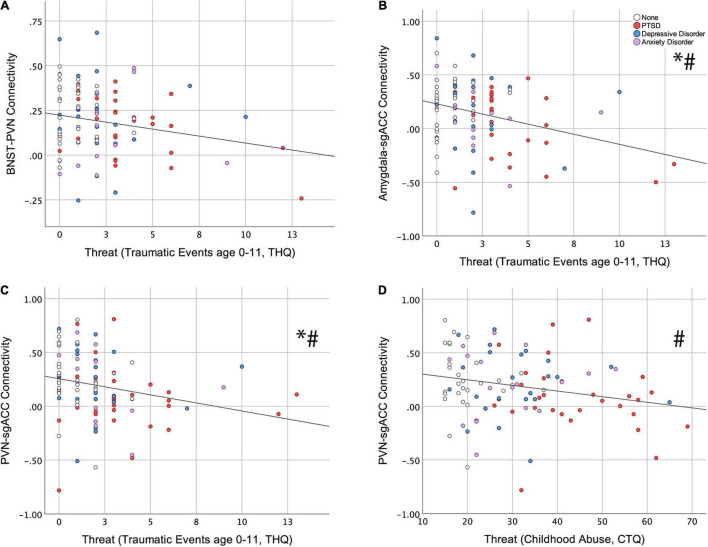
Childhood adversity is associated with altered or dysregulated stress reactivity; these altered patterns of physiological functioning persist into adulthood. Evidence from both preclinical animal models and human neuroimaging studies indicates that early life experience differentially influences stressor-evoked activity within central visceral neural circuits proximally involved in the control of stress responses, including the subgenual anterior cingulate cortex (sgACC), paraventricular nucleus of the hypothalamus (PVN), bed nucleus of the stria terminalis (BNST) and amygdala. However, the relationship between childhood adversity and the resting-state connectivity of this central visceral network remains unclear. To this end, we examined relationships between childhood threat and childhood socioeconomic deprivation, the resting-state connectivity between our regions of interest (ROIs), and affective symptom severity and diagnoses. We recruited a transdiagnostic sample of young adult males and females ( = 100; mean age = 27.28, = 3.99; 59 females) with a full distribution of maltreatment history and symptom severity across multiple affective disorders. Resting-state data were acquired using a 7.2-min functional magnetic resonance imaging (fMRI) sequence; noted ROIs were applied as masks to determine ROI-to-ROI connectivity. Threat was determined by measures of childhood traumatic events and abuse. Socioeconomic deprivation (SED) was determined by a measure of childhood socioeconomic status (parental education level). Covarying for age, race and sex, greater childhood threat was significantly associated with lower BNST-PVN, amygdala-sgACC and PVN-sgACC connectivity. No significant relationships were found between SED and resting-state connectivity. BNST-PVN connectivity was associated with the number of lifetime affective diagnoses. Exposure to threat during early development may entrain altered patterns of resting-state connectivity between these stress-related ROIs in ways that contribute to dysregulated neural and physiological responses to stress and subsequent affective psychopathology.
童年逆境与应激反应改变或失调有关;这些生理功能改变的模式会持续到成年期。临床前动物模型和人类神经影像学研究的证据表明,早期生活经历会差异性地影响中枢内脏神经回路中应激源诱发的活动,这些神经回路近端参与应激反应的控制,包括膝下前扣带回皮质(sgACC)、下丘脑室旁核(PVN)、终纹床核(BNST)和杏仁核。然而,童年逆境与这个中枢内脏网络静息态连通性之间的关系仍不清楚。为此,我们研究了童年威胁与童年社会经济剥夺、感兴趣区域(ROIs)之间的静息态连通性以及情感症状严重程度和诊断之间的关系。我们招募了一个跨诊断的年轻成年男性和女性样本(n = 100;平均年龄 = 27.28,标准差 = 3.99;59名女性),他们在多种情感障碍中的虐待史和症状严重程度分布全面。使用7.2分钟的功能磁共振成像(fMRI)序列采集静息态数据;将指定的ROIs用作掩码以确定ROI到ROI的连通性。威胁通过童年创伤事件和虐待的测量来确定。社会经济剥夺(SED)通过童年社会经济地位(父母教育水平)的测量来确定。在对年龄、种族和性别进行协变量调整后,更大的童年威胁与更低的BNST - PVN、杏仁核 - sgACC和PVN - sgACC连通性显著相关。未发现SED与静息态连通性之间存在显著关系。BNST - PVN连通性与终身情感诊断的数量相关。早期发育期间暴露于威胁可能会导致这些与应激相关的ROIs之间静息态连通性模式改变,从而导致对压力的神经和生理反应失调以及随后的情感精神病理学。