Department of Epidemiology, Columbia University Mailman School of Public Health, New York, New York, United States of America.
New York State Psychiatric Institute, New York, New York, United States of America.
PLoS One. 2021 Mar 19;16(3):e0248641. doi: 10.1371/journal.pone.0248641. eCollection 2021.
The World Health Organization recommends that treatment of depression in low and middle-income countries with a scarcity of psychiatrists could be done in primary care and should include prescription of antidepressant medications for moderate and severe depression. Little is known, however, about the actual practices of antidepressant prescription by primary care physicians in low and middle-income countries, nor about adherence by people receiving such prescriptions. In a large study of primary care clinics in Goa, India, we examined the relationship of actual to recommended prescribing practices for depression, among all patients who screened positive for common mental disorder. We also examined other patient and clinic characteristics associated with antidepressant prescription, and self-reported adherence over a one-month period.
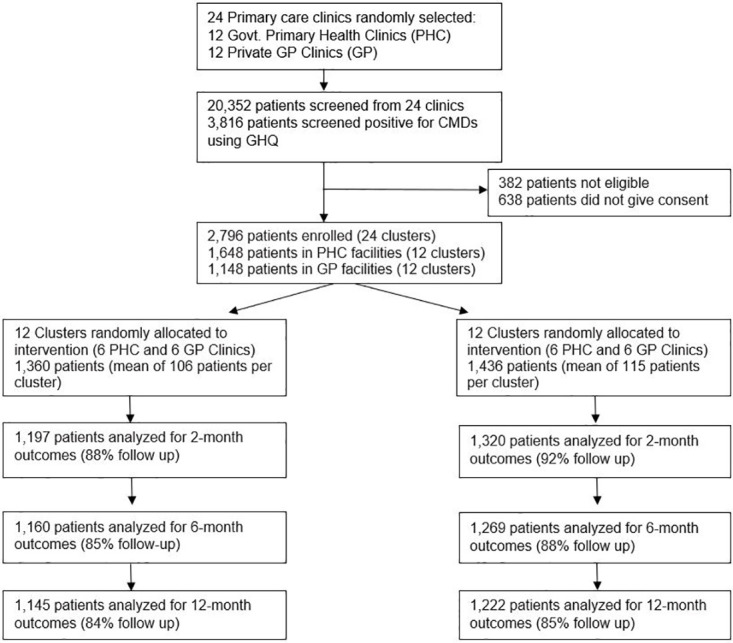
Patients attending 24 primary care clinics were screened for common mental disorders. Those who screened positive were eligible to enroll in a trial to assess the effectiveness of a collaborative stepped care (CSC) intervention for mental disorders. Physicians in the 12 intervention and 12 control clinics (usual care) were free to prescribe antidepressants and follow-up interviews were conducted at 2, 6 and 12 months. Screening results were shared with the physician, but they were blinded to the diagnosis generated later using a standardized diagnostic interview administered by a health counsellor. We categorized these later diagnoses as "moderate/severe depression", "mild depression or non-depression diagnosis", and "no diagnosis". We used a two-level hierarchical logistic regression model to examine diagnostic and other factors associated with antidepressant prescription and one-month adherence.
Overall, about 47% of screened positive patients (n = 1320) received an antidepressant prescription: 60% of those with moderate/severe depression, 48% of those with mild depression or non-depression diagnosis, and 31% with no diagnosis. Women (OR 1.29; 95%CI 1.04-1.60) and older adults (OR 1.80; 95%CI 1.32-2.47) were more likely to receive an antidepressant prescription. While the overall rate of antidepressant prescription was similar in clinics with and without CSC, patients without any diagnosis were more likely to receive a prescription (OR 2.20 95% CI 1.03-4.70) in the usual care clinics. About 47% of patients adhered to antidepressant treatment for one month or more and adherence was significantly better among older adults (OR 3.92; 95% CI 1.70-8.93) and those who received antidepressant as part of the CSC treatment model (OR 6.10 95% CI 3.67-10.14) compared with those attending the usual care clinic.
Antidepressants were widely prescribed following screening in primary care, but prescription patterns were in poor accord with WHO recommendations. The data suggest under-prescription for people with moderate/severe depression; over-prescription for people with mild depression or non-depression diagnoses; and over-prescription for people with no disorders. For all diagnoses adherence was low, especially in usual care clinics. To address these concerns, there is an urgent need to study and develop strategies in primary care practices to limit unnecessary antidepressant prescriptions, target prescription for those patients who clearly benefit, and to improve adherence to antidepressant treatment. ClinicalTrials.gov Identifier: NCT00446407.
世界卫生组织建议,在精神科医生短缺的中低收入国家,可以在初级保健中治疗抑郁症,并且应该包括为中重度抑郁症开具抗抑郁药物的处方。然而,对于初级保健医生实际开具抗抑郁药物处方的情况,以及接受这些处方的患者的遵医嘱情况,我们知之甚少。在印度果阿的一项大型初级保健诊所研究中,我们考察了实际与推荐的抗抑郁药物处方之间的关系,研究对象为所有筛查出常见精神障碍阳性的患者。我们还考察了其他与抗抑郁药物处方相关的患者和诊所特征,以及一个月内的自我报告的遵医嘱情况。
参加 24 个初级保健诊所的患者接受了常见精神障碍的筛查。那些筛查阳性的患者有资格参加评估精神障碍协作阶梯式治疗(CSC)干预有效性的试验。12 个干预诊所和 12 个对照诊所(常规护理)的医生可以自由开具抗抑郁药物,并且在 2、6 和 12 个月时进行随访访谈。将筛查结果与医生共享,但医生对随后使用健康顾问进行的标准化诊断访谈得出的诊断结果是盲态的。我们将这些后来的诊断归类为“中度/重度抑郁”、“轻度抑郁或非抑郁诊断”和“无诊断”。我们使用两水平分层逻辑回归模型来考察诊断和其他因素与抗抑郁药物处方和一个月的遵医嘱情况之间的关系。
总的来说,约 47%的筛查阳性患者(n=1320)收到了抗抑郁药物处方:中度/重度抑郁患者中 60%,轻度抑郁或非抑郁诊断患者中 48%,无诊断患者中 31%。女性(OR 1.29;95%CI 1.04-1.60)和老年人(OR 1.80;95%CI 1.32-2.47)更有可能接受抗抑郁药物处方。虽然有和没有 CSC 的诊所开具抗抑郁药物处方的总体比例相似,但在常规护理诊所,没有任何诊断的患者更有可能开具处方(OR 2.20 95%CI 1.03-4.70)。约 47%的患者在一个月或更长时间内坚持服用抗抑郁药物,且老年人(OR 3.92;95%CI 1.70-8.93)和接受 CSC 治疗模式的患者(OR 6.10 95%CI 3.67-10.14)的遵医嘱情况明显更好,而与参加常规护理诊所的患者相比。
在初级保健中进行筛查后,广泛开具了抗抑郁药物,但处方模式与世界卫生组织的建议相差甚远。数据表明,中度/重度抑郁症患者的处方不足;轻度抑郁或非抑郁诊断患者的处方过多;无疾病患者的处方过多。对于所有诊断,依从性都很低,尤其是在常规护理诊所。为了解决这些问题,迫切需要在初级保健实践中研究和制定策略,限制不必要的抗抑郁药物处方,针对那些明显受益的患者开具处方,并提高抗抑郁药物治疗的依从性。临床试验注册编号:NCT00446407。
