Medicine Course, Federal University of Fronteira Sul, Campus Chapecó, Chapecó, SC, Brazil.
Post-Graduation Program in Biological Sciences: Toxicological Biochemistry, CCNE, Federal University of Santa Maria, Santa Maria, RS, Brazil.
Mol Cell Biochem. 2021 Aug;476(8):2891-2898. doi: 10.1007/s11010-021-04130-4. Epub 2021 Mar 19.
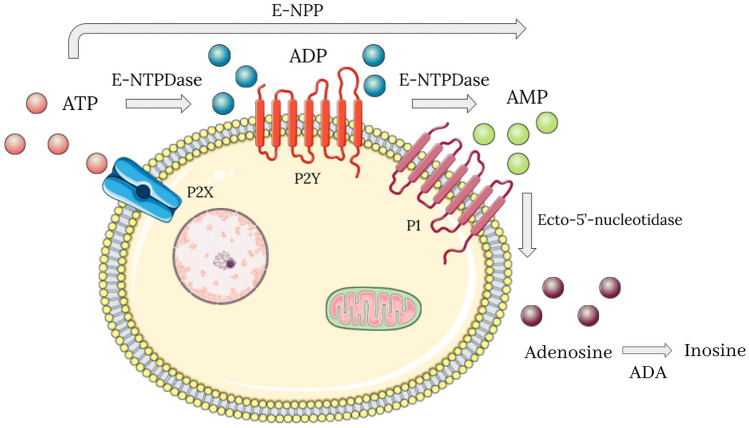
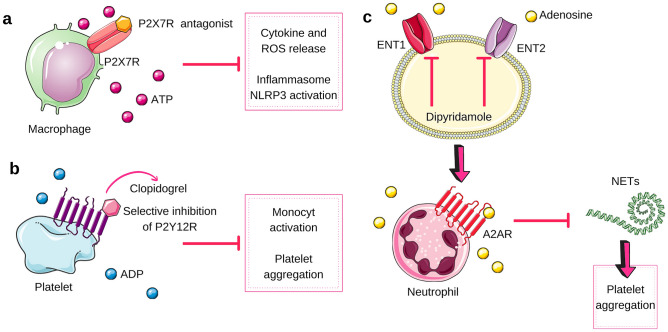
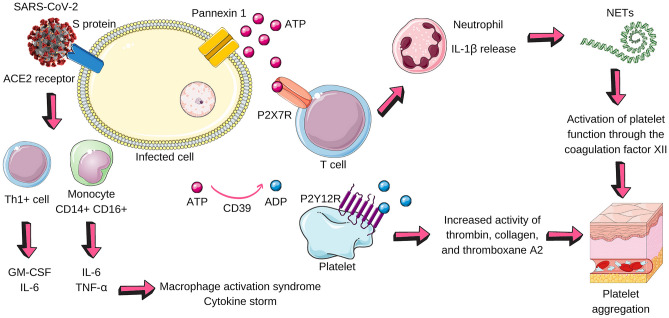
The coronavirus disease (COVID-19), caused by SARS-CoV-2 infection, accounts for more than 2.4 million deaths worldwide, making it the main public health problem in 2020. Purinergic signaling is involved in the pathophysiology of several viral infections which makes the purinergic system a potential target of investigation in COVID-19. During viral infections, the ATP release initiates a cascade that activates purinergic receptors. This receptor activation enhances the secretion of pro-inflammatory cytokines and performs the chemotaxis of macrophages and neutrophils, generating an association between the immune and the purinergic systems. This review was designed to cover the possible functions of purinergic signaling in COVID-19, focusing on the possible role of purinergic receptors such as P2X7 which contributes to cytokine storm and inflammasome NLRP3 activation and P2Y1 that activates the blood coagulation pathway. The possible role of ectonucleotidases, such as CD39 and CD73, which have the function of dephosphorylating ATP in an immunosuppressive component, adenosine, are also covered in detail. Moreover, therapeutic combination or association possibilities targeting purinergic system components are also suggested as a possible useful tool to be tested in future researches, aiming to unveil a novel option to treat COVID-19 patients.
由 SARS-CoV-2 感染引起的冠状病毒病(COVID-19)在全球范围内导致超过 240 万人死亡,成为 2020 年的主要公共卫生问题。嘌呤能信号参与几种病毒感染的病理生理学,这使得嘌呤能系统成为 COVID-19 研究的潜在目标。在病毒感染期间,ATP 的释放引发了一系列级联反应,激活了嘌呤能受体。这种受体的激活增强了促炎细胞因子的分泌,并趋化巨噬细胞和中性粒细胞,从而使免疫和嘌呤能系统之间产生关联。本综述旨在涵盖嘌呤能信号在 COVID-19 中的可能作用,重点关注嘌呤能受体(如 P2X7)的可能作用,该受体有助于细胞因子风暴和炎症小体 NLRP3 的激活,以及 P2Y1 的作用,其激活了血液凝固途径。还详细介绍了核苷酸酶(如 CD39 和 CD73)的可能作用,它们具有将 ATP 去磷酸化为免疫抑制成分腺苷的功能。此外,还提出了针对嘌呤能系统成分的联合治疗或联合治疗的可能性,作为未来研究中可能有用的工具,旨在为 COVID-19 患者的治疗提供新的选择。