Public Policy Office, amfAR, Foundation for AIDS Research, 1100 Vermont Avenue NW, Suite 600, District of Columbia, Washington, DC, 20005, USA.
Department of Population, Family, and Reproductive Health, Johns Hopkins Bloomberg School of Public Health, Baltimore, MD, USA.
BMC Public Health. 2021 Mar 19;21(1):536. doi: 10.1186/s12889-021-10570-w.
Meeting the contraceptive needs of women living with HIV (WLHIV) has primary health benefits for women, in addition to being a key element to prevent mother-to-child HIV transmission. This analysis will estimate the current number of infant HIV infections prevented by contraception in the era of increased HIV treatment coverage and; 2) model the additional HIV benefits of preventing unintended births to WLHIV.
Secondary data analysis was conducted using publicly available data from the United Nations Programme on HIV/AIDS (UNAIDS) and Population Division, Demographic Health Surveys, and peer-review literature. National data from 70 countries, that had a UNAIDS estimate for the number of WLHIV nationally, were combined into country-level models. Models estimated the current number of infant HIV infections averted by contraception annually and potentially averted if unintended births to WLHIV were prevented. Estimates take into account pregnancy and live birth rates, contraceptive coverage, contraceptive method mix and failure rates, and HIV treatment coverage during pregnancy to prevent mother to child transmission.
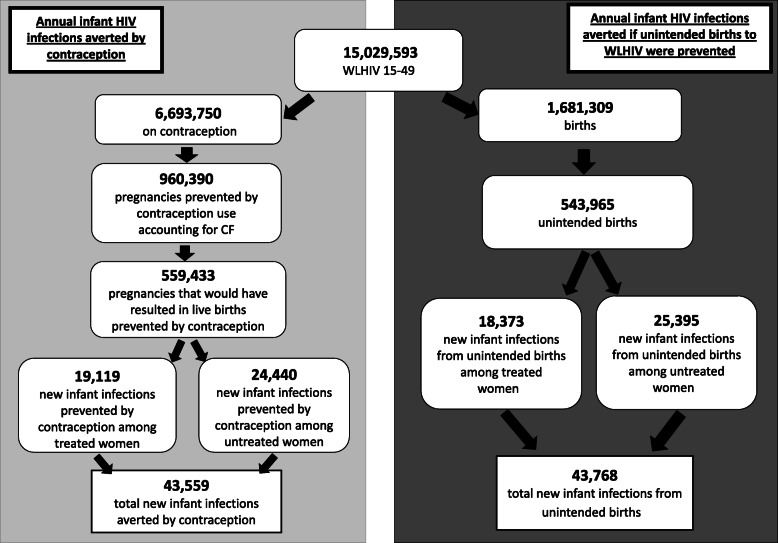
Contraception use among WLHIV prevents an estimated 43,559 new infant HIV infections annually across 70 countries. Countries with the largest number of infant infections averted by contraception included South Africa (9441), Nigeria (4195), Kenya (3508), Zimbabwe (2586), and India (2145). Preventing unintended births to WLHIV could avert an additional 43,768 new infant infections per year, with the greatest potential gains to be made in South Africa (12,036), Nigeria (2770), Uganda (2552), and the Democratic Republic of the Congo (2324).
Contraception continues to play an integral role in global HIV prevention efforts in the era of increasing HIV treatment coverage, especially in sub-Saharan Africa. Broad contraceptive availability, increased contraceptive voluntarism and method mix are key components to preventing unintended births and ending new infant HIV infections worldwide.
满足感染艾滋病毒的妇女(WLHIV)的避孕需求,除了是预防母婴艾滋病毒传播的关键要素外,对妇女的基本健康也有主要益处。本分析旨在:1)估计在艾滋病毒治疗覆盖面扩大的时代,避孕可预防的当前婴儿艾滋病毒感染数量;2)对预防 WLHIV 意外生育进行建模,以估计额外的艾滋病毒预防效益。
使用来自联合国艾滋病毒/艾滋病规划署(UNAIDS)和人口司、人口动态调查和同行评议文献的公开可用数据进行二次数据分析。将来自 70 个国家的国家数据合并到国家一级的模型中,这些国家有 UNAIDS 对全国范围内 WLHIV 数量的估计。模型估计了避孕措施每年预防的婴儿艾滋病毒感染数量,如果预防 WLHIV 的意外生育,潜在可预防的感染数量。这些估计考虑了妊娠和活产率、避孕覆盖率、避孕方法组合和失败率,以及预防母婴传播的孕期艾滋病毒治疗覆盖率。
WLHIV 中的避孕措施每年可预防 70 个国家估计的 43559 例新婴儿艾滋病毒感染。通过避孕措施预防婴儿感染数量最多的国家包括南非(9441)、尼日利亚(4195)、肯尼亚(3508)、津巴布韦(2586)和印度(2145)。预防 WLHIV 的意外生育可能会每年额外预防 43768 例新的婴儿感染,最大的潜在收益将在南非(12036)、尼日利亚(2770)、乌干达(2552)和刚果民主共和国(2324)实现。
在艾滋病毒治疗覆盖面扩大的时代,避孕继续在全球艾滋病毒预防工作中发挥重要作用,尤其是在撒哈拉以南非洲地区。广泛提供避孕措施、增加避孕的自愿性和方法组合是预防意外生育和在全球范围内终止新的婴儿艾滋病毒感染的关键组成部分。