Centre for Life's Origins and Evolution, Department of Genetics, Evolution, and Environment, University College London, Gower Street, London WC1E 6BT, UK.
Oxford University Museum of Natural History, Parks Road, Oxford OX1 3PW, UK.
Sci Adv. 2021 Mar 19;7(12). doi: 10.1126/sciadv.abe2741. Print 2021 Mar.
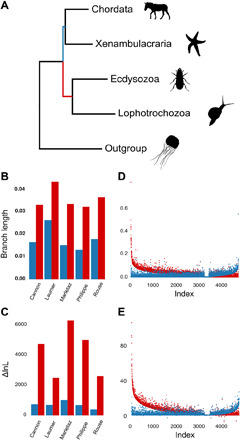
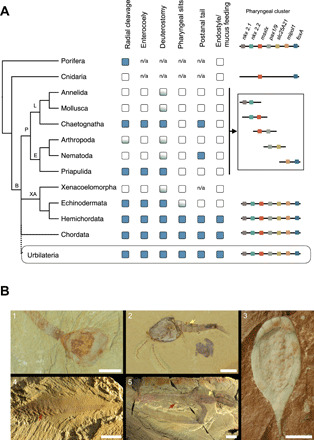
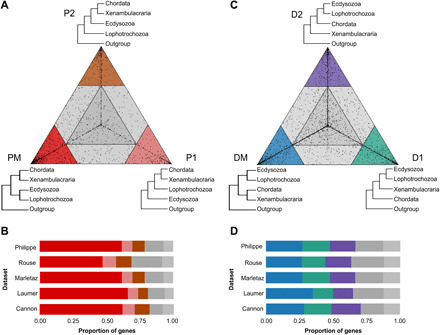
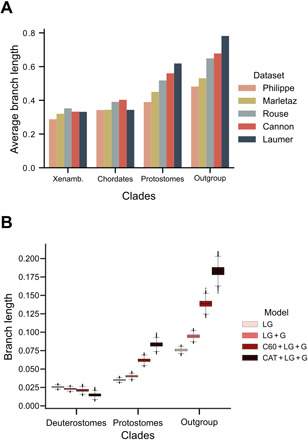
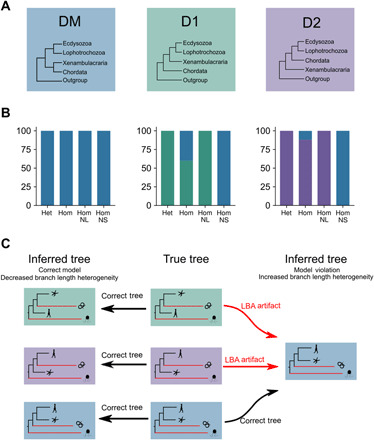
The bilaterally symmetric animals (Bilateria) are considered to comprise two monophyletic groups, Protostomia (Ecdysozoa and the Lophotrochozoa) and Deuterostomia (Chordata and the Xenambulacraria). Recent molecular phylogenetic studies have not consistently supported deuterostome monophyly. Here, we compare support for Protostomia and Deuterostomia using multiple, independent phylogenomic datasets. As expected, Protostomia is always strongly supported, especially by longer and higher-quality genes. Support for Deuterostomia, however, is always equivocal and barely higher than support for paraphyletic alternatives. Conditions that cause tree reconstruction errors-inadequate models, short internal branches, faster evolving genes, and unequal branch lengths-coincide with support for monophyletic deuterostomes. Simulation experiments show that support for Deuterostomia could be explained by systematic error. The branch between bilaterian and deuterostome common ancestors is, at best, very short, supporting the idea that the bilaterian ancestor may have been deuterostome-like. Our findings have important implications for the understanding of early animal evolution.
两侧对称动物(Bilateria)被认为包含两个单系群,原口动物(蜕皮动物和担轮动物)和后口动物(脊索动物和星虫动物)。最近的分子系统发育研究并没有一致支持后口动物的单系性。在这里,我们使用多个独立的基因组数据集来比较原口动物和后口动物的支持情况。正如预期的那样,原口动物总是得到强烈支持,尤其是由更长和更高质量的基因支持。然而,对后口动物的支持总是模棱两可的,几乎高于并系替代方案的支持。导致树重建错误的条件——不适当的模型、短的内部分支、进化更快的基因和不等长的分支——与支持后生动物的单系性一致。模拟实验表明,后生动物的支持可以用系统误差来解释。两侧动物和后口动物共同祖先之间的分支充其量非常短,这支持了这样一种观点,即两侧动物的祖先是后生动物样的。我们的发现对理解早期动物进化具有重要意义。