MRC Human Genetics Unit, Institute of Genetics and Molecular Medicine, University of Edinburgh, Western General Hospital, Edinburgh, United Kingdom.
Transmissible Cancer Group, Department of Veterinary Medicine, Cambridge, United Kingdom.
Mol Biol Evol. 2022 Feb 3;39(2). doi: 10.1093/molbev/msab317.
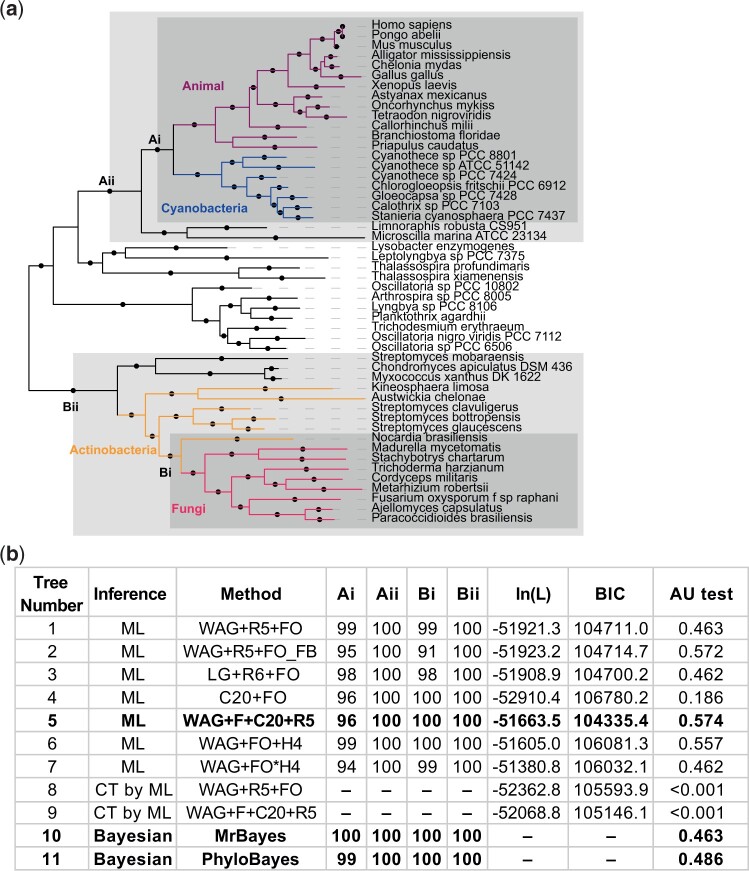
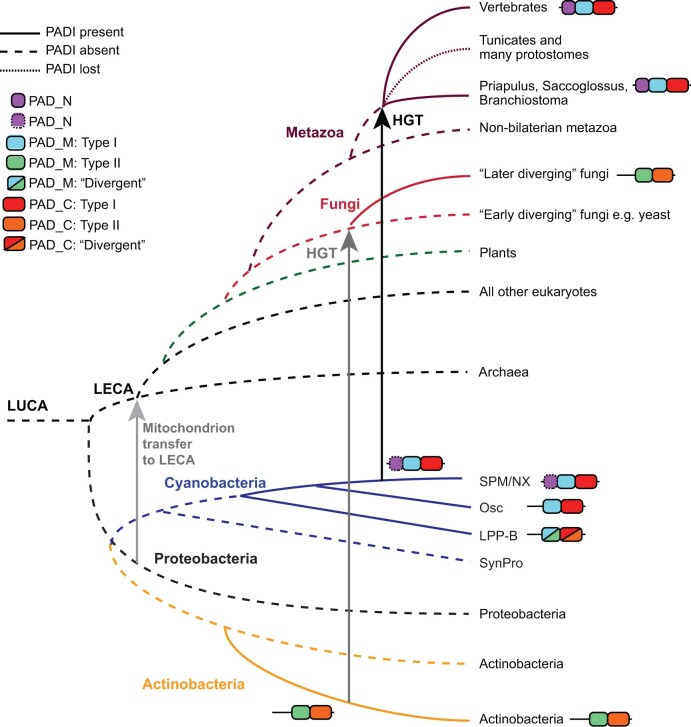
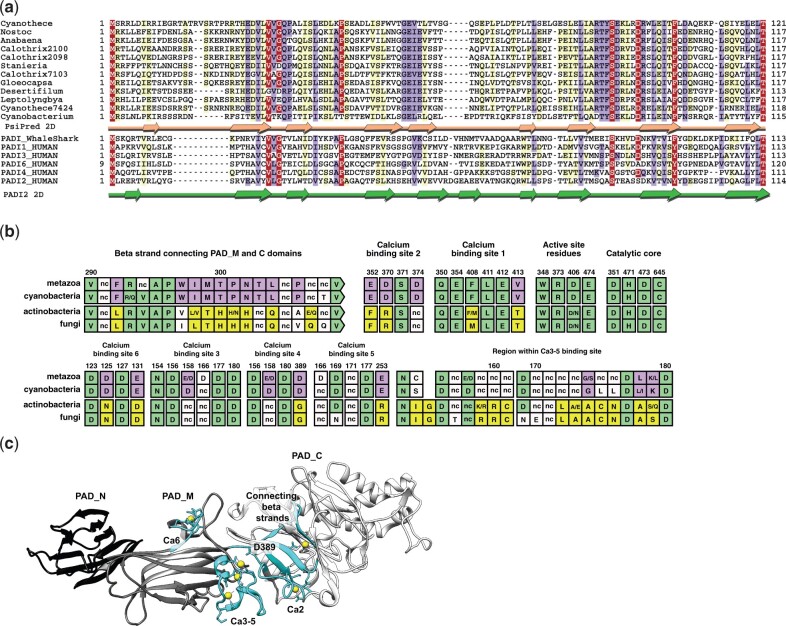
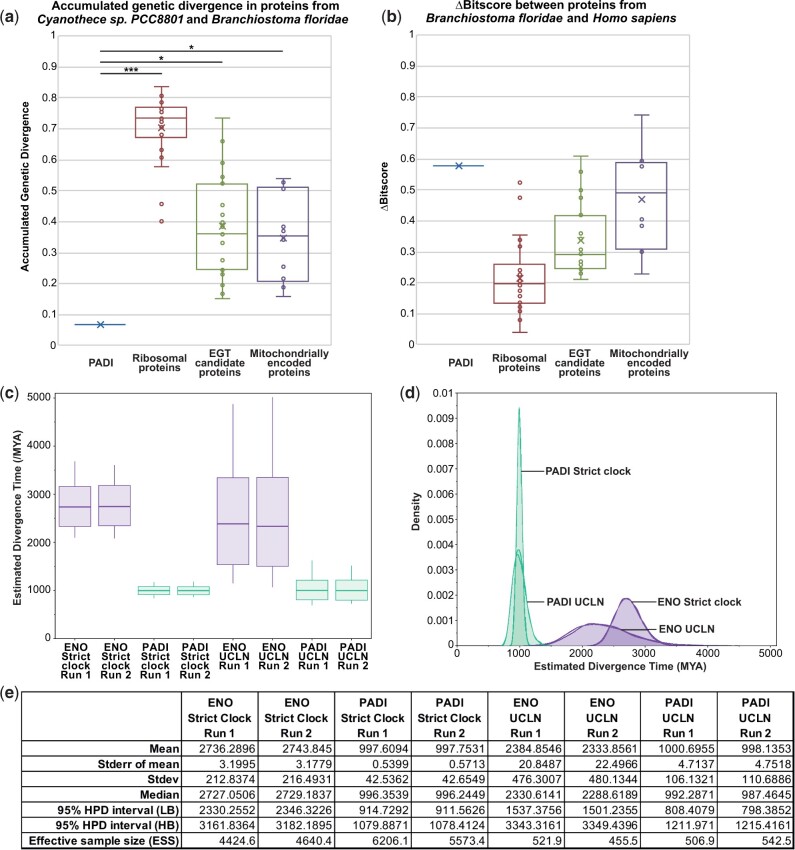
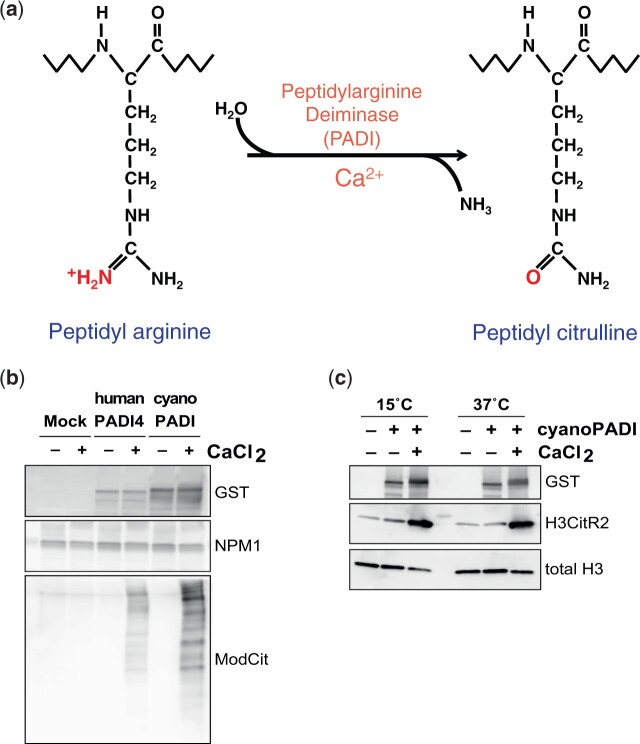
Protein posttranslational modifications add great sophistication to biological systems. Citrullination, a key regulatory mechanism in human physiology and pathophysiology, is enigmatic from an evolutionary perspective. Although the citrullinating enzymes peptidylarginine deiminases (PADIs) are ubiquitous across vertebrates, they are absent from yeast, worms, and flies. Based on this distribution PADIs were proposed to have been horizontally transferred, but this has been contested. Here, we map the evolutionary trajectory of PADIs into the animal lineage. We present strong phylogenetic support for a clade encompassing animal and cyanobacterial PADIs that excludes fungal and other bacterial homologs. The animal and cyanobacterial PADI proteins share functionally relevant primary and tertiary synapomorphic sequences that are distinct from a second PADI type present in fungi and actinobacteria. Molecular clock calculations and sequence divergence analyses using the fossil record estimate the last common ancestor of the cyanobacterial and animal PADIs to be less than 1 billion years old. Additionally, under an assumption of vertical descent, PADI sequence change during this evolutionary time frame is anachronistically low, even when compared with products of likely endosymbiont gene transfer, mitochondrial proteins, and some of the most highly conserved sequences in life. The consilience of evidence indicates that PADIs were introduced from cyanobacteria into animals by horizontal gene transfer (HGT). The ancestral cyanobacterial PADI is enzymatically active and can citrullinate eukaryotic proteins, suggesting that the PADI HGT event introduced a new catalytic capability into the regulatory repertoire of animals. This study reveals the unusual evolution of a pleiotropic protein modification.
蛋白质的翻译后修饰为生物系统增添了极大的复杂性。瓜氨酸化是人类生理和病理生理学中的一个关键调节机制,从进化的角度来看,它是一个谜。虽然肽基精氨酸脱亚氨酶(PADIs)等瓜氨酸化酶在脊椎动物中普遍存在,但在酵母、蠕虫和苍蝇中却不存在。基于这种分布,人们提出 PADIs 是水平转移而来的,但这一点一直存在争议。在这里,我们将 PADIs 的进化轨迹映射到动物谱系中。我们为包含动物和蓝藻 PADI 的进化枝提供了强有力的系统发育支持,该进化枝排除了真菌和其他细菌同源物。动物和蓝藻 PADI 蛋白共享具有功能相关性的主要和三级同源序列,与真菌和放线菌中存在的第二种 PADI 类型不同。分子钟计算和使用化石记录的序列分歧分析估计,蓝藻和动物 PADIs 的最后共同祖先不到 10 亿年。此外,在垂直进化的假设下,在这段进化时间内,PADI 序列的变化是反常的低,即使与可能的内共生基因转移、线粒体蛋白以及生命中最保守的一些序列的产物相比也是如此。证据的一致性表明,PADIs 是通过水平基因转移(HGT)从蓝藻转移到动物中的。祖先蓝藻 PADI 具有酶活性,可以瓜氨酸化真核蛋白,这表明 PADI 的 HGT 事件为动物的调节谱引入了新的催化能力。这项研究揭示了一种多功能蛋白质修饰的不寻常进化。