Department of Pathology, Tri-Service General Hospital; and School of Medicine, National Defense Medical Center, Taipei, Taiwan, Republic of China.
Department of Pathology, Tri-Service General Hospital Songshan Branch; and School of Medicine, National Defense Medical Center, Taipei, Taiwan, Republic of China.
BMC Geriatr. 2021 Mar 20;21(1):192. doi: 10.1186/s12877-021-02146-5.
Sarcopenia is a multifactorial pathophysiologic condition of skeletal muscle mass and muscle strength associated with aging. However, biomarkers for predicting the occurrence of sarcopenia are rarely discussed in recent studies. The aim of the study was to elucidate the relationship between sarcopenia and several pertinent biomarkers.
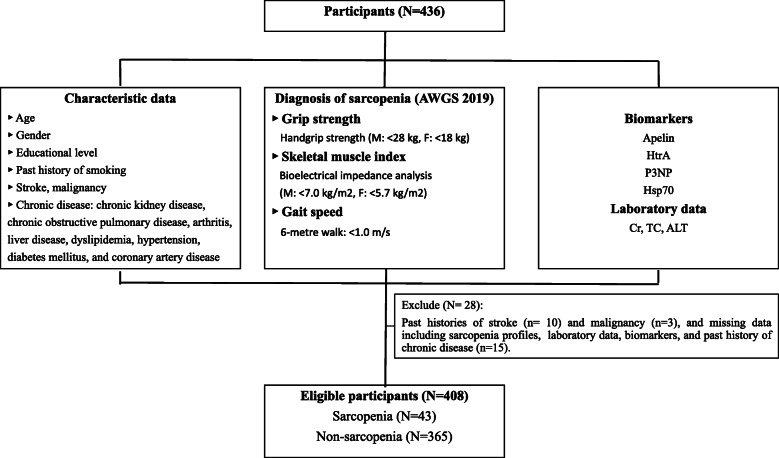
Using the Gene Expression Omnibus (GEO) profiles of the National Center for Biotechnology Information, the associations between mRNA expression of biomarkers and sarcopenia were explored, including high temperature requirement serine protease A1 (HtrA1), procollagen type III N-terminal peptide (P3NP), apelin, and heat shock proteins 70 (Hsp72). We enrolled 408 community-dwelling adults aged 65 years and older with sarcopenia and nonsarcopenia based on the algorithm proposed by the Asian Working Group for Sarcopenia (AWGS). Muscle strength is identified by hand grip strength using an analogue isometric dynamometer. Muscle mass is estimated by skeletal mass index (SMI) using a bioelectrical impedance analysis. Physical performance is measured by gait speed using 6 m walking distance. The associations between these biomarkers and sarcopenia were determined using receiver operating characteristic (ROC) curve analysis and multivariate regression models.
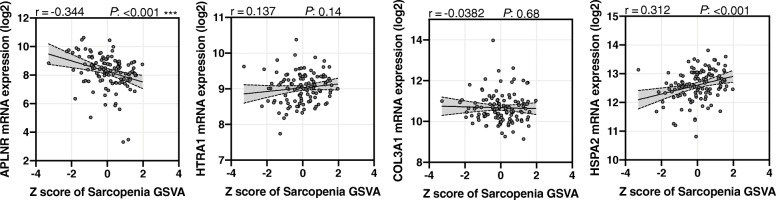
From the GEO profiles, the sarcopenia gene set variation analysis score was correlated significantly with the mRNA expression of APLNR (p < 0.001) and HSPA2 (p < 0.001). In our study, apelin was significantly associated with decreased hand grip strength with β values of - 0.137 (95%CI: - 0.229, - 0.046) in men. P3NP and HtrA1 were significantly associated with increased SMI with β values of 0.081 (95%CI: 0.010, 0.153) and 0.005 (95%CI: 0.001, 0.009) in men, respectively. Apelin and HtrA1 were inversely associated with the presence of sarcopenia with an OR of 0.543 (95%CI: 0.397-0.743) and 0.003 (95%CI: 0.001-0.890) after full adjustment. The cutoff point of HtrA1 was associated with the presence of sarcopenia with an OR of 0.254 (95%CI: 0.083-0.778) in men. The cutoff point of apelin was negatively associated with the presence of sarcopenia with an OR of 0.254 (95%CI: 0.083-0.778).
Our study highlights that P3NP, HtrA, and apelin are useful for diagnosis of sarcopenia in the clinical setting.
肌少症是一种与衰老相关的骨骼肌质量和肌肉力量的多因素病理生理状态。然而,最近的研究很少讨论预测肌少症发生的生物标志物。本研究的目的是阐明肌少症与几种相关生物标志物之间的关系。
使用美国国立生物技术信息中心的基因表达综合数据库(GEO)谱,探索生物标志物的 mRNA 表达与肌少症之间的关联,包括高温需求丝氨酸蛋白酶 A1(HtrA1)、III 型前胶原 N 端肽(P3NP)、apelin 和热休克蛋白 70(Hsp72)。我们根据亚洲肌少症工作组(AWGS)提出的算法,招募了 408 名年龄在 65 岁及以上的有肌少症和无肌少症的社区居民。肌肉力量通过使用模拟等速测力计的手握力来确定。肌肉质量通过生物电阻抗分析用骨骼质量指数(SMI)来估计。通过 6 米步行距离的步行速度来测量身体机能。使用接收者操作特征(ROC)曲线分析和多变量回归模型确定这些生物标志物与肌少症之间的关系。
从 GEO 谱中,肌少症基因集变异分析评分与 APLNR 的 mRNA 表达显著相关(p<0.001)和 HSPA2(p<0.001)。在我们的研究中,apelin 与男性的手握力下降显著相关,β 值为-0.137(95%CI:-0.229,-0.046)。P3NP 和 HtrA1 与 SMI 的增加显著相关,β 值分别为 0.081(95%CI:0.010,0.153)和 0.005(95%CI:0.001,0.009)。Apelin 和 HtrA1 与肌少症的存在呈负相关,经完全调整后,OR 分别为 0.543(95%CI:0.397-0.743)和 0.003(95%CI:0.001-0.890)。HtrA1 的截断点与男性肌少症的存在呈正相关,OR 为 0.254(95%CI:0.083-0.778)。Apelin 的截断点与肌少症的存在呈负相关,OR 为 0.254(95%CI:0.083-0.778)。
我们的研究强调,P3NP、HtrA 和 apelin 可用于临床诊断肌少症。