Department of Family Medicine, Queen's University, Kingston, ON, Canada.
C.T. Lamont Primary Health Care Research Centre, Bruyère Research Institute, Ottawa, ON, Canada.
BMC Fam Pract. 2021 Mar 20;22(1):55. doi: 10.1186/s12875-021-01401-3.
Access to transgender care in Canada is poor. Although primary care providers are ideally positioned to initiate care, many feel uncomfortable providing transgender care. This study aimed to explore the impact of an electronic consultation (eConsult) service between primary care providers and transgender care specialists on access to care and to explore the content of clinical questions that were asked.
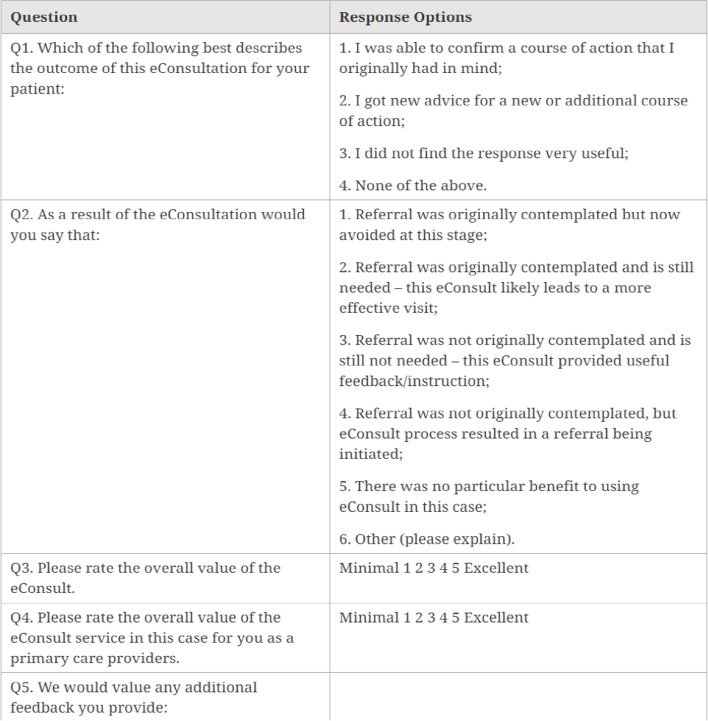
This was a retrospective mixed methods analysis of 62 eConsults submitted between January 2017 and December 2018 by primary care providers to specialists in transgender care in a health region in eastern Ontario, Canada. A descriptive analysis was conducted to assess the average response time and the total time spent by the specialist for the eConsults. An inductive and deductive content analysis was carried out to identify common themes of clinical questions being asked to transgender specialists. A post-eConsult survey completed by primary care providers was assessed to gain insight into avoided face-to-face referrals and overall provider satisfaction.
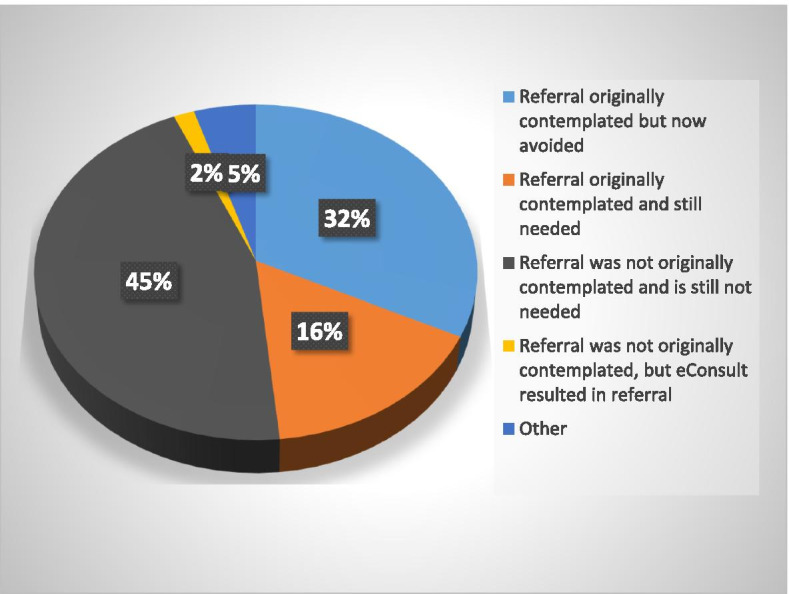
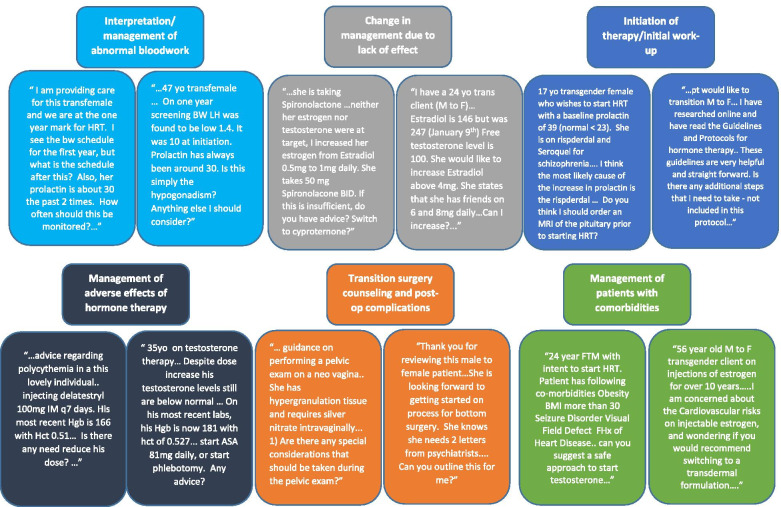
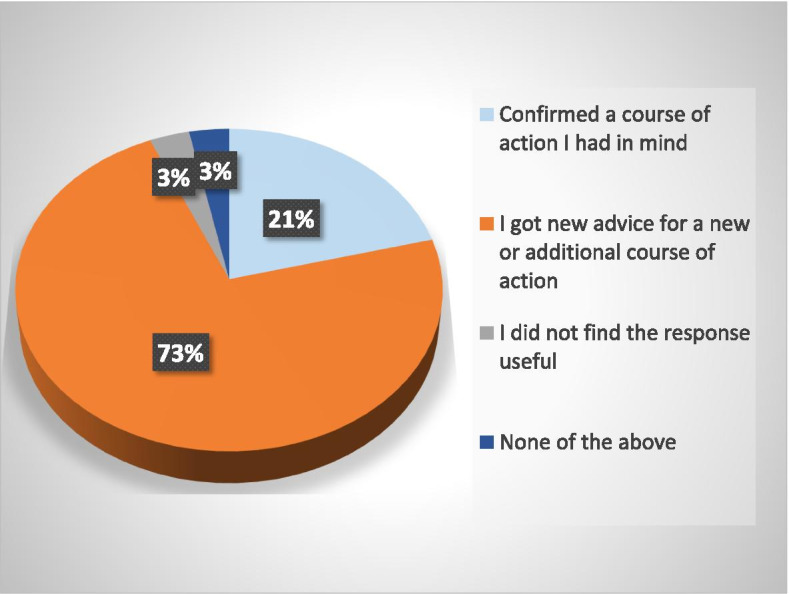
The median specialist response time was 1.2 days (range: 1 h to 5 days) and the average time spent by specialists per eConsult was 18 min (range: 10 to 40 min). The qualitative analysis identified six major themes: 1) interpretation/management of abnormal bloodwork, 2) change in management due to lack of desired effect/hormone levels not a target, 3) initiation of hormone therapy/initial work up, 4) management of adverse effects of hormone therapy, 5) transition related surgery counseling and post-op complications, and 6) management of patients with comorbidities. Approximately one-third of eConsults resulted in an avoided face-to-face referral and 95% of primary care providers rated the value of their eConsult as a 5 (excellent value) or 4.
This study demonstrated that a transgender eConsult service has potential to significantly improve access to care for transgender patients. Given the importance that timely access has on improving mental health and reducing suicide attempts, eConsult has the potential to make a substantial clinical impact on this population. Identified themes of eConsult questions provides insight into potential gaps in knowledge amongst primary care providers that could help inform future continuing education events.
加拿大的跨性别护理服务很差。尽管初级保健提供者是提供护理的理想人选,但许多人在提供跨性别护理方面感到不舒服。本研究旨在探讨初级保健提供者与跨性别护理专家之间的电子咨询(eConsult)服务对护理服务的可及性的影响,并探讨所提出的临床问题的内容。
这是对加拿大安大略省东部一个卫生区域的初级保健提供者在 2017 年 1 月至 2018 年 12 月期间向跨性别护理专家提交的 62 份 eConsult 进行的回顾性混合方法分析。进行了描述性分析,以评估专家对 eConsult 的平均回复时间和总用时。进行了归纳和演绎内容分析,以确定向跨性别专家提出的常见临床问题主题。通过初级保健提供者完成的 eConsult 后调查,了解避免面对面转诊和总体提供者满意度。
专家的平均回复时间为 1.2 天(范围:1 小时至 5 天),专家每次 eConsult 的平均用时为 18 分钟(范围:10 至 40 分钟)。定性分析确定了六个主要主题:1)异常血液检查的解释/管理,2)由于缺乏所需效果/激素水平未达标而改变管理,3)开始激素治疗/初始检查,4)激素治疗的不良反应管理,5)过渡相关手术咨询和术后并发症,以及 6)合并症患者的管理。大约三分之一的 eConsults 导致避免了面对面转诊,95%的初级保健提供者将其 eConsult 的价值评为 5(极好)或 4。
本研究表明,跨性别 eConsult 服务有可能显著改善跨性别患者的护理服务。鉴于及时获得护理对改善心理健康和减少自杀企图的重要性,eConsult 有可能对这一人群产生重大的临床影响。确定的 eConsult 问题主题提供了有关初级保健提供者知识差距的见解,这有助于为未来的继续教育活动提供信息。