Wilmer Eye Institute, Johns Hopkins School of Medicine, 600 N. Wolfe Street, Maumenee Building, Third Floor, Baltimore, MD, 21287, USA.
Departamento de Oftalmología, Escuela de Medicina, Pontificia Universidad Católica de Chile, Santiago, Chile.
BMC Ophthalmol. 2021 Mar 20;21(1):139. doi: 10.1186/s12886-021-01886-7.
To minimize the risk of viral transmission, ophthalmology practices limited face-to-face encounters to only patients with urgent and emergent ophthalmic conditions in the weeks after the start of the COVID-19 epidemic in the United States. The impact of this is unknown.
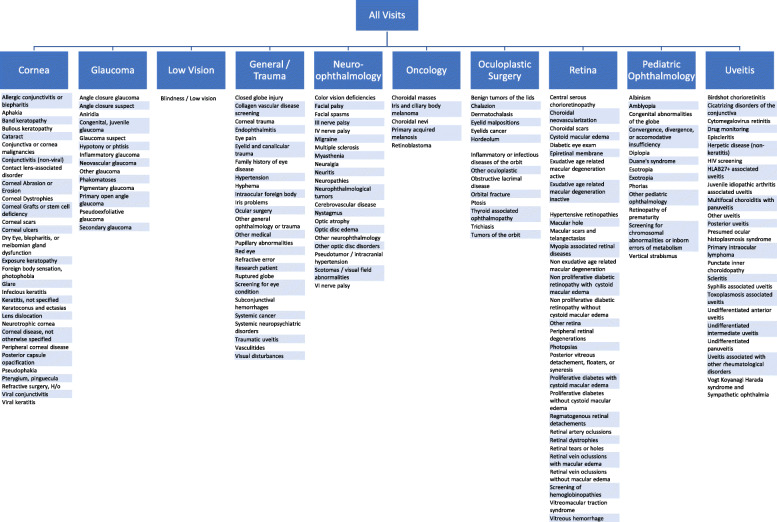
We did a retrospective analysis of the change in the frequency of ICD-10 code use and patient volumes in the 6 weeks before and after the changes in clinical practice associated with COVID-19.
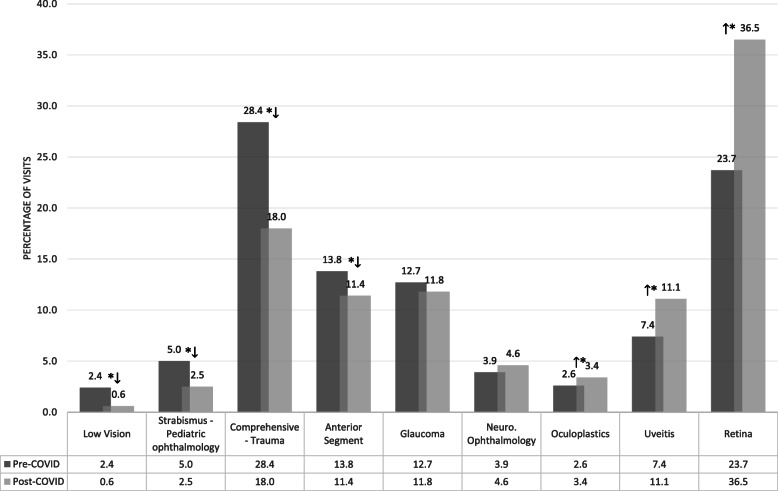
The total number of encounters decreased four-fold after the implementation of clinic changes associated with COVID-19. The low vision, pediatric ophthalmology, general ophthalmology, and cornea divisions had the largest total decrease of in-person visits. Conversely, the number of telemedicine visits increased sixty-fold. The number of diagnostic codes associated with ocular malignancies, most ocular inflammatory disorders, and retinal conditions requiring intravitreal injections increased. ICD-10 codes associated with ocular screening exams for systemic disorders decreased during the weeks post COVID-19.
Ophthalmology practices need to be prepared to experience changes in practice patterns, implementation of telemedicine, and decreased patient volumes during a pandemic. Knowing the changes specific to each subspecialty clinic is vital to redistribute available resources correctly.
为了最大限度地降低病毒传播的风险,美国 COVID-19 疫情开始后数周内,眼科实践将面对面接触仅限于有紧急和紧急眼科疾病的患者。目前尚不清楚这种做法的影响。
我们对 COVID-19 相关临床实践变化前后 6 周内的国际疾病分类第 10 版(ICD-10)编码使用频率和患者量的变化进行了回顾性分析。
与 COVID-19 相关的临床实践改变实施后,就诊总次数减少了四分之三。低视力、儿科眼科、普通眼科和角膜科的门诊就诊量降幅最大。相比之下,远程医疗就诊量增加了六十倍。与需要玻璃体注射的眼部恶性肿瘤、大多数眼部炎症性疾病和视网膜疾病相关的诊断代码增加。COVID-19 后数周,与全身性疾病眼部筛查检查相关的 ICD-10 代码减少。
在大流行期间,眼科实践需要做好准备,以应对实践模式的变化、远程医疗的实施以及患者数量的减少。了解每个亚专科门诊的具体变化对于正确重新分配可用资源至关重要。