Obstetrical, Perinatal and Pediatric Epidemiology Research Team (Epopé), Center for Epidemiology and Statistics, INSERM, Université de Paris, Maternité Port Royal, 123, Boulevard Port Royal, 75014, Paris, France.
Department of Population, Family and Reproductive Health, Johns Hopkins Bloomberg School of Public Health, Baltimore, MD, USA.
BMC Womens Health. 2021 Mar 20;21(1):115. doi: 10.1186/s12905-021-01255-y.
In France, while the prevalence of contraception is high, a significant proportion of pregnancies are unintended. Following the 2012 pill scare, the contraceptive method mix, which was mostly comprised of pills and intrauterine devices (IUD), has become more diversified. In this changing landscape, our objective was to describe trends in live births resulting from contraceptive failure and evaluate how patterns of contraceptive use have contributed to observed changes between 2010 and 2016.
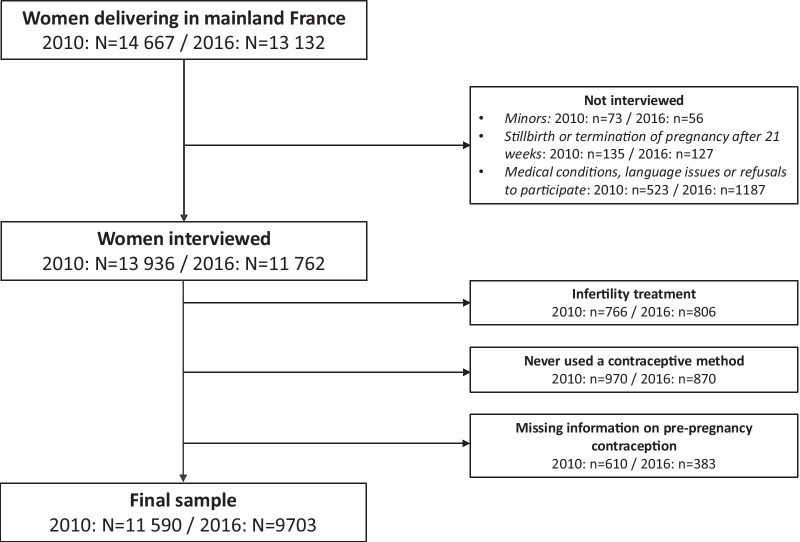
We used data from the 2010 and the 2016 French National Perinatal surveys which included all births from all maternity units in France over a one-week period. Interviews collecting information about pre-conception contraceptive practices were conducted in the maternity ward post-delivery. Women were classified as having a contraceptive failure if they discontinued contraception because they were pregnant. Our study sample included adult women who had a live birth, had ever used contraception and did not undergo infertility treatment (n = 11,590 in 2010 and n = 9703 in 2016). We evaluated changes in contraceptive failure over time using multivariate Poisson regressions to adjust for sociodemographic characteristics and pre-pregnancy contraceptive methods.
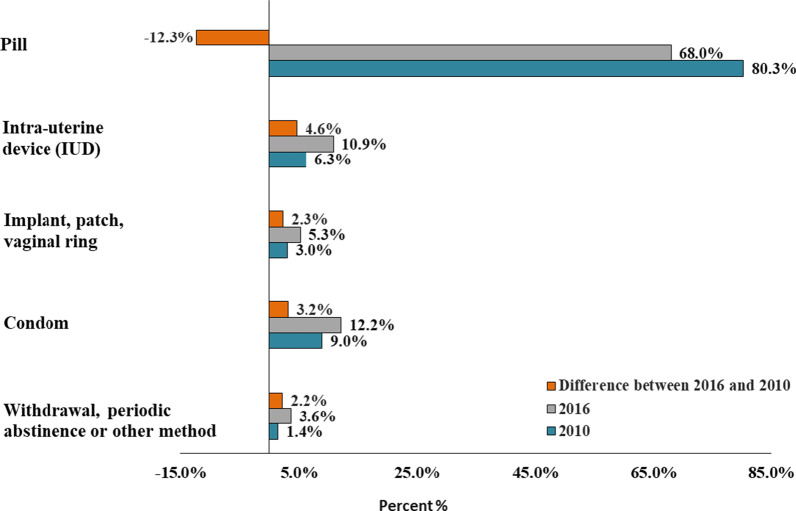
Pre-pregnancy contraception evolved between 2010 and 2016 with a 12.3% point-drop in pill use, and conversely, 4.6%- and 3.2%-point increases in IUD and condom use, respectively. Use of other barrier or natural methods doubled between 2010 and 2016 but remained marginal (1.4% in 2010 vs 3.6% in 2016). Between 2010 and 2016, the proportion of live births resulting from contraceptive failure rose from 7.8 to 10.0%, with higher risks among younger, parous and socially disadvantaged mothers. The risk ratio of contraceptive failure in 2016 compared to 2010 remained higher after sociodemographic adjustments (aRR = 1.34; 95% CI; 1.23-1.47) and after adjusting for pre-pregnancy contraceptive method mix (aRR = 1.35; 95% CI; 1.25-1.49). Increases in contraceptive failures were concentrated among pill and condom users.
Recent shifts in contraceptive behaviors in France following the 2012 pill scare may be associated with a subsequent increase in births resulting from short acting contraceptives failures.
在法国,尽管避孕措施的普及率很高,但仍有相当一部分妊娠是意外发生的。在 2012 年避孕药恐慌之后,避孕方法组合(主要由药丸和宫内节育器[IUD]组成)变得更加多样化。在这种不断变化的情况下,我们的目标是描述避孕失败导致的活产趋势,并评估避孕方法的使用模式如何促成了 2010 年至 2016 年期间的观察到的变化。
我们使用了 2010 年和 2016 年法国国家围产期调查的数据,这些数据包括法国所有产妇单位在一周内的所有分娩。分娩后在产房进行的采访收集了关于孕前避孕措施的信息。如果女性因怀孕而停止避孕,则被归类为避孕失败。我们的研究样本包括有活产、曾经使用过避孕措施且未接受过不孕治疗的成年女性(2010 年有 11590 名,2016 年有 9703 名)。我们使用多变量泊松回归来评估避孕失败随时间的变化,以调整社会人口特征和孕前避孕方法的影响。
2010 年至 2016 年期间,孕前避孕方法发生了变化,药丸使用率下降了 12.3%,而宫内节育器和避孕套的使用率分别上升了 4.6%和 3.2%。其他屏障或自然避孕方法的使用率在 2010 年至 2016 年间翻了一番,但仍处于边缘地位(2010 年为 1.4%,2016 年为 3.6%)。2010 年至 2016 年间,由于避孕失败而导致的活产比例从 7.8%上升至 10.0%,年轻、多产和社会劣势的母亲面临更高的风险。与 2010 年相比,调整社会人口因素后(ARR=1.34;95%CI,1.23-1.47)和调整孕前避孕方法组合后(ARR=1.35;95%CI,1.25-1.49),2016 年避孕失败的风险比仍较高。避孕失败的增加主要集中在药丸和避孕套使用者中。
在 2012 年避孕药恐慌之后,法国最近避孕行为的转变可能与随后因短期避孕药失败而导致的生育增加有关。