Department of Hematology, Zhongnan Hospital of Wuhan University, Wuhan, China.
Department of Immunology, School of Basic Medical Science, Wuhan University, Wuhan, China.
J Hematol Oncol. 2021 Mar 20;14(1):48. doi: 10.1186/s13045-021-01060-y.
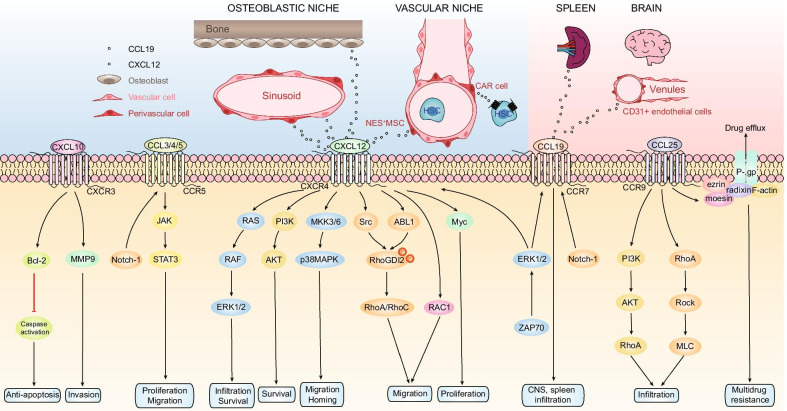
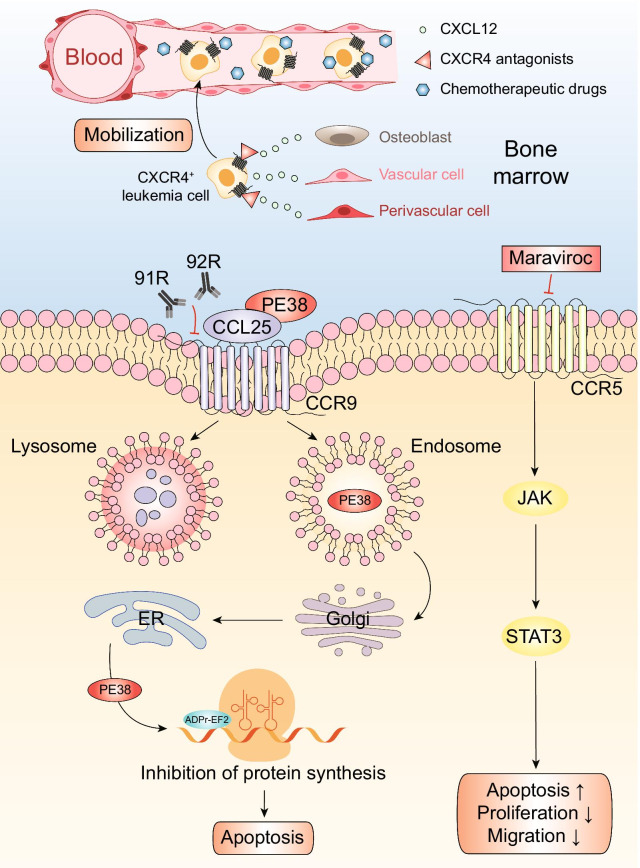
Acute lymphoblastic leukemia (ALL) is a hematological malignancy characterized by the malignant clonal expansion of lymphoid hematopoietic precursors. It is regulated by various signaling molecules such as cytokines and adhesion molecules in its microenvironment. Chemokines are chemotactic cytokines that regulate migration, positioning and interactions of cells. Many chemokine axes such as CXCL12/CXCR4 and CCL25/CCR9 have been proved to play important roles in leukemia microenvironment and further affect ALL outcomes. In this review, we summarize the chemokines that are involved in ALL progression and elaborate on their roles and mechanisms in leukemia cell proliferation, infiltration, drug resistance and disease relapse. We also discuss the potential of targeting chemokine axes for ALL treatments, since many related inhibitors have shown promising efficacy in preclinical trials, and some of them have entered clinical trials.
急性淋巴细胞白血病(ALL)是一种血液系统恶性肿瘤,其特征是淋巴造血前体细胞的恶性克隆性扩增。它在微环境中受到各种信号分子的调节,如细胞因子和黏附分子。趋化因子是趋化细胞因子,可调节细胞的迁移、定位和相互作用。许多趋化因子轴,如 CXCL12/CXCR4 和 CCL25/CCR9,已被证明在白血病微环境中发挥重要作用,并进一步影响 ALL 的结局。在这篇综述中,我们总结了参与 ALL 进展的趋化因子,并详细阐述了它们在白血病细胞增殖、浸润、耐药和疾病复发中的作用和机制。我们还讨论了针对 ALL 治疗靶向趋化因子轴的潜力,因为许多相关抑制剂在临床前试验中显示出了良好的疗效,其中一些已经进入临床试验。