Zhou Zhongyi, Tan Fengbo, Pei Qian, Li Chenglong, Zhou Yuan, Li Yuqiang, Pei Haiping
Department of General Surgery, Xiangya Hospital, Central South University, Changsha 410008, Hunan, China.
National Clinical Research Center for Geriatric Disorders, Xiangya Hospital, Central South University, Changsha 410008, Hunan, China.
Aging (Albany NY). 2021 Mar 19;13(7):9838-9858. doi: 10.18632/aging.202737.
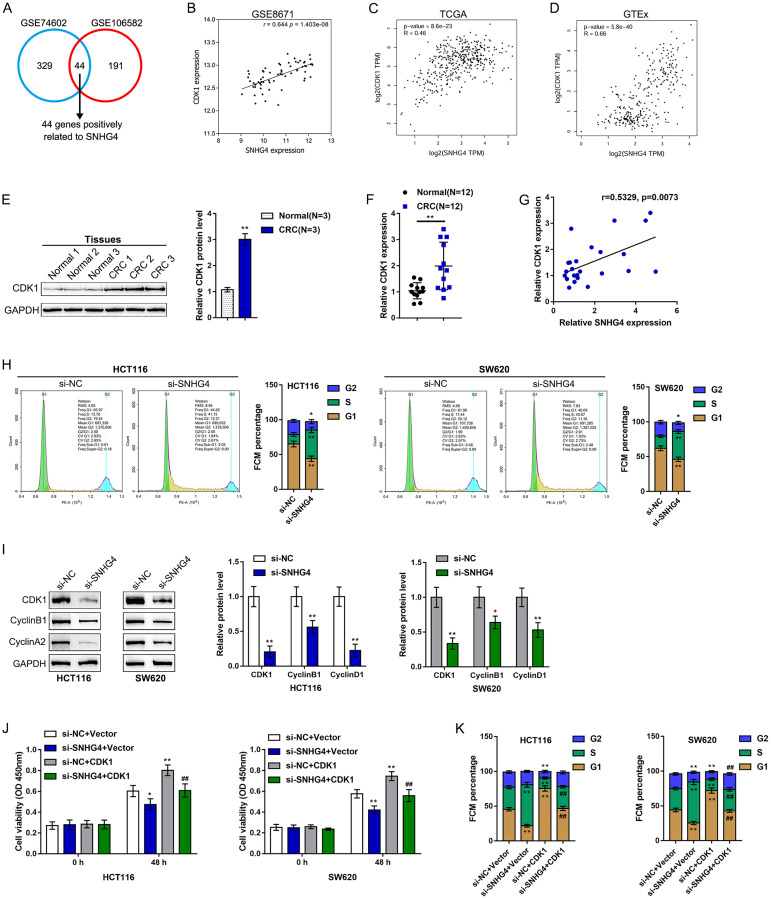
Colorectal cancer (CRC) is a prevalent malignancy worldwide. The development of genome sequencing technology has allowed the discovery that epigenetic regulation might play a critical role in CRC tumorigenesis. In the present study, we found that the long noncoding RNA (lncRNA) SNHG4 was dramatically increased in CRC tissue samples and cell lines based on both publicly available and experimental data. SNHG4 knockdown suppressed the viability and colony formation capacity of CRC cells. The expression of CDK1 was considerably increased in CRC tissue samples and cells and had a positive correlation with the expression of SNHG4 in CRC. SNHG4 silencing not only caused S phase cell cycle arrest but also significantly downregulated the CDK1, cyclin B1, and cyclin A2 protein levels in CRC cells. miR-590-3p simultaneously bound to SNHG4 and CDK1. miR-590-3p functioned to inhibit CDK1 expression. miR-590-3p overexpression exerted the same effects on the CRC cell phenotype as SNHG4 knockdown. The effects of si-SNHG4 on CRC cells were significantly reversed by anti-miR-590-3p, indicating that SNHG4 relieved the miR-590-3p-induced inhibition of CDK1 by acting as a competing endogenous RNA (ceRNA). , SNHG4 silencing inhibited subcutaneously transplanted tumor growth and decreased cell cycle marker levels, whereas miR-590-3p inhibition exerted the opposite effects. The effects of SNHG4 silencing were also reversed by miR-590-3p inhibition. The SNHG4/miR-590-3p/CDK1 axis influences the cell cycle to modulate CRC cell proliferation and subcutaneously transplanted tumor growth. Further application of this axis still requires analysis using more animal models and clinical investigations.
结直肠癌(CRC)是全球范围内一种常见的恶性肿瘤。基因组测序技术的发展使得人们发现表观遗传调控可能在CRC肿瘤发生中起关键作用。在本研究中,基于公开可用数据和实验数据,我们发现长链非编码RNA(lncRNA)SNHG4在CRC组织样本和细胞系中显著上调。SNHG4敲低抑制了CRC细胞的活力和集落形成能力。CDK1在CRC组织样本和细胞中的表达显著增加,且与CRC中SNHG4的表达呈正相关。SNHG4沉默不仅导致S期细胞周期停滞,还显著下调了CRC细胞中CDK1、细胞周期蛋白B1和细胞周期蛋白A2的蛋白水平。miR-590-3p同时与SNHG4和CDK1结合。miR-590-3p起到抑制CDK1表达的作用。miR-590-3p过表达对CRC细胞表型的影响与SNHG4敲低相同。抗miR-590-3p显著逆转了si-SNHG4对CRC细胞的影响,表明SNHG4作为竞争性内源RNA(ceRNA),缓解了miR-590-3p诱导的对CDK1的抑制作用。此外,SNHG4沉默抑制皮下移植瘤生长并降低细胞周期标志物水平,而miR-590-3p抑制则产生相反的效果。miR-590-3p抑制也逆转了SNHG4沉默的作用。SNHG /miR-590-3p/CDK1轴影响细胞周期,从而调节CRC细胞增殖和皮下移植瘤生长。该轴的进一步应用仍需要使用更多动物模型进行分析和临床研究。