Department of Radiology, University Medical Center Utrecht, Utrecht, The Netherlands.
Department of Radiology, Elisabeth-TweeSteden Ziekenhuis, Tilburg, The Netherlands.
Eur Radiol. 2021 Sep;31(9):7058-7066. doi: 10.1007/s00330-021-07781-5. Epub 2021 Mar 20.
Radiologists' perception is likely to influence the adoption of artificial intelligence (AI) into clinical practice. We investigated knowledge and attitude towards AI by radiologists and residents in Europe and beyond.
Between April and July 2019, a survey on fear of replacement, knowledge, and attitude towards AI was accessible to radiologists and residents. The survey was distributed through several radiological societies, author networks, and social media. Independent predictors of fear of replacement and a positive attitude towards AI were assessed using multivariable logistic regression.
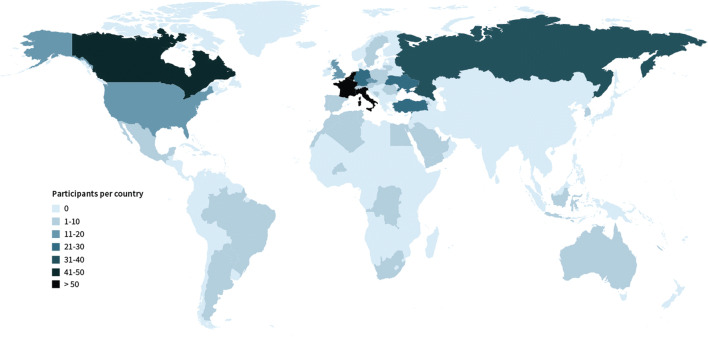
The survey was completed by 1,041 respondents from 54 mostly European countries. Most respondents were male (n = 670, 65%), median age was 38 (24-74) years, n = 142 (35%) residents, and n = 471 (45%) worked in an academic center. Basic AI-specific knowledge was associated with fear (adjusted OR 1.56, 95% CI 1.10-2.21, p = 0.01), while intermediate AI-specific knowledge (adjusted OR 0.40, 95% CI 0.20-0.80, p = 0.01) or advanced AI-specific knowledge (adjusted OR 0.43, 95% CI 0.21-0.90, p = 0.03) was inversely associated with fear. A positive attitude towards AI was observed in 48% (n = 501) and was associated with only having heard of AI, intermediate (adjusted OR 11.65, 95% CI 4.25-31.92, p < 0.001), or advanced AI-specific knowledge (adjusted OR 17.65, 95% CI 6.16-50.54, p < 0.001).
Limited AI-specific knowledge levels among radiology residents and radiologists are associated with fear, while intermediate to advanced AI-specific knowledge levels are associated with a positive attitude towards AI. Additional training may therefore improve clinical adoption.
• Forty-eight percent of radiologists and residents have an open and proactive attitude towards artificial intelligence (AI), while 38% fear of replacement by AI. • Intermediate and advanced AI-specific knowledge levels may enhance adoption of AI in clinical practice, while rudimentary knowledge levels appear to be inhibitive. • AI should be incorporated in radiology training curricula to help facilitate its clinical adoption.
放射科医生的认知可能会影响人工智能(AI)在临床实践中的应用。我们调查了欧洲及其他地区放射科医生和住院医师对 AI 的了解程度和态度。
2019 年 4 月至 7 月期间,一项关于对 AI 的替代恐惧、知识和态度的调查可供放射科医生和住院医师使用。该调查通过多个放射学协会、作者网络和社交媒体进行分发。使用多变量逻辑回归评估对 AI 替代恐惧和积极态度的独立预测因素。
该调查由来自 54 个主要来自欧洲国家的 1041 名受访者完成。大多数受访者为男性(n=670,65%),中位年龄为 38(24-74)岁,n=142(35%)为住院医师,n=471(45%)在学术中心工作。基本的 AI 特定知识与恐惧相关(调整后的 OR 1.56,95%CI 1.10-2.21,p=0.01),而中级(调整后的 OR 0.40,95%CI 0.20-0.80,p=0.01)或高级(调整后的 OR 0.43,95%CI 0.21-0.90,p=0.03)AI 特定知识则与之呈负相关。有 48%(n=501)的人对 AI 持积极态度,并且仅听说过 AI、中级(调整后的 OR 11.65,95%CI 4.25-31.92,p<0.001)或高级(调整后的 OR 17.65,95%CI 6.16-50.54,p<0.001)AI 特定知识与积极态度相关。
放射科住院医师和医生中有限的 AI 特定知识水平与恐惧相关,而中级到高级的 AI 特定知识水平与对 AI 的积极态度相关。因此,额外的培训可能会提高临床应用水平。
48%的放射科医生和住院医师对人工智能(AI)持开放和积极的态度,而 38%的人担心 AI 会取代他们。
中级和高级 AI 特定知识水平可能会促进 AI 在临床实践中的应用,而基本的知识水平似乎会产生抑制作用。
AI 应该纳入放射科培训课程,以帮助促进其临床应用。